


In the ever-evolving world of web development, few questions generate as much debate as the value of certifications. "Is MERN stack certification worth it?" "Should I invest my time and money in a certified MERN stack course?" "Will a certificate help me land a job?" If you're asking these questions, you're not alone.
The MERN stack—MongoDB, Express.js, React, and Node.js—continues to dominate web development in 2026. Companies from startups to enterprises seek developers who can build end-to-end applications using this powerful JavaScript ecosystem. But in a field where skills often matter more than credentials, understanding the true value of certification becomes crucial.
In this comprehensive guide, we'll explore the real worth of MERN stack certifications, examine top programs from prestigious institutions like MIT xPRO and IITs, analyze salary outcomes, and provide honest advice on when certification makes sense—and when it doesn't. By the end, you'll have a clear understanding of whether a certified MERN stack course aligns with your career goals.
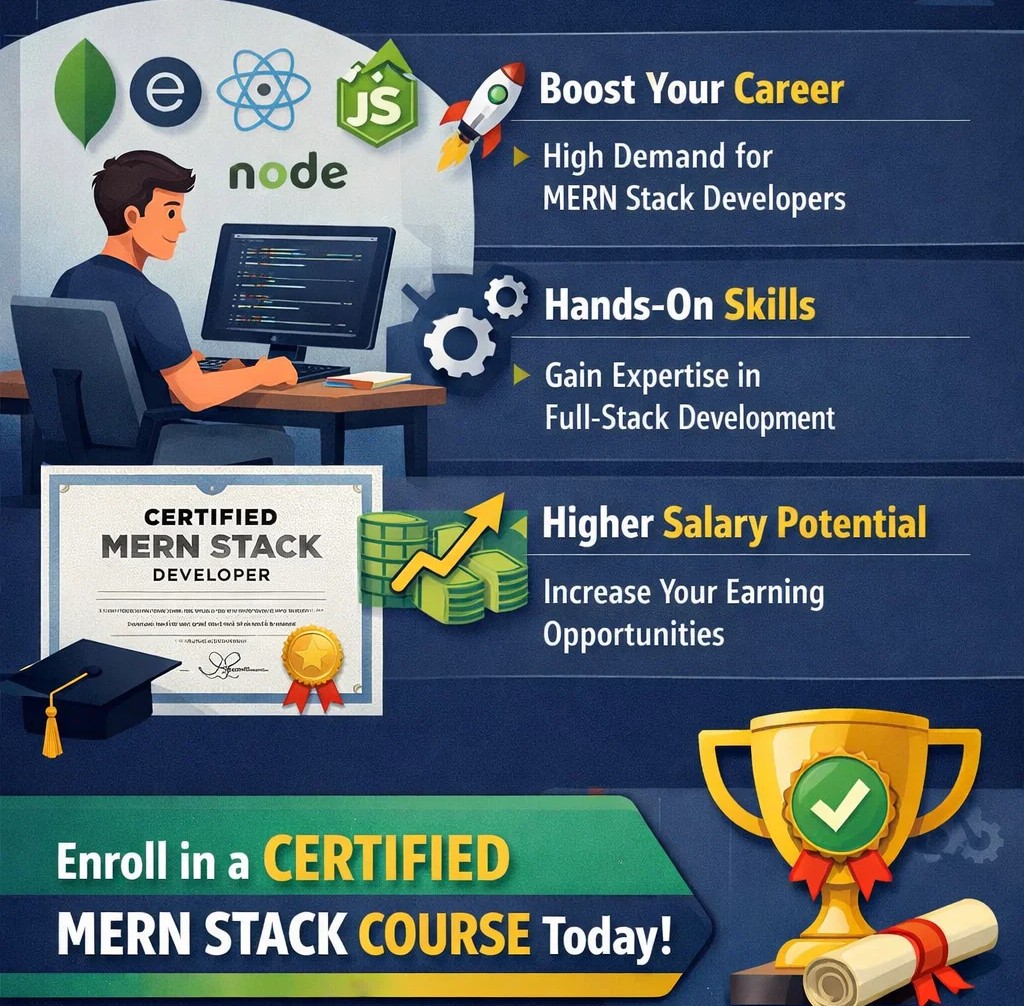
Understanding MERN Stack Certification
What Is a MERN Stack Certification?
A MERN stack certification is a formal credential awarded upon completing a structured training program that covers MongoDB, Express.js, React, and Node.js. These certifications typically validate that you've acquired specific skills, completed projects, and demonstrated competency across the full stack of JavaScript technologies .
However, not all certifications are created equal. They range from prestigious university-backed programs to affordable online course certificates, each carrying different weight in the job market.
Types of MERN Stack Certifications
1. University-Grade Certifications:
These are offered by prestigious institutions and carry significant academic weight. Examples include MIT xPRO's Professional Certificate in Coding: Full Stack Development with MERN, which costs $7,750 and spans 26 weeks . Similarly, IITs and other premier Indian institutes offer executive programs with strong industry recognition .
2. Platform Certifications:
Major learning platforms like Coursera, Scaler, and upGrad offer structured programs with certificates upon completion. Coursera's Meta Full Stack Developer Professional Certificate is recognized globally and takes about 8 months to complete .
3. Bootcamp Certificates:
Intensive, short-term programs from providers like Coding Ninjas or PW Skills offer completion certificates. These focus on practical skills and often include placement assistance .
4. Self-Paced Course Certificates:
Platforms like Udemy and freeCodeCamp offer affordable or free certificates. While less prestigious, they demonstrate commitment and foundational knowledge .
What Makes a Certification "Worth It"?
The value of any certification depends on several factors:
-
Institutional credibility (MIT vs. unknown provider)
-
Curriculum depth and relevance
-
Hands-on project experience
-
Industry recognition and employer perception
-
Career support and placement assistance
-
Return on investment (time and money)
The Case for MERN Stack Certification
1. Structured Learning Path
One of the strongest arguments for certification is the structured curriculum it provides. Self-learning can be overwhelming with the sheer volume of tutorials, documentation, and resources available. Certified courses offer a carefully designed progression from fundamentals to advanced concepts .
For example, comprehensive programs like Scaler Academy's 12-month Full Stack Developer Program cover not just MERN technologies but also data structures, algorithms, and system design—topics often missed in self-study .
2. Hands-On Project Experience
Quality certifications emphasize practical application. Programs like MIT xPRO's 26-week course include building, testing, and deploying web applications using the MERN stack, with learners creating a GitHub portfolio they can share with potential employers .
Grras Solutions' 9-month program promises 15+ real projects and a full capstone application, ensuring graduates have portfolio-ready work . This project experience is often what employers value most.
3. Credibility and Signal Value
A certification from a recognized institution sends a strong signal to employers. MIT xPRO's program, for instance, carries the prestige of one of the world's leading technical universities . Similarly, programs affiliated with IITs in India carry significant weight in the domestic job market .
As one industry observer notes, "Specialized certifications in software developer certification programs open doors to roles at product companies with better pay scales" .
4. Career Support and Placement Assistance
Many premium certification programs include robust career support. Scaler Academy offers 1:1 mentorship, mock interviews, and direct company referrals . Grras Solutions claims 150,000+ placements and 600+ hiring partners . For career switchers and freshers, this structured pathway to employment can be invaluable.
5. Networking Opportunities
Certification programs, especially those with live cohorts, connect you with peers, mentors, and industry professionals. MIT xPRO emphasizes "connecting with an international community of professionals while working on projects based on real-world examples" . These networks often lead to job opportunities and collaborations.
6. Salary Outcomes
Data suggests that completing quality certification programs correlates with strong salary outcomes. According to Scaler's analysis, full-stack developers can earn ₹10-28 LPA after completing comprehensive programs . Grras Solutions reports entry-level MERN developers earning ₹1.8-4 LPA, mid-level ₹4-8 LPA, and senior roles reaching ₹11+ LPA .
Internationally, MERN stack skills command impressive salaries. In Manchester, UK, the median annual salary for positions citing MERN stack is £67,500 (approximately ₹70 lakhs) . In the US, full-stack developers earn around $132,723 on average, with senior roles reaching $200K+ .
The Case Against (or Caveats for) MERN Stack Certification
1. Projects Speak Louder Than Certificates
Perhaps the most important reality check comes from industry professionals themselves. A LinkedIn post by Muqeet Ahmed offers this blunt advice: "Projects > Certificates. One real, deployed project with actual users is worth more than 10 course certificates. Show impact, not just CRUD apps" .
This sentiment is echoed repeatedly in developer communities. Employers want to see what you've built, not just what you've studied.
2. MERN as Baseline, Not Differentiator
Another critical insight: "MERN is becoming a baseline skill, not a differentiator" . In 2026, simply knowing React and Node basics won't make you stand out. Companies expect MERN proficiency as a starting point and look for additional depth in areas like TypeScript, cloud services, and system design.
3. Market Saturation and Competition
The job market for entry-level MERN developers has become increasingly competitive. One commenter notes, "The market is just slow, nothing else, many even not getting a chance to talk or get interviews" . Another observes that "freshers and copy-paste developers will struggle" .
4. Cost-Benefit Considerations
Premium certifications come with significant costs. MIT xPRO's program costs $7,750 (approximately ₹6.5 lakhs) . Even Indian programs like Scaler Academy represent substantial investments. For learners on tight budgets, free alternatives like freeCodeCamp offer comprehensive curricula without financial commitment .
5. Rapidly Changing Technology
The MERN ecosystem evolves quickly. A certification earned today might not reflect the latest best practices in six months. Self-directed learners who continuously update their skills through documentation, open-source contributions, and side projects often stay more current.
6. What Employers Actually Value
Industry hiring managers increasingly look beyond certificates. A 2026 job market analysis lists requirements including performance optimization, security practices (preventing XSS, understanding CSP), system design basics, and DevOps familiarity . These are skills best demonstrated through projects rather than certificates.
When Is MERN Stack Certification Worth It?
Worth It If...
You're a complete beginner: Structured programs provide the guidance and accountability missing from self-study. As one roadmap suggests, having a clear learning path prevents overwhelm and ensures you cover all essential topics .
You need structured accountability: If you've tried self-learning but struggled with consistency, the fixed schedule and deadlines of certification programs can keep you on track.
You value institutional credibility: For certain career paths—academic roles, positions in traditional companies, or opportunities in regions where credentials matter—certification from recognized institutions adds value.
You want placement assistance: Programs with strong industry connections can significantly shorten your job search. Grras Solutions' 600+ hiring partners and 150,000+ placements demonstrate the power of these networks .
You're switching careers: Career switchers benefit from the comprehensive curriculum, portfolio projects, and structured support that certification programs provide .
Not Worth It If...
You're already building projects: If you're actively developing applications, contributing to open source, and learning through doing, a certificate adds little.
You have a strong portfolio: A GitHub profile with deployed, real-world applications speaks louder than any certificate .
You're on a tight budget: Free resources like freeCodeCamp (1000+ hours of coding challenges) and affordable options like Udemy courses (often under ₹1,000) can teach you the same skills .
You expect a certificate to guarantee a job: No certificate guarantees employment. Your skills, portfolio, and interview performance ultimately determine outcomes.
You're already employed and learning on the job: If you're gaining experience through work, additional certificates may provide diminishing returns.
Top MERN Stack Certification Programs in 2026
Premium University-Backed Programs
MIT xPRO Professional Certificate in Coding: Full Stack Development with MERN
Duration: 26 weeks | Format: Online | Price: $7,750
This program stands out for its prestige and comprehensive curriculum. Learners master the MERN stack along with Docker, serverless architectures, CI/CD pipelines, and AWS deployment tools. The program includes 24+ modules, a capstone project deploying a fully functional application, and career coaching with resume review and interview preparation. Graduates earn a certificate and 48 CEUs from MIT xPRO .
IITs and Premier Indian Institutes
Programs like Scaler Academy (12 months, ₹10-28 LPA average salary outcome) and upGrad's IIIT-B certification offer strong domestic recognition. IIT Hyderabad's Executive Postgraduate Program in Software Engineering combines academic rigor with practical skills .
Comprehensive Indian Programs
Scaler Academy Full Stack Developer Program
Duration: 12 months | Format: Live online | Key Features: MERN + DSA, 1:1 mentorship, placement support
This program is designed for serious learners targeting product-based companies. It covers not just MERN but also data structures, algorithms, and system design .
Grras Solutions Advanced MERN Stack Development
Duration: 9 months | Format: Live online + classroom | Key Features: 15+ projects, GenAI integration, AWS
Grras emphasizes production-ready skills with modern additions like Generative AI and comprehensive cloud training. They report 150,000+ placements and tie-ups with 600+ hiring partners .
Budget-Friendly Options
PW Skills MERN Full Stack Development Course
Duration: 6 months | Format: Online | Price: Affordable
This project-based program covers the complete MERN stack with instructor support and career guidance, making it ideal for students and career switchers on a budget .
Coding Ninjas Full Stack JavaScript Program
Duration: 8-10 months | Format: Live online | Key Features: Interview prep, placement assistance
Structured for entry-level developers and fresh graduates, this program includes code reviews and dedicated placement support .
Free Alternatives
freeCodeCamp Full Stack Developer Certification
Duration: Self-paced | Format: Online | Price: Free
With over 1,000 hours of interactive coding challenges and projects, freeCodeCamp offers a comprehensive curriculum that helps learners build a strong GitHub portfolio without any financial investment .
What Employers Actually Look For in 2026
Beyond "Just MERN"
According to industry experts, the 2026 job market demands depth beyond basic MERN knowledge. Key differentiators include :
Frontend Depth:
-
Performance optimization (memoization, virtualization)
-
Server Components and modern rendering patterns
-
Accessibility (a11y) and UX thinking
-
State management beyond Redux
Security Essentials (Must-Have):
-
Preventing XSS through escaping and sanitization
-
Understanding Content Security Policy (CSP)
-
Secure authentication flows (tokens, cookies, CSRF protection)
-
Dependency and supply-chain security
Backend Strength:
-
System design basics (auth, rate limiting, caching)
-
REST and GraphQL understanding
-
Microservices and event-driven patterns
DevOps & Cloud (Huge Advantage):
-
Docker and CI/CD pipelines
-
AWS/GCP basics
-
Observability (logs, metrics, tracing)
The Verdict from Industry Professionals
Akshay Pai summarizes the 2026 reality: "Companies won't hire MERN developers just for knowing the stack. They will hire you for how well you solve real business problems with it" .
Muqeet Ahmed adds: "MERN is not dead — average MERN developers are struggling. Skilled, adaptable developers are still getting opportunities" .
Making the Decision: A Practical Framework
Questions to Ask Yourself
1. Where are you in your learning journey?
-
Absolute beginner: Certification with structured curriculum makes sense
-
Some self-study but stuck: Consider mentorship-focused programs
-
Already building projects: Probably don't need certification
2. What's your learning style?
-
Need structure and deadlines: Certification programs provide this
-
Self-motivated and disciplined: Free resources may suffice
3. What's your career timeline?
-
Need a job in 3-6 months: Intensive programs with placement support
-
Learning while working: Self-paced or part-time options
-
Long-term skill building: Free resources work well
4. What's your budget?
-
Can invest ₹3-6 lakhs: Premium programs with strong support
-
Limited budget: PW Skills, Coding Ninjas, or free alternatives
-
No budget: freeCodeCamp + personal projects
5. What's your target job market?
-
Product-based Indian companies: Scaler, upGrad, IIT programs
-
Global/remote roles: MIT xPRO, Coursera Meta certificate
-
Startups: Project portfolio matters most
The Hybrid Approach
Many successful developers combine strategies:
-
Use free resources (freeCodeCamp, documentation) for fundamentals
-
Take targeted paid courses for specific skills (system design, advanced React)
-
Build projects continuously and maintain a strong GitHub profile
-
Network actively regardless of certification status
Maximizing Value from a MERN Stack Certification
If you decide to pursue certification, here's how to extract maximum value:
Before Enrolling
-
Research thoroughly: Read reviews, connect with alumni, verify placement claims
-
Understand the curriculum: Does it go beyond basics? Does it include security, deployment, modern practices?
-
Check prerequisites: Ensure you're ready for the program level
During the Program
-
Build portfolio projects: Don't just complete assignments—make them showcase-ready
-
Engage with mentors and peers: These connections often lead to opportunities
-
Go beyond the curriculum: Explore related technologies (TypeScript, Docker, AWS)
-
Document your learning: Blog about your projects, share on LinkedIn
After Completion
-
Update your portfolio with capstone projects
-
Add certification to LinkedIn and resume (with context about what you built)
-
Continue learning: Certification is a milestone, not the destination
-
Leverage alumni networks and placement support
The Future: MERN Stack in 2026 and Beyond
Continued Relevance
The MERN stack remains highly relevant in 2026, particularly for :
-
Startups & SaaS companies needing rapid development and MVPs
-
Product-based companies with frontend-heavy React applications
-
Enterprise modernization projects migrating legacy systems
-
AI-enabled products using MERN as the UI/API layer for AI/ML services
Evolving Expectations
The bar continues to rise. Developers who succeed will be those who :
-
Understand engineering depth, not just framework syntax
-
Think in terms of business problem-solving
-
Continuously adapt to new tools and practices
-
Build real, deployed applications that demonstrate impact
Salary Outlook
For skilled MERN developers, compensation remains strong:
-
India: Entry-level ₹4-8 LPA, experienced ₹15-30+ LPA
-
US: Average $132,723, senior roles $200K+
-
UK: Median £67,500 in markets like Manchester
Conclusion: Is MERN Stack Certification Worth It?
After examining the evidence, the answer emerges: MERN stack certification is worth it—but only under the right conditions and for the right reasons.
Certification Is Worth It When...
-
It provides structured learning you can't achieve through self-study
-
It comes from an institution with genuine credibility (MIT, IITs)
-
It includes hands-on projects that build your portfolio
-
It offers mentorship and placement support that accelerates your job search
-
You're a beginner or career switcher needing guidance and accountability
Certification Is Not Worth It When...
-
You expect it to replace actual coding experience and projects
-
You choose a low-quality provider with no industry recognition
-
You're already building real applications and learning effectively
-
You can't afford it and would stretch your finances
The Bottom Line
In 2026, the most valuable credential isn't a certificate—it's a GitHub profile full of well-built, deployed applications that solve real problems. The developers who succeed are those who combine continuous learning with consistent building .
As one industry veteran puts it: "Consistency + depth + real projects = survival in this market" .
A certification can be a valuable tool in your journey—providing structure, credibility, and connections. But it's just one tool among many. The real work of becoming a skilled MERN stack developer happens when you close the tutorial and open your code editor.
Your next step: Assess where you are, what you need, and whether a certification aligns with those needs. Then, whether you choose a prestigious program, a budget-friendly course, or the free route, commit to building, learning, and growing.
The MERN stack will continue to evolve, but the fundamental truth remains: employers hire people who can build things that work. Focus on becoming that person, and the credentials will take care of themselves.


Comments
No comments yet. Be the first to comment.
Leave a Comment