


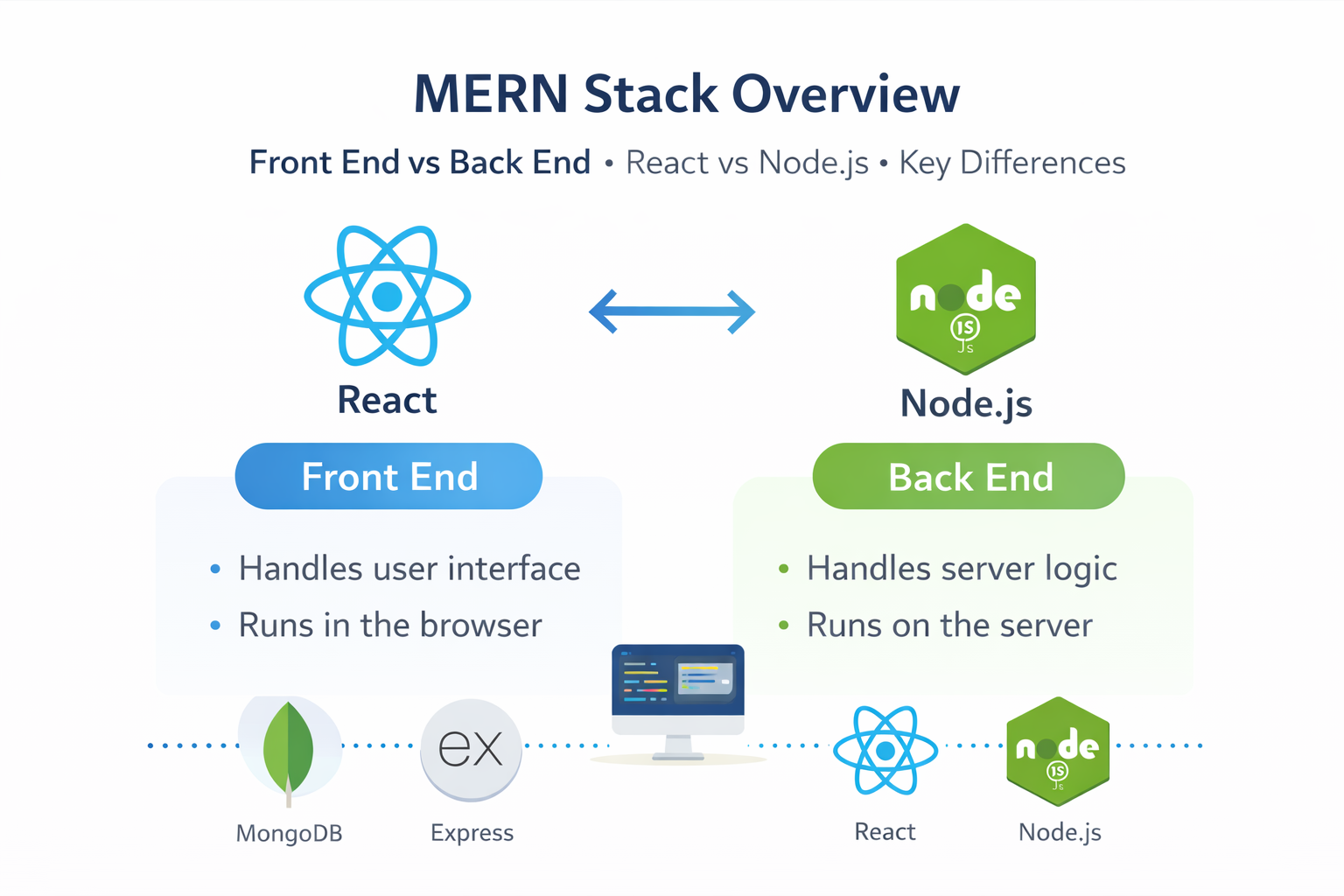
MERN Stack Overview: Front End vs Back End and the Difference Between React and Node.js
The modern digital landscape is defined by speed, interactivity, and seamless data flow. For businesses and developers alike, choosing the right "stack"—the combination of technologies used to build an application—is the most critical decision in the software development lifecycle. Among the myriad of options available, the MERN stack has emerged as a titan in the industry.
The MERN stack has become one of the most widely adopted full-stack development frameworks in modern web development. It enables developers to build scalable, high-performance, and maintainable web applications using a single programming language—JavaScript—across the entire application. This unification of the language is a revolutionary shift; it breaks down the silos between front-end and back-end teams, allowing for a "Universal JavaScript" approach that accelerates development cycles and reduces friction.
MERN stands for MongoDB, Express.js, React, and Node.js, with each technology playing a distinct and essential role in application development. As businesses increasingly demand fast, interactive, and data-driven web solutions, understanding the MERN stack architecture has become a valuable skill for developers. To use the stack effectively, it is important to clearly understand the difference between front-end and back-end development, as well as the individual responsibilities of React and Node.js within the ecosystem.
What Is the MERN Stack? A Deep Dive into the Components
The MERN stack is a JavaScript-based technology stack used for developing full-stack web applications. It combines four open-source technologies that work together seamlessly to handle both client-side and server-side operations. By using a single language (JavaScript) and a single data format (JSON), the MERN stack creates a "frictionless" environment where data moves from the database to the user’s screen without complex transformations.
The Four Pillars of MERN:
-
MongoDB (The Database Layer): A NoSQL database that stores data in flexible, JSON-like documents. Unlike traditional relational databases that use tables and rows, MongoDB allows for a dynamic schema, making it ideal for evolving applications.
-
Express.js (The Web Framework): A minimal and flexible web application framework for Node.js. It acts as the "glue" for the backend, providing a robust set of features to handle routing, cookies, and HTTP requests.
-
React (The Front-End Library): Developed by Meta (formerly Facebook), React is used for building high-performance user interfaces. It is famous for its "Virtual DOM," which ensures that web pages update instantly without needing a full refresh.
-
Node.js (The Runtime Environment): The engine that allows JavaScript to run on a server. Before Node.js, JavaScript was confined to the browser. Node.js unlocked the ability to use JavaScript for server-side logic, file systems, and database connections.
This combination allows developers to create end-to-end applications where data flows smoothly from the user interface to the database and back.
Understanding Front-End and Back-End Development
In any web application, development is broadly divided into two major areas: front end and back end. In the world of MERN, these two layers represent the "Client" and the "Server." While they operate in different environments, they must communicate perfectly via APIs (Application Programming Interfaces) to provide a cohesive experience.
1. Front-End Development in the MERN Stack
The front end represents everything a user sees and interacts with in a web application. This includes layout design, buttons, forms, animations, and dynamic content updates. In the MERN stack, React is the powerhouse responsible for front-end development.
Why React for the Front End?
React allows developers to build interactive user interfaces using reusable components. Think of components as Lego blocks; you build a "Button" block, a "Navbar" block, and a "User Profile" block, and then assemble them to create a page. Instead of reloading entire pages—which can be slow and jarring—React updates only the required parts of the user interface. This is known as a Single Page Application (SPA) architecture, resulting in faster performance and a smoother experience reminiscent of a mobile app.
Key responsibilities of the front end include:
-
Rendering User Interfaces: Converting code into visual elements in the browser.
-
Managing User Interactions: Handling events like clicks, form submissions, and scrolls.
-
State Management: Keeping track of data that changes over time (e.g., Is the user logged in? What is in their shopping cart?).
-
Client-Side Routing: Allowing users to move between "pages" (like Home and Profile) without the browser performing a hard refresh.
-
API Consumption: Sending requests to the backend and displaying the returned data (JSON).
2. Back-End Development in the MERN Stack
The back end is the "brain" of the application. It is responsible for handling the core logic, processing client requests, managing authentication, handling data storage, and ensuring secure communication between different parts of the system. While the front end is about presentation, the back end is about power and security.
In the MERN stack, Node.js and Express.js together manage backend operations, supported by MongoDB for persistent storage.
The Role of Node.js and Express
Node.js provides the runtime environment that allows JavaScript to execute on the server. Express.js is a lightweight framework built on top of Node.js that simplifies the "heavy lifting" of backend coding. It handles routing (directing requests to the right code), middleware (checking if a user is authorized), and API creation.
Key responsibilities of the back end include:
-
Handling HTTP Requests: Receiving data from the front end and sending back the appropriate response.
-
Business Logic: Performing calculations, processing payments, or filtering data based on complex rules.
-
Authentication & Authorization: Verifying who the user is (Login) and what they are allowed to do (Permissions).
-
Database Management: Creating, reading, updating, and deleting records in MongoDB (CRUD operations).
-
Application Security: Protecting the app from common threats like SQL injection or Cross-Site Scripting (XSS).
MERN Stack Front End vs Back End: Key Differences
To truly master the MERN stack, one must respect the "Separation of Concerns." Although they share a language, the environments they run in are vastly different.
| Feature | Front End (React) | Back End (Node/Express/MongoDB) |
| Execution Environment | The User's Web Browser | A Server or Cloud Provider |
| Primary Goal | User Engagement & Interaction | Data Integrity, Logic, & Security |
| Visibility | Code is visible to the user (inspect element) | Code is private and hidden on the server |
| Data Handling | Displays data to the user | Stores and retrieves data from the DB |
| Performance Metric | Low Latency & Smooth Animations | Throughput & Scalability |
Understanding this separation helps developers structure applications properly. A common mistake is putting too much "logic" in the front end, which can lead to security vulnerabilities. Conversely, putting too much "rendering" logic in the back end can make the UI feel sluggish.
The Core Confusion: Difference Between React and Node.js
One of the most common questions among learners and even some stakeholders is the difference between React and Node.js. Since both use JavaScript, they are often assumed to serve similar purposes, but in reality, they operate in entirely different worlds.
What is React?
React is a front-end library developed by Facebook. It is a "View" library. It is strictly concerned with what happens on the client’s screen. React code is downloaded by the user's browser, which then executes it to build the website layout. It cannot talk to a database directly; it must ask a server for data.
What is Node.js?
Node.js, on the other hand, is a runtime environment. It is not a library or a framework; it is the "engine" that lets you run JavaScript outside of a browser. Node.js handles the "behind-the-scenes" processes. It can access the computer's file system, listen to network ports, and connect to databases.
Key Differences at a Glance:
-
React is used for UI/UX; Node.js is used for server-side logic.
-
React runs in the browser; Node.js runs on the server (machines like AWS, Google Cloud, or Heroku).
-
React uses the Virtual DOM for speed; Node.js uses an Event-Driven, Non-Blocking I/O model for scalability.
-
React is a library you "import" into your front-end code; Node.js is the environment you "install" on your server to run your backend.
Role of MongoDB in the MERN Stack: The NoSQL Advantage
In the MERN stack, data is the lifeblood, and MongoDB is the heart that pumps it. MongoDB is a NoSQL, document-oriented database. In traditional databases, you have to define "tables" with rigid "columns." If you want to add a new piece of information (like a user’s social media handle) but forgot to create a column for it, the database will reject the data.
MongoDB uses Documents (similar to JSON). This allows for a "Schema-less" design. If one user document has a Twitter handle and another doesn’t, MongoDB doesn't care. This flexibility is what makes MERN so popular for startups—you can change your data structure as quickly as your business grows.
Why MongoDB fits MERN perfectly:
-
JSON Everywhere: React uses JSON, Express sends JSON, and MongoDB stores BSON (Binary JSON). There is no need for complex data translation.
-
Horizontal Scalability: You can easily distribute your data across multiple servers.
-
High Speed: For read-heavy applications (like social media feeds), MongoDB is exceptionally fast.
How the MERN Stack Works Together: The Life of a Request
To visualize the MERN stack in action, let’s follow a single action: A user clicking "Add to Cart."
-
The User Action (React): The user clicks the button. React updates the local "State" to show a loading spinner.
-
The API Call: React sends an HTTP request (via a tool like Axios) to a specific URL on the server (e.g.,
/api/cart/add). -
The Server Logic (Node/Express): The Node.js server receives the request. Express identifies the route and runs the "Add to Cart" function.
-
Database Update (MongoDB): The server tells MongoDB to find the user’s cart document and push a new item ID into the array.
-
The Response: MongoDB confirms the save. Express sends a "200 OK" status back to the client with the updated cart data.
-
The Final UI Update (React): React receives the new data, stops the loading spinner, and updates the cart icon to show "1 item."
This cycle happens in milliseconds, creating the illusion of an instant, desktop-like experience.
Advantages of Using the MERN Stack for Businesses
Why should a company choose MERN over other stacks like LAMP (Linux, Apache, MySQL, PHP) or MEAN (using Angular instead of React)?
1. Unified Language (JavaScript)
The biggest advantage is the Shared Language. When the front end and back end speak the same language, developers can move between tasks easily. A front-end developer can help debug a back-end route without learning a whole new syntax. This leads to smaller, more efficient teams.
2. Isomorphic Coding
You can share code between the server and the client. For example, form validation logic can be written once and used in both React (for instant feedback) and Node.js (for final security checks).
3. The React Ecosystem
React is currently the most popular front-end library in the world. This means there are thousands of pre-made components, libraries, and tools available to speed up development. If you need a calendar, a chart, or a payment gateway, there is already a React library for it.
4. High Performance and Scalability
Node.js is built on Google’s V8 engine, which is incredibly fast. Its non-blocking nature makes it perfect for "Real-Time" applications like chat apps, gaming servers, or collaborative tools like Google Docs.
Common Challenges in MERN Stack Development
While powerful, the MERN stack is not a "magic wand." It requires discipline and best practices to avoid common pitfalls.
-
Project Structure: Because MERN doesn't force a specific folder structure (unlike frameworks like Ruby on Rails), beginners often create "spaghetti code." Professional developers must implement a clean MVC (Model-View-Controller) architecture.
-
State Management Complexity: As React apps grow, keeping track of data across dozens of components becomes hard. Developers often need to implement Redux or the Context API, which adds a learning curve.
-
SEO Challenges: Since React is rendered in the browser (Client-Side Rendering), search engines like Google sometimes struggle to "read" the content. To fix this, developers must implement Server-Side Rendering (SSR) using frameworks like Next.js.
-
Security Misconfigurations: Using NoSQL doesn't mean you're safe from injection. Developers must use libraries like
Mongooseto enforce schemas and sanitize all user input.
MERN Stack in Real-World Applications
The MERN stack is the engine behind some of the most successful platforms in the world.
-
Social Media: Facebook and Instagram use React heavily.
-
Streaming Services: Netflix uses Node.js to handle the massive amounts of data and requests from millions of viewers.
-
E-commerce: Platforms like Airbnb and various modern marketplaces use MERN for its ability to handle dynamic listings and real-time bookings.
For training institutes and organizations, the MERN stack also provides an excellent learning pathway. It teaches the fundamentals of the "Request-Response" cycle, database management, and modern UI design, all within a single language ecosystem.


Comments
No comments yet. Be the first to comment.
Leave a Comment