


Are you ready to embark on one of the most rewarding career journeys in technology? The MERN stack—MongoDB, Express.js, React, and Node.js—continues to dominate web development in 2026, powering everything from startup MVPs to enterprise-scale applications at companies like Netflix, Uber, and Instagram .
But here's the challenge: with so many resources available, where do you even start? What should you learn first? How long will it take? And most importantly, what does a MERN stack learning path look like in 2026 that actually leads to a job?
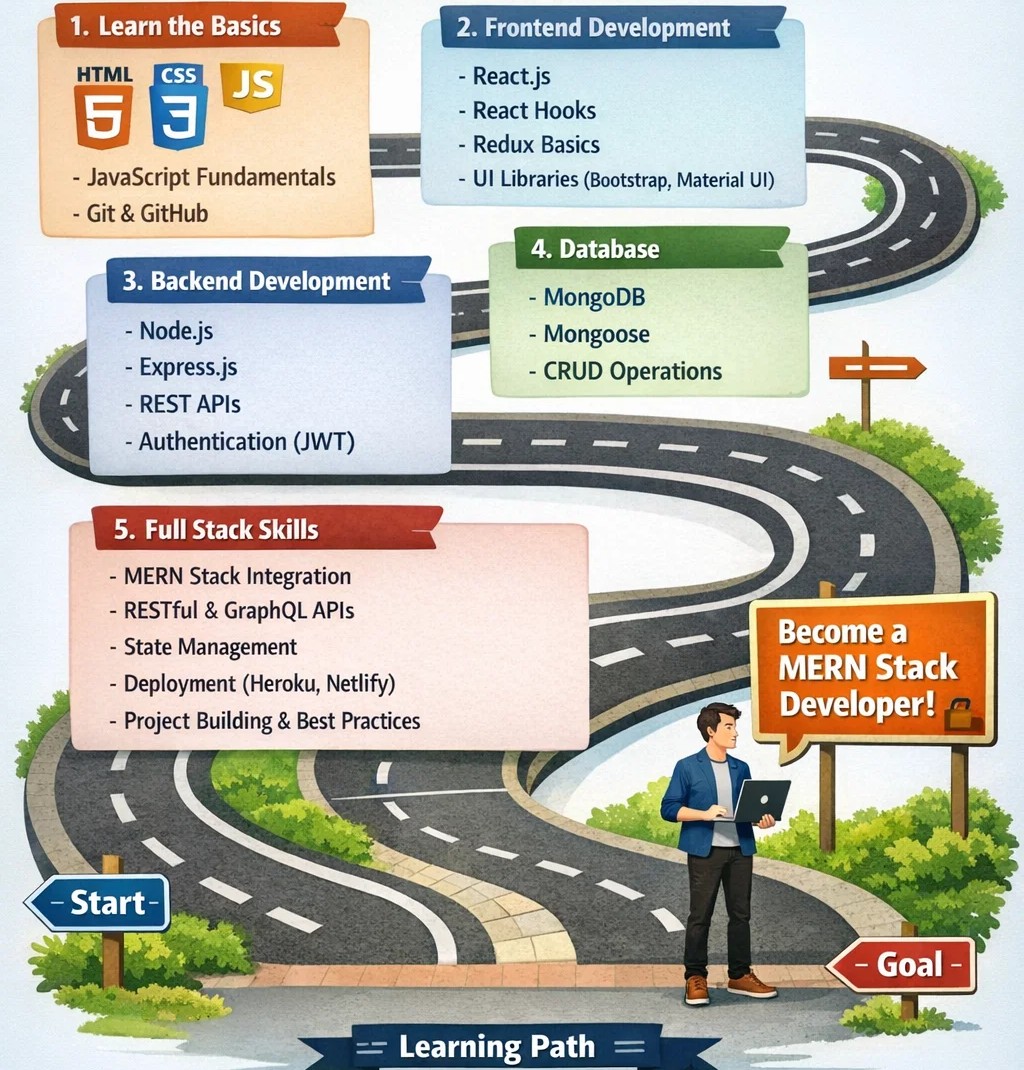
This comprehensive guide answers all those questions and more. We've crafted a step-by-step MERN stack roadmap based on current industry requirements, emerging trends like AI integration and edge computing, and real hiring practices. Whether you're a complete beginner or someone looking to formalize your self-taught skills, this roadmap will show you exactly how to become a MERN stack developer in 2026.
Let's dive in.
Why MERN Stack in 2026? The State of the Ecosystem
Before we jump into the learning path, let's address the elephant in the room: Is the MERN stack still relevant in 2026? The answer is a resounding yes—but it has evolved significantly.
The MERN Stack Isn't Dead—It's Evolving
Contrary to some industry chatter, the MERN stack is experiencing what experts call a "renaissance" in 2026 . Far from fading away, MERN has transformed into a high-performance ecosystem for intelligent, edge-optimized applications. Here's what's happening:
Projected Growth: By 2026, there will be approximately 285,000 MERN-related jobs globally—a staggering 185% increase since 2022 . Demand isn't slowing; it's accelerating.
AI Integration: A remarkable 44% of new MERN projects will integrate AI capabilities by 2026 . MongoDB now features native Vector Search, allowing developers to store AI embeddings directly alongside application data, making MERN the primary stack for building AI agents and Retrieval-Augmented Generation (RAG) applications .
Performance Leap: With Node.js 22, React Server Components, and Express v5, the stack delivers performance that rivals newer, more opinionated frameworks while maintaining its signature accessibility .
What's Changed in the 2026 MERN Stack
The modern MERN stack has matured significantly:
| Component | 2026 Evolution |
|---|---|
| MongoDB | Native Vector Search for AI embeddings, AI-native database features |
| Express.js | v6.0+ with native async/await, optimized for microservices and serverless |
| React | React Compiler era—automatic optimization, 30% smaller bundles |
| Node.js | Web Standard APIs (fetch, WebStreams, WebCrypto), edge deployment ready |
| TypeScript | Now the default—end-to-end type safety from database to UI |
As Avneet Sutariya notes in his 2026 analysis, "MERN isn't 'dead'—it has evolved. If you know MERN, you have a solid foundation, but in 2026, you must expand into TypeScript, Next.js, and Cloud-native services to stay competitive" .
The Complete MERN Stack Learning Path 2026
Now, let's get to the heart of this guide: your step-by-step MERN stack roadmap. This learning path is structured to take you from absolute beginner to job-ready developer in approximately 6 months of consistent effort .
Phase 1: Web Foundations (Month 1)
Before diving into the MERN stack specifically, you need a solid foundation in web fundamentals. This phase is non-negotiable—skipping it will only cause frustration later .
What You'll Learn
HTML5: Understand the structure of web pages, semantic elements, forms, and accessibility basics. You should be able to create well-structured documents that convey meaning beyond just appearance.
CSS3: Master selectors, the box model, flexbox, and CSS Grid. Learn responsive design principles so your layouts work on mobile, tablet, and desktop. Modern CSS variables and custom properties are also valuable.
JavaScript (ES6+): This is the most critical foundation. Focus on:
-
Variables, data types, and operators
-
Functions and scope
-
Arrays and objects
-
ES6+ features: arrow functions, destructuring, spread/rest operators, template literals
-
Asynchronous JavaScript: promises, async/await
-
DOM manipulation and events
Essential Tools:
-
VS Code: The industry-standard code editor
-
Git & GitHub: Version control basics (init, add, commit, push, pull, branching)
-
Chrome DevTools: Debugging and testing in the browser
Practical Project
Build a personal portfolio website with responsive design. Include sections for your bio, skills, and contact information. Host it on GitHub Pages to practice deployment .
Resources
-
freeCodeCamp's Responsive Web Design certification
-
MDN Web Docs for reference
-
JavaScript.info for deep JavaScript understanding
Phase 2: Frontend with React.js (Month 2)
With your foundation solid, it's time to tackle React—the "R" in MERN and the most in-demand frontend library globally .
What You'll Learn
React Fundamentals:
-
JSX: Writing HTML-like syntax within JavaScript
-
Components: Building reusable UI pieces (functional components first)
-
Props: Passing data between components
-
State: Managing component data with useState
-
Effects: Handling side effects with useEffect
React Ecosystem:
-
React Router: Navigation between different views/pages
-
Hooks Deep Dive: Custom hooks, useReducer, useMemo, useCallback
-
State Management: Context API for medium apps, Redux Toolkit for complex applications
-
API Integration: Fetching data from external APIs using fetch or axios
Modern React in 2026:
-
React Server Components: Understanding when to use server vs. client components
-
React Compiler: Automatic optimization—less manual memoization
Practical Project
Build a Weather App that fetches real-time weather data from an API . Include search functionality, current conditions, and a 5-day forecast. This project teaches API integration, state management, and responsive UI design.
Resources
-
React official documentation (excellent and up-to-date)
-
freeCodeCamp's React course
-
Scaler's React modules
Phase 3: Backend with Node.js & Express.js (Month 3)
Now you'll move to the server side, learning how to build APIs and handle server logic .
What You'll Learn
Node.js Fundamentals:
-
What is Node.js and how it works (event loop, non-blocking I/O)
-
Setting up a Node.js project with npm init
-
Modules: require vs. import, creating custom modules
-
Working with the file system
-
Understanding package.json and dependencies
Express.js Framework:
-
Creating a basic server
-
Routing: handling different HTTP methods (GET, POST, PUT, DELETE)
-
Middleware: what it is and how to use it
-
Request and response objects
-
Error handling strategies
RESTful APIs:
-
API design principles
-
CRUD operations
-
Status codes and response formatting
-
Testing APIs with Postman
Modern Backend in 2026:
-
Express v5/v6 features (native async/await)
-
Web Standard APIs in Node.js (fetch, WebStreams)
-
Basic understanding of serverless deployment
Practical Project
Build a Blog API with endpoints for creating, reading, updating, and deleting posts . Test all endpoints using Postman. This project teaches routing, request handling, and API design.
Resources
-
Node.js official documentation
-
Express.js official documentation
-
Postman for API testing
Phase 4: Database with MongoDB (Month 4)
Every application needs to store data. MongoDB, a NoSQL database, is the perfect fit for JavaScript developers because it stores data in JSON-like documents .
What You'll Learn
MongoDB Basics:
-
Documents, collections, and databases
-
NoSQL vs. SQL concepts
-
Setting up MongoDB locally and with MongoDB Atlas (cloud)
-
CRUD operations (Create, Read, Update, Delete)
Mongoose ODM:
-
Defining schemas and models
-
Data validation
-
Relationships and referencing
-
Population (MongoDB's version of joins)
-
Middleware (pre and post hooks)
Advanced MongoDB:
-
Aggregation pipeline for complex data transformations
-
Indexing for performance
-
2026 Feature: Vector Search for AI embeddings
Practical Project
Enhance your Blog API by connecting it to MongoDB. Store posts in a database and implement all CRUD operations. Add a comments feature to practice relationships .
Resources
-
MongoDB University (free courses)
-
Mongoose documentation
-
MongoDB Atlas tutorials
Phase 5: Full-Stack Integration & Authentication (Month 5)
Now comes the magic moment: connecting everything you've learned into complete, end-to-end applications .
What You'll Learn
Connecting Frontend to Backend:
-
Making API calls from React using axios or fetch
-
Handling CORS (Cross-Origin Resource Sharing)
-
Displaying loading states and errors
-
Environment variables for configuration
Authentication & Authorization:
-
JWT (JSON Web Tokens): How tokens work, generating and verifying tokens
-
Password Hashing: Using bcrypt to securely store passwords
-
Protected Routes: Securing both frontend routes and backend endpoints
-
Login/Signup Flows: Complete user authentication systems
Security Best Practices:
-
Input validation and sanitization
-
Preventing XSS and CSRF attacks
-
Rate limiting to prevent brute force attacks
-
Secure HTTP headers with helmet.js
Modern Security in 2026:
-
Understanding Content Security Policy (CSP)
-
Dependency security auditing
Practical Project
Build a Task Manager App with user authentication . Users should be able to sign up, log in, and create/manage their own tasks. This project ties together everything: React frontend, Node/Express backend, MongoDB database, and JWT authentication.
Resources
-
JWT.io documentation
-
bcrypt documentation
-
OWASP security guidelines
Phase 6: Advanced Concepts & Deployment (Month 6)
In your final month, you'll learn how to take your applications to production and add advanced features that impress employers .
What You'll Learn
Deployment:
-
Frontend Hosting: Vercel, Netlify
-
Backend Hosting: Render, Railway, AWS
-
Database Hosting: MongoDB Atlas
-
Environment variables in production
-
Custom domains and SSL
DevOps Basics:
-
CI/CD pipelines with GitHub Actions
-
Containerization basics with Docker
-
Monitoring and logging
Advanced Features:
-
File uploads with Multer and Cloudinary
-
Payment gateway integration (Stripe/Razorpay basics)
-
Real-time features with Socket.IO
-
Performance optimization techniques
Modern 2026 Additions:
-
Basic AI integration (using OpenAI APIs or similar)
-
TypeScript adoption (increasingly mandatory)
Practical Project
Build and deploy a full-stack e-commerce application or social media clone . Include user authentication, product listings, shopping cart, and payment processing. Deploy it completely and share the live link on your resume.
Resources
-
Vercel/Netlify documentation
-
Render/Railway guides
-
Stripe/Razorpay documentation
Essential Tools and Technologies in the MERN Ecosystem
Beyond the core four technologies, modern MERN developers need familiarity with these supporting tools :
Frontend Tools
-
Redux Toolkit: For complex state management
-
Tailwind CSS / Material-UI: For rapid UI development
-
React Router: For navigation
-
Axios: For API calls
Backend Tools
-
Postman / Insomnia: API testing
-
JWT & bcrypt: Authentication
-
Multer: File uploads
-
Nodemailer: Email sending
Database Tools
-
MongoDB Compass: GUI for MongoDB
-
Mongoose: ODM for schema modeling
-
MongoDB Atlas: Cloud database hosting
Development & Deployment
-
Git & GitHub: Version control
-
VS Code: Code editor with extensions
-
Vercel / Netlify: Frontend deployment
-
Render / Railway: Backend deployment
-
GitHub Actions: CI/CD automation
The Modern MERN Developer: Skills Beyond the Stack
In 2026, simply knowing the four technologies isn't enough to stand out. Here's what employers are looking for beyond basic MERN proficiency :
1. TypeScript Proficiency
Writing plain JavaScript is increasingly viewed as "legacy" . TypeScript provides end-to-end type safety from your MongoDB schema to your React components, preventing 90% of common runtime bugs. If you know MERN, you have a solid foundation, but you must expand into TypeScript to stay competitive .
2. Cloud-Native Thinking
Modern MERN applications are often deployed to edge networks, ensuring users anywhere experience sub-50ms latency . Familiarity with cloud platforms (AWS, Google Cloud, or Azure) and serverless concepts is highly valuable.
3. AI Integration
With 44% of new MERN projects integrating AI , understanding how to work with AI APIs (OpenAI, Anthropic) and vector databases is becoming a significant differentiator.
4. System Design Basics
Senior roles require understanding how to design scalable systems—handling authentication, rate limiting, caching, and database optimization at scale.
5. DevOps Awareness
CI/CD pipelines, containerization with Docker, and basic infrastructure knowledge help you deploy and maintain applications independently.
Project Ideas to Build Your Portfolio
Projects are what actually get you hired. Here's a progression from beginner to advanced :
Beginner Projects
-
To-Do List Application: Master CRUD operations
-
Weather App: Practice API integration
-
Personal Blog: Content management basics
Intermediate Projects
-
E-commerce Platform: Products, cart, user accounts
-
Social Media App: Posts, likes, comments, user profiles
-
Chat Application: Real-time communication with Socket.IO
Advanced Projects
-
Task Management Tool: Kanban boards, teams, assignments
-
Learning Management System: Courses, enrollments, progress tracking
-
AI-Integrated App: Content generation or intelligent recommendations
Pro Tip: Make your GitHub a portfolio. Clean code, clear README files, and working demo links matter more than certificates .
How Long Does It Take to Become a MERN Stack Developer?
This depends on your background and available time:
-
Full-time learner (40 hours/week): 3-4 months to job-ready
-
Part-time learner (15-20 hours/week): 6-8 months
-
Self-paced with other commitments: 8-12 months
The key is consistency. Following the roadmap above with dedicated practice for 6 months can take you from beginner to employable .
Career Outcomes and Salary Expectations
Job Roles You Can Target
-
Full Stack Developer
-
MERN Stack Developer
-
Frontend Developer (React)
-
Backend Developer (Node.js)
-
JavaScript Developer
Salary Expectations (India)
-
Freshers: ₹4-8 LPA
-
Mid-Level (2-4 years): ₹8-15 LPA
-
Senior (5+ years): ₹15-30+ LPA
Global Opportunities
-
US Average: $132,723 for full-stack developers
-
UK (Manchester): £67,500 median salary
-
Remote work opportunities through platforms like Toptal and Upwork
Industry Demand
MERN developers are needed across:
-
IT services and consulting (TCS, Infosys, Wipro)
-
Product companies and startups
-
E-commerce platforms
-
Fintech and healthcare
-
EdTech and SaaS
Frequently Asked Questions
Is the MERN stack suitable for beginners?
Absolutely. Because it uses JavaScript throughout, you only need to learn one language for both frontend and backend. This makes it more beginner-friendly than stacks requiring multiple languages .
Do I need to learn other frameworks first?
No. You can start with the fundamentals (HTML, CSS, JavaScript) and then dive directly into the MERN stack. However, understanding vanilla JavaScript deeply before jumping to React is strongly recommended .
Should I learn MongoDB or SQL first?
For the MERN stack, start with MongoDB. However, in 2026, many teams are moving back to PostgreSQL/Supabase for better data integrity . Understanding both NoSQL and SQL concepts makes you more versatile.
Do I need TypeScript?
Increasingly, yes. In 2026, TypeScript is becoming the default choice for professional MERN development due to its type safety and improved developer experience .
What about Next.js?
Next.js (a React framework) is worth learning after mastering basic React. It provides server-side rendering and better performance out of the box. Many 2026 MERN developers use Next.js for the frontend instead of vanilla React .
How do I get my first job?
-
Build a strong portfolio with 3-4 substantial projects
-
Network on LinkedIn and attend tech meetups
-
Apply strategically to both internships and entry-level positions
-
Prepare for interviews with common JavaScript and system design questions
-
Consider freelance platforms (Upwork, Fiverr) to build experience
Conclusion: Your MERN Stack Journey Starts Now
The MERN stack in 2026 is more powerful and relevant than ever. It has evolved from a simple web framework into a high-performance ecosystem for building intelligent, edge-optimized applications that power the modern web . With nearly 300,000 jobs globally and a 185% growth in demand since 2022 , now is the perfect time to invest in these skills.
This roadmap has given you a clear, structured path:
| Phase | Focus | Timeline |
|---|---|---|
| 1 | Web Foundations (HTML, CSS, JavaScript) | Month 1 |
| 2 | React.js Frontend | Month 2 |
| 3 | Node.js & Express.js Backend | Month 3 |
| 4 | MongoDB Database | Month 4 |
| 5 | Full-Stack Integration & Authentication | Month 5 |
| 6 | Advanced Concepts & Deployment | Month 6 |
But remember what industry experts emphasize: "Consistency + depth + real projects = survival in this market" . A roadmap is only effective if you act on it. Start small, stay consistent, build projects, and never stop learning.
As Jay Mehta notes in his 2026 outlook, "The stack that powered Instagram, Netflix, and Uber isn't going anywhere—it's accelerating" . The MERN stack isn't just a skill—it's your launchpad to a future-proof, high-paying career in web development.
Your next step? Open your code editor, start Phase 1 today, and begin your journey. The world of full-stack JavaScript development awaits.


Comments
No comments yet. Be the first to comment.
Leave a Comment