


If you're navigating the world of web development in 2026, you've likely encountered three terms that can feel confusing: MERN stack, MEAN stack, and full stack development. What's the difference? Which one is better? And most importantly, which one should you learn or choose for your next project?
Here's the truth: there is no universal "better" option . Each approach serves different needs, and the right choice depends entirely on your goals, project requirements, and team expertise. The MERN and MEAN stacks are specific technology combinations, while "full stack" is a broader concept that encompasses many possible technology choices.
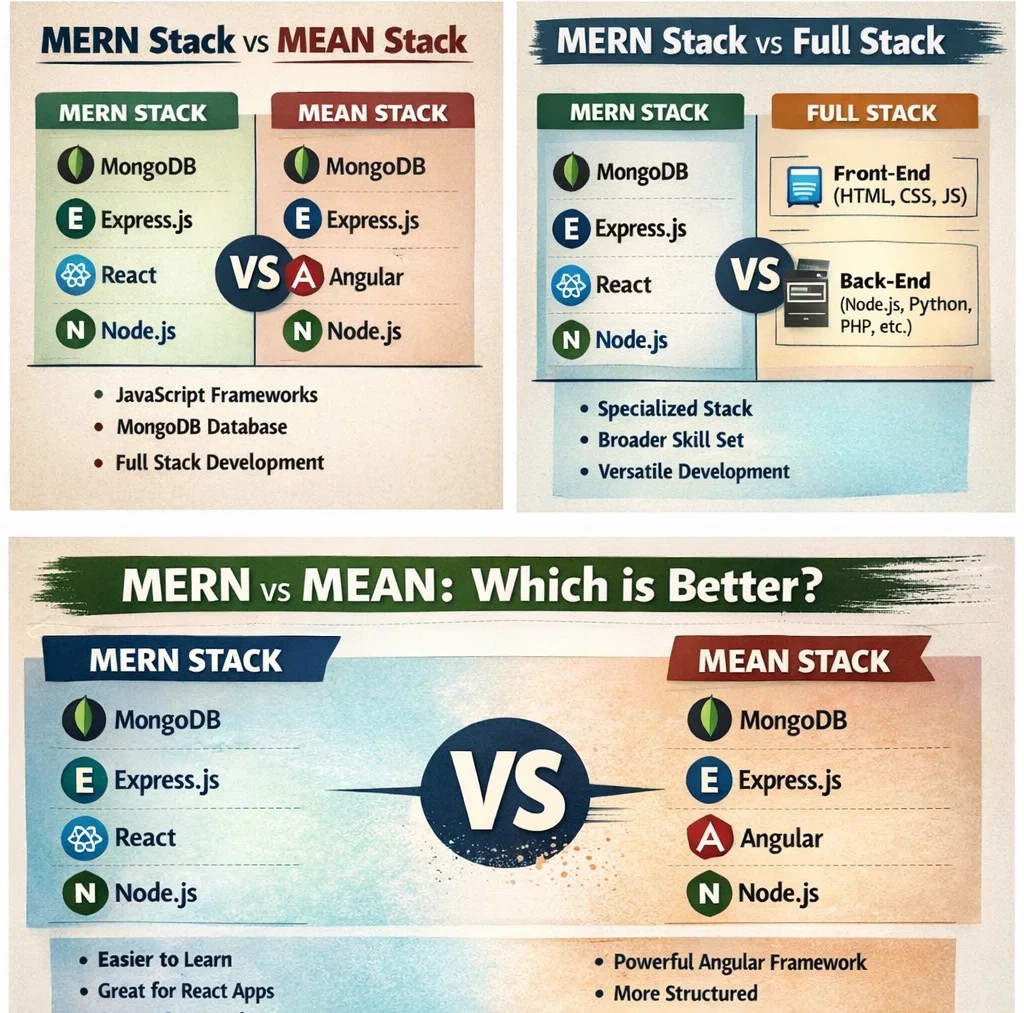
In this comprehensive guide, we'll break down everything you need to know about MERN stack vs MEAN stack vs full stack development in 2026. We'll compare their architectures, learning curves, performance characteristics, career opportunities, and ideal use cases. By the end, you'll have a clear understanding of which path aligns with your goals.
Let's dive in.
Understanding the Basics: What Are We Comparing?
Before we compare these approaches, we need to understand what each term actually means.
What Is the MERN Stack?
The MERN stack is a specific combination of four JavaScript-based technologies used to build full-stack web applications :
-
MongoDB: A NoSQL database that stores data in flexible, JSON-like documents
-
Express.js: A lightweight backend framework for building APIs and handling server logic
-
React.js: A frontend library for building dynamic user interfaces (developed by Meta/Facebook)
-
Node.js: A JavaScript runtime that executes code on the server
The key characteristic of MERN is that it uses JavaScript across the entire application—from database to backend to frontend. This unified language approach makes development more consistent and efficient .
What Is the MEAN Stack?
The MEAN stack is nearly identical to MERN, with one crucial difference at the frontend layer :
-
MongoDB: Same NoSQL database
-
Express.js: Same backend framework
-
Angular: A full-featured frontend framework developed by Google (replaces React)
-
Node.js: Same JavaScript runtime
Like MERN, MEAN also uses JavaScript throughout, but Angular brings a more structured, opinionated approach compared to React's flexibility .
What Is Full Stack Development?
Full Stack Development is not a specific technology stack—it's a broader concept referring to developers who can work on both frontend and backend components of an application, regardless of the specific technologies used .
A Full Stack Developer might work with:
-
Frontend: HTML, CSS, JavaScript, React, Angular, Vue, or others
-
Backend: Node.js, Python, Java, PHP, Ruby on Rails, .NET
-
Database: MySQL, PostgreSQL, MongoDB, Oracle
-
DevOps: Deployment, cloud services, CI/CD pipelines
Unlike MERN or MEAN, which are JavaScript-centric, full stack development offers complete technology flexibility .
Core Technologies Comparison
Let's compare the technologies at the heart of each approach.
MERN Stack Technologies
| Component | Technology | Role |
|---|---|---|
| Database | MongoDB | NoSQL document database, stores data in JSON-like format |
| Backend Framework | Express.js | Lightweight framework for APIs and server logic |
| Frontend | React.js | Component-based library for dynamic UIs |
| Runtime | Node.js | JavaScript runtime for server-side execution |
MEAN Stack Technologies
| Component | Technology | Role |
|---|---|---|
| Database | MongoDB | Same as MERN |
| Backend Framework | Express.js | Same as MERN |
| Frontend | Angular | Full-featured framework with built-in tools (TypeScript-based) |
| Runtime | Node.js | Same as MERN |
Full Stack Development Possibilities
| Layer | Possible Technologies |
|---|---|
| Frontend | React, Angular, Vue, HTML/CSS/JavaScript |
| Backend | Node.js, Python (Django/Flask), Java (Spring), PHP (Laravel), .NET, Ruby on Rails |
| Database | MySQL, PostgreSQL, MongoDB, Oracle, SQL Server |
| Deployment | AWS, Azure, Google Cloud, Docker, Kubernetes, CI/CD tools |
The key insight: MERN and MEAN are specific subsets of full stack development, while full stack is the broader universe of possibilities .
Architecture and Philosophy Differences
MERN Stack: Flexibility and Component-Based Architecture
MERN uses React for the frontend, which follows a component-based architecture. This means you build reusable UI pieces that manage their own state and can be composed together .
Key characteristics:
-
Component-based: UI built from reusable, self-contained components
-
Virtual DOM: Improves performance by updating only changed elements
-
One-way data flow: Data moves in a single direction, making debugging easier
-
Unopinionated: React is a library, not a full framework—you choose additional tools as needed
-
JSX syntax: Write HTML-like code within JavaScript
React's flexibility means teams have freedom to choose their own state management (Redux, Context API), routing solutions, and styling approaches. This is powerful but requires more decision-making during project setup .
MEAN Stack: Structured MVC Architecture
MEAN uses Angular for the frontend, which follows a more structured, opinionated approach often aligned with the MVC (Model-View-Controller) pattern .
Key characteristics:
-
Full-featured framework: Includes built-in routing, forms, HTTP services, and testing tools
-
Two-way data binding: Changes in the UI automatically update the model and vice versa
-
TypeScript by default: Strong typing and object-oriented features
-
Dependency injection: Built-in system for managing dependencies
-
Opinionated structure: Enforces consistent project organization
Angular's structured approach promotes consistency, especially for larger teams. The built-in tools reduce dependency on third-party libraries, but the learning curve is steeper .
Full Stack Development: Technology-Agnostic
Full stack development isn't tied to any specific architecture—it adapts to whatever technologies you choose. You might use React with Node.js, Angular with Java Spring, or Vue with Python Django .
Key characteristics:
-
Flexibility: Choose the best tool for each job
-
Broader knowledge: Understand multiple ecosystems
-
Adaptable: Can work across different project types
-
No single "right way": Architecture depends on technology choices
This flexibility is valuable for enterprises with diverse technology needs but requires continuous learning across multiple stacks .
Learning Curve Comparison
MERN Stack Learning Curve
MERN is generally considered easier for beginners to learn .
Why MERN is more accessible:
-
React has a gentler learning curve—developers pick up JSX quickly
-
Massive community with countless tutorials and resources
-
JavaScript throughout means you focus on one language
-
Flexible enough to start building quickly without mastering complex concepts upfront
Challenges:
-
React's flexibility means you'll need to make decisions about additional tools
-
You may need to learn Redux, React Router, and other libraries separately
-
The ecosystem changes rapidly
MEAN Stack Learning Curve
MEAN has a steeper learning curve, primarily due to Angular's complexity .
Why MEAN is more challenging:
-
Angular requires learning TypeScript, dependency injection, decorators, and RxJS
-
Two-way data binding and change detection concepts take time to master
-
More concepts to grasp before building your first application
-
Opinionated structure means you must learn "the Angular way"
Benefits once mastered:
-
Comprehensive framework with built-in solutions
-
Consistent project structure across applications
-
Strong typing catches errors early
-
Excellent for large-scale applications
Full Stack Development Learning Curve
Full stack development has the broadest learning curve because it encompasses multiple technologies .
Why full stack learning is expansive:
-
May need to learn multiple programming languages
-
Must understand both frontend and backend paradigms
-
Database knowledge across SQL and NoSQL
-
Deployment and DevOps concepts
The smart strategy: Many developers start with a specific stack (like MERN) and later expand into full stack development as they gain experience .
Performance and Scalability
MERN Stack Performance
MERN delivers excellent frontend performance due to React's virtual DOM, which minimizes actual DOM manipulations and speeds up rendering .
Performance strengths:
-
Virtual DOM: Updates only what changed, providing snappy user experiences
-
Lightweight core: React itself is focused and efficient
-
Fast rendering: Especially noticeable in complex, interactive UIs
-
SEO optimization: Next.js (React framework) enables server-side rendering for better search visibility
Scalability considerations:
-
Works well for small to medium projects out of the box
-
Can scale for large applications with proper architecture and tools
-
Node.js backend handles high concurrency well due to non-blocking I/O
MEAN Stack Performance
MEAN offers strong server-side performance and is well-suited for data-intensive applications .
Performance strengths:
-
Built-in optimization: Angular's change detection and ahead-of-time compilation
-
TypeScript benefits: Type safety reduces runtime errors
-
Structured data flow: Predictable performance characteristics
-
Angular Universal: Server-side rendering for SEO improvement
Scalability considerations:
-
Excels in large-scale, complex applications
-
Angular's structure helps maintain performance as applications grow
-
Built-in tools support large team collaboration
Full Stack Performance
Full stack performance depends entirely on your technology choices .
You can optimize for:
-
High concurrency: Node.js, Go, or Elixir
-
Enterprise stability: Java or .NET
-
Rapid development: Python or Ruby
-
Data-intensive workloads: Appropriate database choices
The flexibility allows you to match performance characteristics to specific project needs.
Security Considerations
MERN Stack Security
MERN requires manual security configuration—it doesn't come with built-in protections .
Security considerations:
-
Authentication and authorization must be implemented manually (JWT, OAuth)
-
Input validation and sanitization are developer responsibilities
-
Protection against XSS and CSRF requires explicit configuration
-
Security depends heavily on developer expertise
Mitigation strategies:
-
Use security middleware like helmet.js
-
Implement proper CORS configuration
-
Validate all user input
-
Keep dependencies updated
MEAN Stack Security
MEAN offers stronger built-in security through Angular and TypeScript .
Security advantages:
-
TypeScript reduces certain classes of bugs and vulnerabilities
-
Angular's built-in sanitization helps prevent XSS attacks
-
Structured framework encourages security best practices
-
Dependency injection system promotes clean, testable code
Considerations:
-
Backend security still requires careful implementation
-
Regular updates are still essential
-
Complex applications may have unique security needs
Full Stack Security
Full stack security varies widely based on technology choices .
-
Java/Spring offers enterprise-grade security features
-
Python/Django includes built-in protections
-
Node.js/Express requires more manual configuration
-
Database choices impact data security capabilities
The key is understanding security requirements and choosing technologies that match your compliance needs.
Use Cases: When to Choose Each Stack
When to Choose MERN Stack
MERN excels in projects that demand speed, flexibility, and rich user interfaces .
Ideal MERN use cases :
-
Startup MVPs: Rapid development and iteration
-
Single Page Applications (SPAs): Dynamic, app-like experiences
-
SaaS platforms: Subscription-based software services
-
E-commerce websites: Interactive product catalogs and shopping experiences
-
Social networking platforms: Real-time updates and engaging UIs
-
Real-time applications: Chat apps, collaboration tools
-
AI-powered dashboards: Modern interfaces for AI applications
Examples:
-
Netflix-style streaming platforms
-
Instagram-like social applications
-
Airbnb-style marketplaces
-
Real-time analytics dashboards
When to Choose MEAN Stack
MEAN is best suited for applications requiring long-term stability, structure, and enterprise-grade features .
Ideal MEAN use cases :
-
Enterprise-grade applications: Large-scale corporate systems
-
Financial and banking platforms: Regulated industries requiring structure
-
Large-scale CRM and ERP systems: Complex business logic
-
Corporate dashboards: Internal tools with consistent requirements
-
Data-intensive applications: Complex data processing needs
-
Government platforms: Compliance-heavy environments
Examples :
-
Banking applications
-
Healthcare management systems
-
Logistics platforms
-
Enterprise resource planning systems
When to Choose Full Stack Development
Full stack development (flexible technology choice) is valuable when :
-
Enterprise environments with existing technology standards
-
Projects requiring specific language ecosystems (Java, Python, .NET)
-
Long-term, scalable systems where technology flexibility matters
-
Teams with diverse expertise across multiple stacks
-
Projects integrating with legacy systems
Career Opportunities and Salary Trends
MERN Stack Developer Careers
MERN developers are in high demand, especially in startups and product companies .
Job roles :
-
Full Stack Developer (MERN specialization)
-
React Developer
-
Node.js Developer
-
MERN Stack Developer
-
Web Application Developer
-
Technical Lead
Salary trends (India) :
-
Freshers: ₹4-8 LPA
-
Experienced (3-5 years): ₹8-15 LPA
-
Senior roles: ₹15-30+ LPA
Global opportunities:
-
US average for full-stack developers: $132,723
-
UK (Manchester) median: £67,500
MEAN Stack Developer Careers
MEAN developers are valued in enterprises and structured environments .
Job roles :
-
Full Stack Developer (MEAN specialization)
-
Angular Developer
-
Enterprise Application Developer
-
Software Engineering Manager
-
Technical Lead
Salary trends:
-
Comparable to MERN, often slightly higher in enterprise contexts
-
Strong demand in financial, healthcare, and government sectors
Full Stack Developer Careers
Full Stack Developers often earn higher salaries due to their broader skill sets .
Why full stack developers are valued :
-
Handle complete application lifecycle
-
Reduce company hiring costs
-
Bridge frontend and backend teams
-
Adapt easily to multiple ecosystems
-
Prepare for leadership roles
Career progression :
-
Junior Full Stack Developer
-
Senior Full Stack Developer
-
Technical Lead
-
Solution Architect
-
Engineering Manager
-
CTO
2026 Trends and Future Outlook
MERN Stack Trends
-
AI integration boom: 44% of new MERN projects integrate AI capabilities; MongoDB now features native Vector Search for AI embeddings
-
Rising adoption in SaaS: Dominant choice for subscription-based platforms
-
Edge computing: MERN increasingly deployed to edge networks for sub-50ms latency
-
Next.js dominance: Server-side rendering and hybrid architectures becoming standard
-
React Compiler era: Automatic optimization reducing manual memoization
MEAN Stack Trends
-
Enterprise stability: Continued strength in regulated industries
-
Fintech adoption: Strong presence in financial applications
-
Government digital transformation: Preferred for compliance-heavy projects
-
Angular's evolution: Signals and improved change detection
-
Long-term maintainability: Valued for projects requiring 5-10 year lifespans
Full Stack Trends
-
Cloud-native development: Microservices and serverless architectures
-
DevOps integration: CI/CD becoming standard expectation
-
AI-ready systems: All stacks adapting to AI integration needs
-
Edge computing: Performance optimization across all technologies
-
TypeScript adoption: Increasingly standard across JavaScript ecosystems
Decision Framework: Which One Should You Choose?
Choose MERN Stack If :
-
You want faster development cycles and quick MVPs
-
Your project requires dynamic, interactive UI/UX
-
You're building a startup or SaaS product
-
Flexibility and customization are key priorities
-
Your team prefers React's component model
-
You value a massive ecosystem of third-party tools
-
You want to leverage React Native for mobile apps later
Choose MEAN Stack If :
-
You're building an enterprise-level application
-
You need a structured, opinionated framework
-
Long-term maintenance is a top priority
-
Your team prefers TypeScript and Angular's approach
-
You're in a regulated industry (finance, healthcare, government)
-
You value built-in tools over third-party libraries
-
You need strong governance and consistency across large teams
Choose Full Stack Development (broad) If :
-
You're targeting enterprise roles with specific technology requirements
-
You want maximum career flexibility across industries
-
Your project requires non-JavaScript technologies
-
You're interested in architecture and leadership roles
-
You need to integrate with existing legacy systems
-
You want to understand multiple ecosystems deeply
The Smart Strategy: A Practical Approach
Many successful developers follow this path :
-
Start with MERN for faster entry into web development
-
Build projects to solidify your understanding
-
Expand to full stack by learning additional technologies
-
Specialize based on market demand and personal interest
As one developer notes: "The tech world is not about choosing one forever. Many developers start with MERN and later expand into Full Stack" .
Common Mistakes to Avoid
When Choosing Between MERN and MEAN
Mistake 1: Focusing only on short-term speed
Consider long-term maintainability, not just how fast you can start.
Mistake 2: Neglecting SEO strategies
Both MERN (with Next.js) and MEAN (with Angular Universal) support server-side rendering—plan for it early.
Mistake 3: Underestimating governance needs
MERN's flexibility requires discipline; MEAN's structure provides it automatically.
Mistake 4: Choosing based on personal preference alone
Consider team skills, project requirements, and business goals.
Mistake 5: Ignoring mobile needs
MERN's React Native integration is smoother; MEAN requires more planning for mobile.
When Learning Full Stack Development
Mistake 1: Trying to learn everything at once
Master one stack first, then expand .
Mistake 2: Ignoring depth for breadth
Employers value deep understanding of core technologies.
Mistake 3: Skipping fundamentals
Strong JavaScript/HTML/CSS knowledge matters regardless of stack.
Mistake 4: Not building projects
Theory without practice won't get you hired.
Frequently Asked Questions
Is MERN Stack better than MEAN Stack in 2026?
Not necessarily. MERN is better for flexibility and UI-rich applications, while MEAN excels in structured, enterprise-level projects . The "better" choice depends entirely on your specific needs.
Which stack is more future-proof?
Both are future-proof. MERN is more popular among startups and has a massive community, while MEAN remains strong in enterprise environments with long-term support from Google .
Is MERN Stack good for large applications?
Yes, when built with proper architecture, MERN can scale efficiently for large applications . Many large-scale applications use React successfully.
Which stack has better job opportunities?
Both offer excellent opportunities. MERN has more positions overall due to React's popularity, especially in startups and product companies. MEAN offers strong opportunities in enterprise environments, often with higher stability .
Which stack is more cost-effective?
MERN often reduces development time for MVPs and smaller projects, making it more cost-effective for startups. MEAN may require more upfront investment but offers long-term benefits for enterprise projects .
Can I switch from MERN to MEAN later?
Yes, but it's a significant transition due to the different frontend philosophies. Your MongoDB/Express/Node knowledge transfers, but the frontend (React vs. Angular) requires new learning.
Should I learn both?
Many developers benefit from knowing both. Start with one, master it, then learn the other. Understanding both React and Angular makes you a more versatile developer.
Does MERN or MEAN work better with AI?
Both integrate well with AI services via their Node.js backend. React's hooks and Angular's Signals both enable dynamic, AI-driven UIs. MongoDB's vector search capabilities benefit both stacks equally .
Conclusion: Making Your Choice
After exploring MERN stack vs MEAN stack vs full stack development in depth, one truth emerges clearly: there is no universal "better" option .
MERN Stack: The Choice for Flexibility and Speed
Choose MERN when you value:
-
Rapid development and iteration
-
Rich, interactive user experiences
-
Flexibility to choose your tools
-
Startup and SaaS environments
-
React's component ecosystem
MEAN Stack: The Choice for Structure and Stability
Choose MEAN when you need:
-
Enterprise-grade architecture
-
Built-in tools and consistency
-
Long-term maintainability
-
Regulated industry compliance
-
Structured team collaboration
Full Stack Development: The Broad Career Path
Pursue full stack development when you want:
-
Maximum career flexibility
-
Enterprise role opportunities
-
Deep system understanding
-
Leadership and architecture positions
-
Ability to work across diverse technologies
Your Action Plan
-
Assess your goals: What kind of applications do you want to build? What industries interest you?
-
Consider your team: What skills does your team already have?
-
Start with one: Master MERN or MEAN before expanding
-
Build real projects: Theory alone won't prepare you
-
Stay adaptable: Technology evolves—keep learning
As industry experts note: "The stack you choose today determines how quickly you launch, how easily you integrate AI, how securely you scale, and how future-proof your architecture remains" .
Whether you choose MERN, MEAN, or the broader full stack path, the key is to start building, stay consistent, and never stop learning. The web development landscape in 2026 offers incredible opportunities for developers who understand both the technologies and the business problems they solve.
Your next step? Pick a stack that aligns with your goals, open your code editor, and start building. The journey of a thousand applications begins with a single line of code.


Comments
No comments yet. Be the first to comment.
Leave a Comment