


Python for AI and Machine Learning Career: Your 2026 Roadmap to Success at Techcadd Mohali
Artificial Intelligence is no longer a futuristic concept confined to science fiction movies. It is here, and it is transforming every industry imaginable. From the chatbots that handle your customer service queries to the recommendation engines that suggest what to watch next on Netflix, from fraud detection systems in banks to diagnostic tools in healthcare, AI is everywhere.
At the heart of this AI revolution is Python. As the most popular and widely used programming language for AI and Machine Learning, Python has become the gateway to some of the most exciting, high-paying, and future-proof careers available today.
If you are a student in Mohali, a working professional looking to upskill, or someone seeking a complete career transformation, you have likely heard the buzzwords: Artificial Intelligence, Machine Learning, Deep Learning, Generative AI. But beyond the buzz lies a fundamental truth: a career in Python for AI and Machine Learning is not just another job opportunity. It is one of the most secure, lucrative, and future-proof career paths you can choose in 2026.
At Techcadd Mohali, we do not simply teach Python programming. We build AI engineers. We transform beginners into industry-ready professionals equipped with the skills that companies are desperately seeking. This blog will walk you through the immense scope of a Python for AI and Machine Learning career, the skills you need to master, the roles you can target, and why Techcadd Mohali is the ideal place to begin your journey.
The 2026 Landscape: Why AI and Machine Learning Dominate
Let us look at the current market reality. According to LinkedIn's latest Jobs on the Rise report, AI-related roles dominate the list of fastest-growing jobs. AI engineers, also referred to as machine learning engineers, rank as the fastest-growing role overall. These professionals design and implement AI models used for tasks such as prediction and decision-making.
Explosive Demand Across Industries
In India, the story is no different. Companies across sectors, including fintech, healthcare, e-commerce, manufacturing, and even traditional industries, are racing to adopt AI and automation. Industry reports indicate a significant shortage of skilled AI professionals. Estimates suggest a gap of over one million AI, machine learning, and data analytics experts by the end of 2026. This gap represents a golden opportunity for anyone entering the field now.
Python is the Language of AI
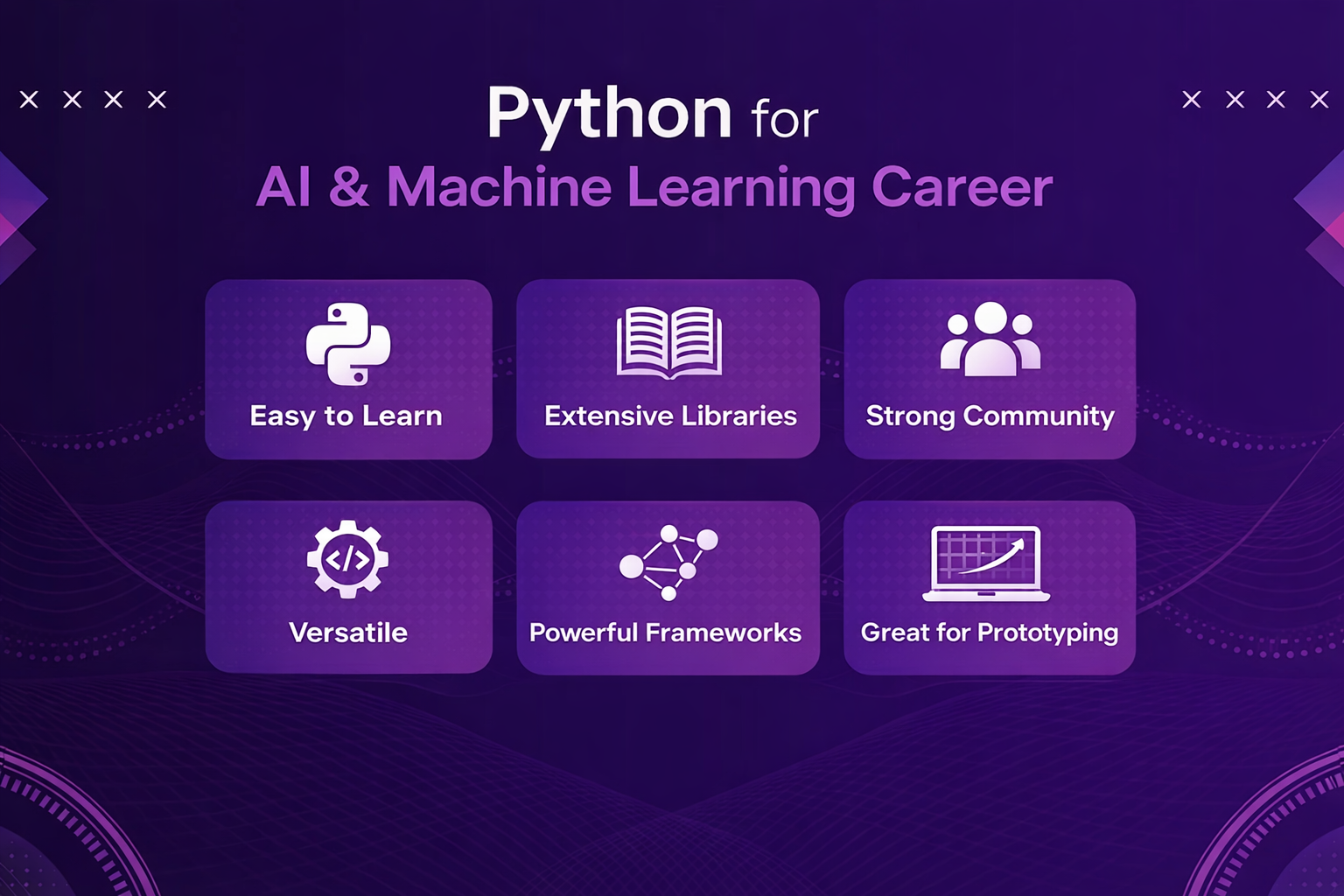
While other programming languages exist, Python is the undisputed king for AI and Machine Learning. Its simplicity, flexibility, and powerful ecosystem of libraries make it indispensable. Key libraries include TensorFlow and PyTorch for deep learning and neural networks, Scikit-learn for classical machine learning algorithms, LangChain and Hugging Face Transformers for working with Large Language Models and generative AI, and NumPy and Pandas for data manipulation and analysis.
According to hiring experts, the most in-demand skills that employers are prioritizing include hands-on programming in Python, familiarity with modern machine learning libraries such as PyTorch and TensorFlow, and the skills required for deploying and managing models in a production environment.
AI Applies Everywhere
One of the most attractive aspects of this field is its cross-domain applicability. AI is not confined to technology companies. It is revolutionizing finance through algorithmic trading, fraud detection, and risk assessment. It is transforming healthcare with predictive diagnostics, personalized medicine, and medical imaging. It is reshaping retail with recommendation engines, inventory optimization, and customer segmentation. It is optimizing manufacturing with predictive maintenance, quality control, and supply chain management. It is enhancing marketing with customer behavior analysis, content personalization, and ad targeting.
As a Python for AI and Machine Learning professional, you are not limited to one industry. You can work in a bank, a hospital, a retail giant, or a cutting-edge AI startup.
Remote Work and Global Opportunities
By 2026, the remote work revolution is well-established. The freelance and remote market for AI engineers is stronger than ever. You can secure projects and full-time positions from companies based in Bangalore, Mumbai, the United States, or Europe, all while sitting comfortably in Mohali. This opens up salary potential that was previously only achievable by migrating to metro cities.
Stellar Salary Potential
AI engineering is consistently ranked as one of the top high-income skills in India. According to industry data, the average salary for a Machine Learning Engineer with Python skills in India is approximately ten to twelve lakhs per annum, with experienced professionals earning significantly more. Entry-level positions start around five to six lakhs, while senior AI engineers and specialists can command salaries ranging from twenty-two lakhs to over sixty lakhs per annum.
Career Opportunities: What Can You Become?
One of the most exciting aspects of entering the Python for AI and Machine Learning field is the variety of high-paying roles available. As you progress through your training at Techcadd Mohali, you will be prepared to target multiple career paths.
Here are the top roles you can aim for in 2026.
AI Engineer / Machine Learning Engineer
This role involves designing and implementing AI models and machine learning systems. AI Engineers work on developing algorithms that can learn from data and make predictions or decisions. They are responsible for building, training, and deploying models that power intelligent applications. The average salary ranges from ten to twenty-five lakhs per annum.
GenAI Engineer
Generative AI is the hottest area in technology right now. GenAI Engineers build applications using Large Language Models and generative AI techniques. They work with models like GPT and create applications for content generation, chatbots, code assistance, and more. This role commands salaries ranging from eighteen to thirty-five lakhs per annum.
Data Scientist
Data Scientists analyze complex data, build predictive models, and generate insights that drive business decisions. They work with large datasets, apply statistical techniques, and communicate findings to stakeholders. The average salary ranges from ten to twenty-two lakhs per annum.
MLOps Engineer
MLOps Engineers focus on deploying, monitoring, and managing machine learning models in production. They bridge the gap between data science and operations, ensuring that models run reliably and efficiently at scale. This role is critical for organizations that have moved beyond experimentation and need to operationalize AI. Salaries range from fifteen to thirty lakhs per annum.
AI Research Scientist
AI Research Scientists work at the cutting edge, designing new models and algorithms to advance the field of artificial intelligence. They often work on problems that have not been solved before, publishing papers and pushing the boundaries of what AI can do. This role commands salaries ranging from twenty to forty lakhs per annum.
Computer Vision Engineer
Computer Vision Engineers build systems that can interpret and understand visual information from images and videos. They work on applications like facial recognition, object detection, autonomous vehicles, and medical image analysis. Salaries range from twelve to twenty-eight lakhs per annum.
NLP Engineer
Natural Language Processing Engineers develop systems that can understand and generate human language. They work on applications like chatbots, sentiment analysis, machine translation, and voice assistants. Salaries range from twelve to twenty-eight lakhs per annum.
Other exciting roles in the ecosystem include AI Consultant, who helps organizations plan and implement AI initiatives aligned with business goals, and Prompt Engineer, who designs effective prompts for large language models.
The Skills You Need to Master
To capture these opportunities and build a successful career, you need more than just basic Python knowledge. You need a structured, comprehensive, and job-oriented skillset. At Techcadd Mohali, our curriculum is designed to build you from the ground up into a confident, industry-ready professional.
Here is the step-by-step roadmap to becoming an AI and Machine Learning professional.
Phase 1: The Foundation
Every skyscraper needs a strong foundation. Your AI career begins here.
You must master core Python, including data structures like lists, tuples, and dictionaries, object-oriented programming concepts, and exception handling. This is the language you will use every single day.
AI and Machine Learning are built on mathematics. You need to understand linear algebra, including vectors and matrices. You need calculus, specifically derivatives and gradients. You need probability theory and statistics, including descriptive statistics and hypothesis testing. Mastering these mathematical foundations is crucial for long-term success because they outlast any specific tool or library.
Data lives in databases. You must learn to extract, filter, and aggregate data using Structured Query Language. SQL is a non-negotiable skill for any AI professional.
Phase 2: Core Data Science Skills
With the foundation laid, you move to the tools of the trade.
You will master Pandas and NumPy, the essential Python libraries for cleaning, transforming, and analyzing data. Real-world data is messy, and these tools help you make sense of it.
Insights are useless if you cannot communicate them. You will learn to tell stories with data using Matplotlib and Seaborn for Python-based visualizations.
Data cleaning and preprocessing is the grunt work that occupies a huge portion of an AI engineer's time. You will learn to handle missing values, identify and treat outliers, normalize data, and perform feature engineering.
Phase 3: Machine Learning Fundamentals
This is where you move from analysis to prediction.
You will dive into supervised learning techniques like linear and logistic regression, and classification algorithms like decision trees, random forests, and support vector machines. You will learn unsupervised learning techniques like K-means and hierarchical clustering. You will understand how to evaluate model performance using Scikit-learn.
Understanding metrics like accuracy, precision, recall, F1-score, and ROC curves is essential for building reliable models. You will also learn hyperparameter tuning to optimize model performance.
Phase 4: Advanced AI and Deep Learning
This is where you enter the cutting edge.
You will work with neural networks, understanding architectures like CNNs for computer vision and RNNs or LSTMs for sequence data. You will use frameworks like TensorFlow and PyTorch.
You will learn to work with text data, covering topics like tokenization, word embeddings, sentiment analysis, and named entity recognition for Natural Language Processing.
You will build systems that can interpret images, covering topics like image classification, object detection, and image segmentation for Computer Vision.
The hottest area in AI right now is Generative AI and Large Language Models. You will learn to work with models like GPT, use frameworks like LangChain for building applications with LLMs, and understand concepts like retrieval-augmented generation and prompt engineering.
Phase 5: MLOps and Deployment
A model sitting on your laptop is useless. It needs to be deployed to production where it can create value.
You will learn to put your models into production using cloud platforms like AWS with SageMaker, Azure, or Google Cloud. You will understand tools like Docker for containerization and Kubernetes for orchestration. You will learn about CI/CD for machine learning, building pipelines for continuous integration and deployment of ML models.
Phase 6: Portfolio Building
Learning is complete only when you can show what you have built.
Your GitHub profile is your new resume. You will build three to five real-world projects that demonstrate your skills to potential employers. These projects are what will get you hired. Ideas include AI chatbots with RAG, image generation apps, predictive analytics dashboards, and voice assistants.
Why Techcadd Mohali is Your Ideal Launchpad
You now understand the what and the why of a Python for AI and Machine Learning career. The final, critical question is where to get trained. Choosing the right institute is the most important decision in your journey. Here is why Techcadd Mohali stands out as the best choice in the region.
Industry-Relevant and Updated Curriculum
The tech world changes fast. Our courses are not static brochures printed years ago. They are updated every quarter to match the 2026 industry standards. We cover everything from core Python fundamentals to advanced deep learning, generative AI, and MLOps. You learn exactly what companies are hiring for right now.
Expert Faculty with Real-World Experience
At Techcadd Mohali, you learn from professionals, not freshers. Our trainers have worked in multinational corporations and faced real business challenges. They do not just teach theory from a textbook. They mentor you on how to think like an AI engineer, how to approach problems logically, and how to navigate the realities of a corporate job. They bring real-world scenarios into the classroom and share insights that you cannot get from books.
Hands-On, Project-Based Learning
We firmly believe that you learn to code by coding. Our approach is heavily project-based. You will work on multiple live projects throughout the course, building a strong portfolio that speaks louder than any certificate. From data preprocessing to model deployment, you get your hands dirty at every stage.
Comprehensive Placement Support
Our commitment to you does not end when the course ends. We provide comprehensive placement assistance. This includes resume building workshops that teach you to present your skills effectively. It includes rigorous mock interview sessions that prepare you for the pressure of real technical interviews. It includes soft skills training to make you a well-rounded candidate. Our dedicated placement cell maintains strong relationships with the tech industry in Mohali, Chandigarh, and beyond, actively working to connect you with relevant opportunities.
State-of-the-Art Infrastructure
We provide a premium learning environment with modern computer labs, high-speed internet, and all necessary software and libraries pre-installed. Our small batch sizes ensure every student receives individual attention from instructors.
A Trusted Name in Punjab
Techcadd has established itself as a leading and fastest-growing IT training institute in Punjab. Our mission is simple: to bridge the gap between academic learning and the practical requirements of the industry. We are a trusted name among students and parents alike, built on a foundation of quality education and genuine care for student success.
Your 12-Month Transition Plan
Switching to an AI and Machine Learning career is a journey, not a sprint. It requires dedication and a structured approach. Here is a realistic timeline to guide your expectations and efforts.
In months one to three, focus on the foundation. Master Python fundamentals, mathematics including linear algebra, calculus, and probability, and statistics. Start building very small, simple programs to apply what you learn.
In months four to six, move to core skills. Dive deep into data manipulation with Pandas and NumPy. Learn data visualization. Start with classical machine learning algorithms using Scikit-learn.
In months seven to nine, explore advanced AI. Learn deep learning with TensorFlow and PyTorch. Explore NLP and computer vision concepts. Start working with LLMs and generative AI.
In months ten to twelve, focus on deployment and portfolio. Learn MLOps and model deployment on cloud platforms. Build two to three substantial projects for your portfolio. Polish your GitHub profile. Network actively on LinkedIn. Attend mock interviews. Start applying for jobs with confidence.
At Techcadd Mohali, our courses are structured to fit this timeline, and our mentors guide you every step of the way, ensuring you never feel lost or overwhelmed.
Conclusion: Your Future Starts Today
The AI revolution is not coming. It is already here. According to experts, AI engineers will soon be as indispensable as executives and managers are now. The job market in India for 2026 is set for robust demand for AI and Machine Learning professionals. The skills gap is real, and companies are desperate for trained, job-ready talent.
The question is not whether you should enter this field. The questions are when you will start and where you will get the right training.
Delaying your decision means delaying your career growth and letting opportunities pass you by. Every month you wait is a month where someone else grabs the job you could have had.
Techcadd Mohali invites you to take that first, decisive step. Do not let this wave pass you by. Equip yourself with the most in-demand skills of the decade and build a career that is secure, intellectually stimulating, and financially rewarding.


Comments
No comments yet. Be the first to comment.
Leave a Comment