DRAG
Techcadd

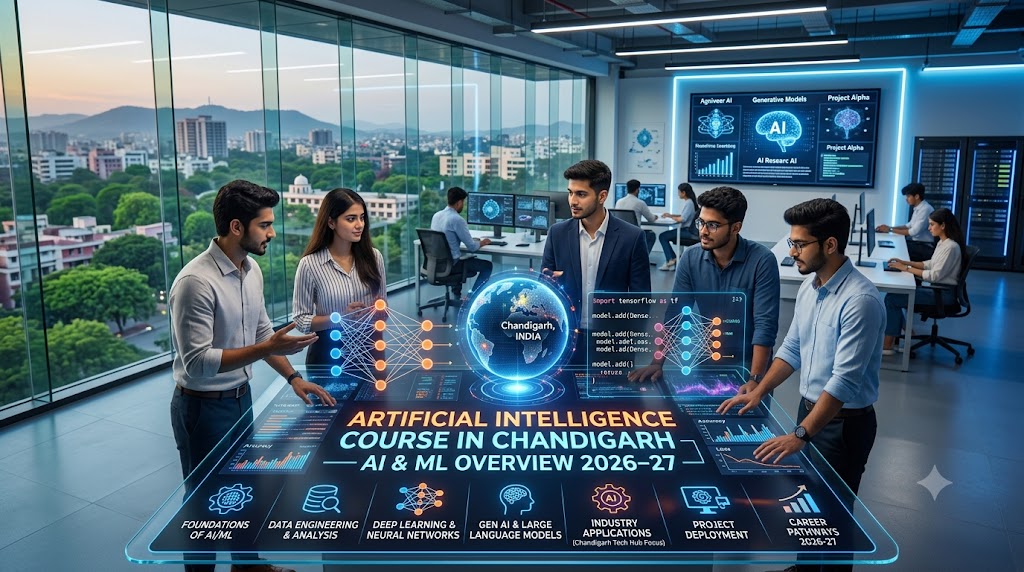
Artificial Intelligence Course in Chandigarh — AI & ML Overview 2026–27

Build job-ready Artificial Intelligence and Machine Learning skills with our 2026–27 course in Chandigarh. Learn Python, ML, Deep Learning, NLP, Computer Vision, Generative AI, LLMs, and RAG through hands-on projects and…

Industry-Ready Curriculum
Expert Mentors
100% Placement Support
  • Home
  • Courses
  • Artificial Intelligence Course in Chandigarh — AI & ML Overview 2026–27
13+
Years of Experience
10K+
Students Trained
4.8
14 Student Reviews
95%
Placement Rate
Artificial Intelligence Course in Chandigarh — AI & ML Overview 2026–27

Build job-ready Artificial Intelligence and Machine Learning skills with our 2026–27 course in Chandigarh. Learn Python, ML, Deep Learning, NLP, Computer Vision, Generative AI, LLMs, and RAG through hands-on projects and practical applications.

Artificial Intelligence Course in Chandigarh — AI & ML Overview 2026–27

Artificial Intelligence is rapidly transforming the way businesses operate across software development, healthcare, finance, education, retail, manufacturing, cybersecurity, logistics, e-commerce, and many other industries. As organizations increasingly adopt automation, predictive analytics, intelligent applications, and Generative AI, the demand for professionals with practical Artificial Intelligence and Machine Learning skills continues to grow.

Our Artificial Intelligence Course in Chandigarh is designed for students, graduates, working professionals, developers, data analysts, and career switchers who want to build practical skills in AI and Machine Learning. The course combines programming fundamentals, data analysis, Machine Learning, Deep Learning, Natural Language Processing, Computer Vision, Generative AI, Large Language Models, and AI application development.

The 2026–27 curriculum follows the complete AI development journey — starting with Python programming and data preparation and progressing toward advanced Machine Learning, Deep Learning, Transformers, LLM applications, Retrieval-Augmented Generation, deployment, and industry-oriented projects.

Learners work with widely used technologies such as Python, NumPy, Pandas, Scikit-learn, TensorFlow, Keras, PyTorch, OpenCV, NLTK, spaCy, Transformers, LangChain, Streamlit, Flask, FastAPI, Git, GitHub, and Docker.

What You Will Learn

Module 1: Python for Artificial Intelligence

Build a strong programming foundation with Python, one of the most widely used programming languages for Artificial Intelligence and Machine Learning. Learn variables, data types, operators, conditional statements, loops, functions, modules, packages, file handling, exception handling, and object-oriented programming.

The module also introduces virtual environments, package management, debugging, and writing reusable Python code. Learners work with NumPy for numerical computing and Pandas for data manipulation, preparing them for practical Machine Learning workflows.

Module 2: Data Analysis & Visualization

Learn how to work with real-world datasets and convert raw information into useful insights. Topics include data collection, data cleaning, missing-value handling, duplicate removal, data transformation, outlier detection, and exploratory data analysis.

Learners practice using Pandas, NumPy, Matplotlib, Seaborn, and Plotly to analyze and visualize datasets. The module focuses on understanding distributions, relationships between variables, correlation, patterns, trends, and data quality before applying Machine Learning algorithms.

Module 3: Statistics & Mathematics for AI

Develop an understanding of the mathematical and statistical concepts required to work effectively with AI models. Topics include probability, mean, median, mode, variance, standard deviation, distributions, correlation, covariance, and basic statistical concepts.

The mathematics component covers vectors, matrices, linear algebra, functions, derivatives, and optimization fundamentals. Instead of focusing only on theoretical formulas, learners understand how these concepts support model training, feature representation, optimization, and performance evaluation.

Module 4: Machine Learning Fundamentals

Learn the core principles of Machine Learning and understand how algorithms learn patterns from data. The module introduces supervised and unsupervised learning along with practical model-building workflows.

Learners work with algorithms including Linear Regression, Logistic Regression, Decision Trees, Random Forest, Support Vector Machines, K-Nearest Neighbors, K-Means, PCA, and ensemble techniques.

The learning process includes data splitting, training, prediction, evaluation, feature preparation, and interpretation of results. Practical datasets are used to understand classification, regression, clustering, and dimensionality reduction.

Module 5: Advanced Machine Learning

Move beyond basic algorithms and learn techniques used to improve Machine Learning model performance. Topics include feature engineering, feature selection, cross-validation, hyperparameter tuning, model pipelines, ensemble learning, boosting methods, and advanced evaluation techniques.

Learners also explore techniques for handling imbalanced datasets, preventing overfitting, improving generalization, and selecting suitable evaluation metrics. Scikit-learn is used extensively to build organized and reusable Machine Learning workflows.

Module 6: Deep Learning

Explore neural networks and understand how modern AI systems learn complex patterns from large datasets. Learn about neurons, layers, activation functions, loss functions, optimizers, forward propagation, backpropagation, epochs, batches, and model training.

The module introduces regularization techniques and practical approaches for improving neural network performance. Learners build Deep Learning models using TensorFlow, Keras, and PyTorch and understand how neural networks can be applied to image, text, and predictive AI problems.

Module 7: Computer Vision

Learn how Artificial Intelligence can be used to understand and process images and visual information. The Computer Vision module introduces image loading, resizing, normalization, filtering, image transformations, preprocessing, and feature extraction.

Learners build applications involving image classification, object detection, image processing, and face-related applications. Modern approaches such as YOLO-based object detection and deep learning architectures are introduced to demonstrate how AI systems can identify and analyze objects in images and video.

Module 8: Natural Language Processing

Learn how Artificial Intelligence systems process and understand human language. The NLP module covers text preprocessing, tokenization, stop-word handling, stemming, lemmatization, TF-IDF, text classification, word embeddings, and sentiment analysis.

Learners use tools such as NLTK and spaCy to work with text data and build practical NLP applications. Sequence-based approaches and transformer-based NLP models are also introduced to provide a foundation for modern language applications.

Module 9: Transformers, LLMs & Generative AI

Explore the technologies powering many modern AI applications. Learn the fundamentals of attention mechanisms, self-attention, positional encoding, transformer architectures, embeddings, Large Language Models, prompt engineering, and Generative AI.

The module introduces conversational AI, text generation, embeddings, vector databases, semantic search, and Retrieval-Augmented Generation (RAG). Learners also explore how frameworks such as LangChain can be used to connect language models with documents, databases, tools, and external knowledge sources.

Practical applications may include AI assistants, document question-answering systems, knowledge-base chatbots, and intelligent search applications.

Module 10: AI Application Development

Learn how to convert Machine Learning and AI models into practical applications that users can interact with. Learners work with Streamlit, Flask, and FastAPI to create interfaces, backend services, and APIs for AI-powered applications.

The module focuses on connecting trained models with application logic, handling user input, processing predictions, integrating APIs, and creating functional AI solutions. This helps learners understand the transition from an experimental notebook to a usable software application.

Module 11: Model Deployment & MLOps

Understand how AI applications can be prepared and deployed for real-world usage. Learn the fundamentals of Git, GitHub, Docker, APIs, model serving, application deployment, environment management, and basic MLOps workflows.

Learners understand the importance of version control, reproducibility, dependency management, testing, monitoring concepts, and maintaining AI applications after deployment. The goal is to introduce the practices required to move AI projects from development environments toward production-ready applications.

Module 12: Industry Projects & Capstone

Apply your skills by developing practical AI projects based on real-world problems. Projects can cover areas such as predictive analytics, customer sentiment analysis, recommendation systems, computer vision, conversational AI, document intelligence, Generative AI, and RAG-based applications.

The capstone project combines multiple technologies learned throughout the course into an end-to-end solution. Learners can work through stages including problem definition, data collection, preprocessing, model development, evaluation, application creation, and deployment.

The objective is to help learners build portfolio-ready AI projects that demonstrate both technical knowledge and practical problem-solving ability.

Who Can Join?

The Artificial Intelligence course is suitable for:

  • B.Tech, BCA, MCA, and other technical students

  • Graduates interested in Artificial Intelligence and Machine Learning

  • Working professionals planning to move toward AI/ML roles

  • Python developers looking to enter Machine Learning

  • Data analysts interested in advanced AI technologies

  • Students interested in Generative AI and LLM applications

  • Professionals looking to develop AI-based applications

  • Career switchers interested in technology and AI careers

Prior advanced AI knowledge is not required. A basic understanding of computers and programming can be helpful, while Python fundamentals are developed as part of the curriculum.

Practical Learning Approach

The course follows a hands-on and project-oriented learning approach. Concepts are introduced through practical examples and then reinforced through coding exercises, assignments, mini-projects, and larger end-to-end applications.

Instead of learning algorithms only from theory, learners understand how to apply them to datasets and real-world problems. The training emphasizes data preparation, model selection, experimentation, evaluation, application development, and deployment.

Learners also get exposure to development tools and workflows commonly used while building AI solutions. This practical approach helps bridge the gap between academic concepts and real-world AI development.

Career Opportunities After the Course

Artificial Intelligence skills can support career opportunities across multiple technology domains. Depending on their skills, experience, and specialization, learners can explore roles such as:

  • Artificial Intelligence Engineer

  • Machine Learning Engineer

  • Data Scientist

  • Junior Data Scientist

  • AI/ML Developer

  • NLP Engineer

  • Computer Vision Developer

  • Generative AI Developer

  • LLM Application Developer

  • Python Developer

  • Data Analyst

  • AI Application Developer

The course is designed to provide a broad foundation so learners can later specialize in areas such as Machine Learning, Deep Learning, NLP, Computer Vision, or Generative AI.

Why Learn Artificial Intelligence in Chandigarh?

Chandigarh and the surrounding Tricity region, including Mohali and Panchkula, have a growing technology and startup ecosystem. Learning Artificial Intelligence in Chandigarh provides students and professionals with an opportunity to develop industry-relevant technical skills while working on practical projects.

A structured classroom or training environment can also help learners maintain consistency, interact with instructors, collaborate with peers, and receive guidance while working through technical challenges.

The focus of the course is not simply on completing a syllabus but on developing the ability to build, explain, deploy, and improve AI solutions.

Project-Based AI Training

Projects play an important role throughout the Artificial Intelligence curriculum. Learners can work on projects involving Machine Learning prediction, customer analytics, sentiment analysis, image classification, object detection, recommendation systems, AI chatbots, document-based question answering, and Generative AI.

Working on projects helps learners understand the complete development lifecycle and provides practical examples that can be discussed during interviews and included in professional portfolios.

Build a Job-Ready AI Portfolio

A strong AI portfolio should demonstrate more than certificates. It should show the ability to solve problems using data, build models, create applications, and communicate technical results.

Throughout the course, learners can develop multiple projects that demonstrate their knowledge of Python, Machine Learning, Deep Learning, NLP, Computer Vision, Generative AI, APIs, and deployment.

These projects can be documented using Git and GitHub, allowing learners to maintain organized repositories and demonstrate their development experience to potential employers.

Start Your Artificial Intelligence Journey

Artificial Intelligence is becoming an important part of modern technology, and learning AI requires a combination of programming, mathematics, Machine Learning, software development, and practical problem-solving skills.

Our Artificial Intelligence Course in Chandigarh for 2026–27 provides a structured pathway from foundational programming and data analysis to advanced AI technologies such as Deep Learning, Transformers, LLMs, Generative AI, and RAG.

Whether you are a student starting your technology career, a Python developer moving into AI, a professional upgrading your skills, or a career switcher exploring Artificial Intelligence, the course is designed to help you develop practical knowledge through coding, projects, and real-world applications.

Build your foundation, work on practical AI projects, explore modern Generative AI technologies, and develop the skills required to move toward an AI-focused career.

Why Learn Artificial Intelligence in Chandigarh?

Artificial Intelligence has become one of the most important technologies shaping modern businesses and digital products. From intelligent chatbots and recommendation systems to predictive analytics, autonomous applications, computer vision, and Generative AI, organizations are increasingly using AI to automate processes, improve decision-making, personalize customer experiences, and develop new products.

For students and professionals looking to enter this growing technology field, choosing the right learning environment is an important step. An Artificial Intelligence course in Chandigarh can provide a structured pathway for learning programming, Machine Learning, Deep Learning, Natural Language Processing, Computer Vision, Generative AI, and modern AI application development.

The AI learning approach focuses on combining theoretical understanding with practical implementation. Instead of learning individual technologies in isolation, learners can understand how different components work together to create complete AI solutions.

Practical AI & ML Curriculum

A strong Artificial Intelligence program should provide more than an introduction to Machine Learning algorithms. Learners need to understand the complete development lifecycle, from collecting and preparing data to training models, evaluating results, creating applications, and deploying solutions.

The curriculum is structured around practical Artificial Intelligence and Machine Learning concepts used in modern software and data applications. Learners progress from Python programming and data analysis toward Machine Learning, Deep Learning, NLP, Computer Vision, Generative AI, and deployment.

The foundation begins with Python because it is widely used across the AI ecosystem. Learners develop programming skills before working with libraries such as NumPy, Pandas, Matplotlib, and Scikit-learn.

As learners progress, they explore supervised and unsupervised Machine Learning, model evaluation, feature engineering, optimization, neural networks, and advanced AI concepts. This structured progression makes it easier to understand how individual concepts contribute to larger AI systems.

The curriculum also introduces modern AI technologies, helping learners understand the transition from traditional Machine Learning toward Deep Learning, Transformers, LLMs, and Generative AI.

Hands-on Coding & Projects

Artificial Intelligence is a highly practical field, and understanding concepts requires regular implementation. Reading about an algorithm is different from actually preparing a dataset, training a model, analyzing predictions, identifying errors, and improving the results.

The learning approach therefore emphasizes hands-on coding, datasets, assignments, exercises, mini-projects, and larger applications.

Learners can practice tasks such as:

  • Loading and cleaning datasets

  • Performing exploratory data analysis

  • Creating data visualizations

  • Preparing features for Machine Learning

  • Training classification and regression models

  • Evaluating model performance

  • Building neural networks

  • Processing text and images

  • Creating AI-powered applications

  • Developing APIs for AI models

  • Connecting applications with Generative AI models

  • Deploying projects for practical use

Project-based learning helps learners develop problem-solving abilities rather than simply memorizing algorithms. It also provides opportunities to understand common development challenges such as missing data, model overfitting, poor predictions, incorrect feature selection, dependency issues, and deployment problems.

Modern AI Technologies

The AI industry is continuously evolving, making it important for learners to understand both foundational and modern technologies.

The 2026–27 Artificial Intelligence learning path includes technologies such as Transformers, Large Language Models, embeddings, vector databases, Retrieval-Augmented Generation, LangChain, Generative AI, and conversational AI.

Learners can understand how attention mechanisms and Transformer architectures have changed Natural Language Processing and enabled modern language models.

The Generative AI component introduces concepts such as prompt engineering, embeddings, semantic search, document processing, LLM applications, and RAG systems.

Retrieval-Augmented Generation is particularly useful for building applications that need to answer questions using specific documents or organizational knowledge. Learners can understand how documents can be processed, converted into embeddings, stored in vector databases, retrieved based on user queries, and provided to a language model for generating context-aware responses.

Frameworks such as LangChain can also be introduced to help learners understand how different AI components can be connected into practical workflows.

This combination of foundational Machine Learning and modern Generative AI gives learners exposure to both established and emerging areas of Artificial Intelligence.

Real-World Problem Solving

Learning Artificial Intelligence becomes more meaningful when concepts are connected to practical problems.

AI technologies can be applied across healthcare, finance, education, retail, cybersecurity, manufacturing, marketing, logistics, e-commerce, and software development. A project-oriented learning environment allows learners to understand how AI techniques can be selected according to the problem being solved.

Projects may include applications such as:

  • Customer prediction systems

  • Sentiment analysis applications

  • Recommendation systems

  • Document question-answering systems

  • AI chatbots

  • Image classification

  • Object detection

  • Predictive analytics

  • Customer segmentation

  • Text classification

  • Generative AI assistants

  • RAG-based knowledge systems

For example, a sentiment analysis project can introduce NLP preprocessing, feature extraction, classification, model evaluation, and application development. Similarly, an object detection project can demonstrate image preprocessing, deep learning, model inference, and computer vision deployment.

These projects help learners understand the connection between technical concepts and real-world business requirements.

Portfolio Development

A professional AI portfolio can be valuable when applying for internships, entry-level positions, freelance opportunities, and AI-focused roles.

Rather than depending only on certificates, learners can demonstrate their skills through practical projects. A well-documented project can show the complete development process, including the problem statement, dataset, preprocessing approach, model selection, evaluation results, application interface, and deployment.

Learners can maintain their projects using Git and GitHub, creating an accessible record of their technical work.

A portfolio may include projects from multiple AI domains, such as Machine Learning prediction, NLP, Computer Vision, Deep Learning, Generative AI, and RAG.

This variety can help demonstrate the ability to work with different types of data and technologies.

Portfolio development also encourages learners to understand how to explain their projects. Being able to describe why a particular model was selected, what challenges were encountered, how performance was measured, and how the application was deployed can be useful during technical interviews.

AI Application Development

Modern AI professionals increasingly need to understand more than model training. AI models often need to be integrated into applications that users can interact with.

The course therefore introduces AI application development using technologies such as Streamlit, Flask, and FastAPI.

Streamlit can be used to create interactive interfaces for Machine Learning and Generative AI projects. Flask and FastAPI can be used to develop backend services and APIs that connect applications with trained models.

Learners can practice creating applications where users submit information, the backend processes the request, an AI model generates a prediction or response, and the result is returned through the application interface.

The learning path can also introduce Git, GitHub, Docker, and cloud deployment concepts to help learners understand how AI applications move from local development environments toward deployable systems.

This application-focused approach is especially useful for developers who want to combine software engineering with Artificial Intelligence.

Suitable for Beginners and Developers

Artificial Intelligence can appear complex when learners encounter advanced concepts without a strong foundation. A structured learning path can make the transition easier by introducing concepts progressively.

The course starts with programming and data-related fundamentals before moving into Machine Learning and advanced AI technologies.

Learners with basic programming knowledge can build their skills step by step, while developers who already understand Python or software development can spend more time exploring Machine Learning, Deep Learning, LLM applications, APIs, and deployment.

The learning path can therefore support different types of learners, including students, recent graduates, Python developers, data analysts, working professionals, and career switchers.

Beginners can focus on building a strong foundation, while experienced programmers can use the course to expand into AI application development and modern Generative AI technologies.

Career-Oriented Learning

Artificial Intelligence skills can open opportunities across multiple technical roles. However, developing a career in AI requires practical knowledge, programming ability, problem-solving skills, and the ability to work with real datasets and applications.

The course emphasizes technical skills that can support career paths such as:

  • Machine Learning Engineer

  • Artificial Intelligence Engineer

  • Data Scientist

  • Data Analyst

  • AI/ML Developer

  • NLP Engineer

  • Computer Vision Engineer

  • Generative AI Developer

  • LLM Application Developer

  • Python Developer

  • AI Application Developer

Career outcomes can vary depending on a learner's existing education, technical skills, experience, portfolio, and interview performance. The objective of the training is to provide a practical foundation that learners can continue developing through projects and professional experience.

Learn AI in a Technology-Focused Environment

Chandigarh, along with the surrounding Tricity region, provides opportunities for students, developers, and professionals interested in technology and software development. Learning Artificial Intelligence in Chandigarh can provide access to structured training, practical projects, peer interaction, and instructor guidance.

For learners who prefer classroom-based or locally accessible education, studying AI in Chandigarh can provide a consistent environment for developing technical skills.

The focus should remain on practical learning — understanding concepts, writing code, completing projects, solving technical problems, and learning how AI systems are developed.

Build Skills for the Future of AI

Artificial Intelligence is evolving rapidly, from traditional Machine Learning and Deep Learning to Transformers, LLMs, Generative AI, and intelligent AI agents.

This makes continuous learning important for anyone planning to build a career in the field. A strong foundation in Python, mathematics, statistics, data analysis, and Machine Learning can provide the base required to understand newer AI technologies.

Once the fundamentals are clear, learners can explore advanced areas such as Generative AI, RAG, LLM application development, computer vision, NLP, model deployment, and MLOps.

The goal is not simply to learn a collection of tools but to develop the ability to select appropriate technologies, solve problems, build applications, evaluate results, and continuously improve AI solutions.

Why Choose a Practical AI Learning Path?

A practical AI learning path brings together several important components of modern AI development:

  • Structured Python and programming fundamentals

  • Data analysis and visualization

  • Statistics and mathematics for Machine Learning

  • Supervised and unsupervised Machine Learning

  • Advanced model optimization

  • Deep Learning

  • Computer Vision

  • Natural Language Processing

  • Transformers and Large Language Models

  • Generative AI

  • Retrieval-Augmented Generation

  • AI application development

  • APIs and model integration

  • Git and GitHub

  • Docker and deployment fundamentals

  • Industry-oriented projects

  • Portfolio development

Combining these areas helps learners understand the complete journey from an initial problem statement to a working AI application.

Start Your Artificial Intelligence Journey in Chandigarh

Choosing to learn Artificial Intelligence is an investment in developing skills that can be applied across multiple technology domains. Whether your goal is to become a Machine Learning Engineer, Data Scientist, AI Developer, Generative AI Developer, or AI-focused Python developer, building strong fundamentals and practical experience is essential.

An Artificial Intelligence Course in Chandigarh for 2026–27 provides a structured opportunity to learn foundational programming and data skills while progressing toward Machine Learning, Deep Learning, NLP, Computer Vision, Transformers, LLMs, Generative AI, RAG, application development, and deployment.

With hands-on coding, practical assignments, real-world problem-solving, portfolio projects, and exposure to modern AI technologies, learners can develop a stronger understanding of how Artificial Intelligence is used beyond the classroom.

The most effective way to learn AI is to combine conceptual understanding with continuous implementation. Start with the fundamentals, build projects, experiment with different models and technologies, understand your results, and gradually move toward more advanced AI applications.

Future Scope of Artificial Intelligence & Machine Learning

Artificial Intelligence (AI) and Machine Learning (ML) are rapidly becoming important technologies across industries. Businesses are using intelligent systems to automate repetitive tasks, analyze large volumes of information, improve decision-making, predict future trends, personalize customer experiences, and develop new digital products.

The future scope of Artificial Intelligence and Machine Learning extends far beyond traditional predictive models. Modern AI now includes Deep Learning, Natural Language Processing, Computer Vision, Generative AI, Large Language Models, AI agents, recommendation systems, intelligent automation, and AI-powered software applications.

As organizations continue to adopt these technologies, professionals who understand both AI concepts and practical software development can explore opportunities across multiple technical domains.

Growing Demand for AI Skills

Artificial Intelligence and Machine Learning are being adopted across sectors such as healthcare, finance, education, manufacturing, retail, cybersecurity, e-commerce, logistics, telecommunications, and software development.

Organizations use AI for applications such as:

  • Business forecasting

  • Customer behavior prediction

  • Recommendation systems

  • Fraud detection

  • Document processing

  • Customer support automation

  • Sentiment analysis

  • Image and video analysis

  • Predictive maintenance

  • Search and information retrieval

  • Process automation

  • Generative content creation

  • Decision-support systems

The increasing use of AI means professionals need more than theoretical knowledge. Companies often require people who can understand data, build models, integrate AI systems into applications, and work with software development and deployment tools.

This creates opportunities for individuals who develop a combination of programming, data analysis, Machine Learning, AI application development, and problem-solving skills.

Machine Learning Engineer

A Machine Learning Engineer focuses on developing and implementing Machine Learning systems. Their responsibilities can include preparing data, developing models, evaluating performance, optimizing algorithms, and deploying models into applications.

Machine Learning Engineers may work with supervised learning, unsupervised learning, ensemble models, neural networks, feature engineering, model pipelines, and model-serving systems.

Typical technologies can include Python, NumPy, Pandas, Scikit-learn, TensorFlow, PyTorch, SQL, APIs, Git, Docker, and cloud platforms.

In production environments, Machine Learning Engineers also need to understand software engineering practices, testing, version control, deployment, monitoring, and model maintenance.

As organizations move from experimental AI projects toward production systems, the ability to build reliable and maintainable Machine Learning pipelines can become increasingly valuable.

Artificial Intelligence Engineer

An Artificial Intelligence Engineer develops applications that use AI technologies to solve practical problems. The role can involve Machine Learning, Deep Learning, NLP, Computer Vision, Generative AI, and intelligent automation.

AI Engineers may develop systems such as intelligent assistants, recommendation engines, document-processing applications, image recognition systems, predictive applications, and AI-powered business tools.

Modern AI Engineering increasingly involves integrating pre-trained models and APIs rather than always training models from scratch.

Professionals may work with LLM APIs, embeddings, vector databases, RAG pipelines, AI agents, prompt engineering, and application frameworks.

This makes software development skills particularly useful because AI models need to be connected to real applications, databases, APIs, and user interfaces.

Data Scientist

Data Scientists use statistics, programming, Machine Learning, and data visualization to identify patterns and generate insights from data.

Their work may include collecting datasets, cleaning data, performing exploratory analysis, developing predictive models, evaluating results, and communicating findings to business teams.

Data Scientists can work on problems such as customer churn prediction, sales forecasting, customer segmentation, fraud detection, demand prediction, risk analysis, and recommendation systems.

Strong knowledge of Python, SQL, statistics, Machine Learning, data visualization, and business problem-solving can provide a useful foundation for this career path.

As AI tools evolve, Data Scientists may increasingly combine traditional statistical modeling with automated Machine Learning, Deep Learning, Generative AI, and advanced analytics.

Generative AI & LLM Developer

One of the fastest-evolving areas of Artificial Intelligence is Generative AI.

Generative AI systems can generate text, images, code, audio, and other types of content. Large Language Models have also created new possibilities for building intelligent applications that can understand and generate human-like text.

A Generative AI or LLM Developer may work with:

  • Large Language Models

  • Prompt engineering

  • Embeddings

  • Vector databases

  • Retrieval-Augmented Generation

  • Conversational AI

  • AI agents

  • Document intelligence

  • LLM APIs

  • Model evaluation

  • AI application frameworks

Developers can build applications such as AI assistants, document question-answering systems, knowledge-base chatbots, research assistants, coding assistants, and automated content-processing systems.

Understanding the fundamentals of Machine Learning and NLP remains useful because it provides the technical background required to understand how modern AI systems process and represent information.

NLP Engineer

Natural Language Processing Engineers work on systems that enable computers to process and understand human language.

NLP applications include:

  • Sentiment analysis

  • Text classification

  • Document processing

  • Search systems

  • Text summarization

  • Question answering

  • Conversational AI

  • Named entity recognition

  • Language understanding

  • Text generation

Traditional NLP techniques such as TF-IDF and word embeddings remain useful for many applications, while modern systems increasingly use Transformer architectures and Large Language Models.

Professionals interested in NLP can therefore build skills across both traditional Machine Learning and modern transformer-based technologies.

Computer Vision Engineer

Computer Vision Engineers develop systems that enable computers to interpret images and videos.

Computer Vision is used across manufacturing, retail, healthcare, security, agriculture, automotive technology, logistics, and robotics.

Applications can include:

  • Object detection

  • Image classification

  • Face-related applications

  • Quality inspection

  • Medical image analysis

  • Retail analytics

  • Traffic monitoring

  • Video analysis

  • Industrial automation

  • Autonomous systems

Technologies such as Python, OpenCV, TensorFlow, PyTorch, and modern object detection architectures such as YOLO can be used to develop Computer Vision solutions.

As cameras and visual sensors become increasingly integrated into digital systems, Computer Vision can continue to provide opportunities for professionals with strong image-processing and Deep Learning skills.

AI in Chandigarh & Tricity

Chandigarh, Mohali, Panchkula, and the surrounding Tricity region have an established ecosystem of educational institutions, technology companies, software services, startups, and digital businesses.

AI and Machine Learning skills can be applied across software development, data analytics, automation, digital products, IT services, education technology, healthcare applications, e-commerce, and business intelligence.

For students and professionals in the region, developing practical AI skills can provide a pathway toward opportunities in local organizations as well as remote and global technology companies.

Learning Artificial Intelligence in Chandigarh can also provide access to training environments where learners can work on projects, collaborate with peers, and develop practical technical skills.

However, career opportunities ultimately depend on an individual's skills, portfolio, experience, interview performance, and the requirements of specific employers.

Freelancing & AI Solutions

Artificial Intelligence also creates opportunities outside traditional full-time employment.

Professionals with practical AI and software development skills can explore freelancing and project-based work involving custom AI solutions.

Potential freelance projects can include:

  • Predictive Machine Learning models

  • Data analytics dashboards

  • AI chatbots

  • Recommendation systems

  • Sentiment analysis

  • Document automation

  • Computer Vision applications

  • AI-powered APIs

  • RAG-based knowledge assistants

  • Generative AI applications

Freelancing requires more than technical knowledge. Professionals also need communication skills, project management, requirement analysis, documentation, testing, and the ability to understand a client's business problem.

Building a portfolio of practical projects can therefore be useful for demonstrating capabilities to potential clients.

AI Application Development

The future of AI is closely connected with software development. Training a model is only one part of creating an AI solution. Organizations also need applications that can interact with users and connect AI models with databases, APIs, business systems, and other services.

AI professionals can therefore benefit from learning technologies such as FastAPI, Flask, Streamlit, Git, GitHub, Docker, and cloud deployment platforms.

This combination of AI and software development can allow professionals to build complete applications rather than isolated Machine Learning experiments.

For example, a developer could create a RAG-based document assistant that accepts uploaded documents, processes the information, generates embeddings, retrieves relevant content, sends context to an LLM, and presents the response through a web application.

Such end-to-end projects demonstrate how different AI and software technologies work together.

Continuous Learning

Artificial Intelligence is evolving rapidly. New models, frameworks, architectures, tools, and development approaches appear regularly.

For this reason, learning AI should be viewed as a continuous process rather than something completed after a single course.

After developing strong fundamentals, professionals can specialize in areas such as:

  • Generative AI

  • Large Language Models

  • AI Agents

  • Natural Language Processing

  • Computer Vision

  • Deep Learning

  • MLOps

  • Reinforcement Learning

  • Recommendation Systems

  • AI Automation

  • Multimodal AI

  • Industry-specific AI solutions

Continuous learning can include building projects, studying technical documentation, experimenting with new frameworks, reading research papers, participating in communities, and solving practical problems.

The ability to learn new technologies can become just as important as knowledge of a specific framework.

AI and Automation

AI is also expected to play an important role in intelligent automation. Traditional automation follows predefined rules, while AI-based automation can use data, language models, computer vision, and predictive systems to handle more complex tasks.

Businesses can use AI automation for document processing, customer communication, information extraction, workflow assistance, data classification, and decision support.

Professionals who understand both automation workflows and AI technologies can explore opportunities in developing intelligent business processes.

AI in Different Industries

The future scope of AI is not limited to technology companies.

In healthcare, AI can support medical image analysis, patient-data analytics, and administrative automation.

In finance, Machine Learning can be used for fraud detection, risk analysis, forecasting, and customer analytics.

In retail and e-commerce, AI can support recommendations, demand forecasting, personalization, customer service, and inventory planning.

In manufacturing, Computer Vision and predictive analytics can assist with quality inspection and predictive maintenance.

In education, AI can support personalized learning, content generation, assessment assistance, and intelligent tutoring applications.

This cross-industry adoption means AI professionals can eventually specialize in both a technical domain and a specific industry.

Build a Long-Term AI Career

Building a long-term career in Artificial Intelligence requires more than learning individual algorithms or tools.

A strong foundation in Python, mathematics, statistics, data analysis, Machine Learning, Deep Learning, and software development can provide the fundamentals required to adapt to new technologies.

From this foundation, professionals can gradually explore specialized areas such as Generative AI, LLMs, AI agents, Computer Vision, NLP, MLOps, or industry-specific applications.

Practical project experience is equally important. Building and deploying applications helps learners understand the challenges involved in transforming an idea into a functional AI solution.

A long-term AI career can therefore be developed through a combination of:

  • Strong technical fundamentals

  • Practical project experience

  • Continuous experimentation

  • Software development skills

  • Data and analytical thinking

  • Portfolio development

  • Understanding of modern AI technologies

  • Communication and problem-solving abilities

  • Continuous learning

The Future of Artificial Intelligence & Machine Learning

The future of Artificial Intelligence is likely to involve increasingly capable models integrated into everyday software, business workflows, and digital products.

Generative AI, LLMs, AI agents, multimodal systems, intelligent automation, Computer Vision, and predictive analytics are expanding the range of problems that AI can address.

At the same time, fundamental skills such as Python programming, statistics, data preparation, Machine Learning, model evaluation, and software engineering remain important.

For students and professionals starting their AI journey, the most valuable approach is to build strong fundamentals and then continuously expand into emerging technologies.

An Artificial Intelligence and Machine Learning course in Chandigarh can provide a structured starting point for developing these skills through programming, practical assignments, projects, AI application development, and exposure to modern AI technologies.

The future scope of AI is broad, but success in this field ultimately depends on the ability to learn continuously, solve real problems, build practical systems, and adapt as the technology evolves.

4.8
14 reviews
5
11
4
3
3
0
2
0
1
0
H
Harshdeep Arora

The AI curriculum gives a clear progression from Python and Machine Learning to Deep Learning and Generative AI. The practical assignments helped me understand how models are actually implemented.

S
Simran Bedi

I liked the combination of Machine Learning and modern AI topics. The NLP, transformer, and LLM concepts made the course especially useful for understanding today's AI applications.

K
Karan Ahuja

The project-based approach made learning much easier. Building complete applications instead of only studying algorithms gave me more confidence while working on my portfolio.

R
Ritika Sethi

The course covers a wide range of AI topics, from data preparation to model deployment. I particularly enjoyed the computer vision and deep learning modules.

M
Manav Kohli

A good option for someone looking to understand the complete AI workflow. Python, ML, NLP, computer vision, and Generative AI are connected through practical examples.

N
Navya Chawla

The Generative AI section was very interesting because it introduced concepts such as embeddings, RAG, LLMs, and conversational applications. The hands-on approach was helpful.

A
Aditya Walia

The Machine Learning concepts are explained progressively, which makes the advanced topics easier to understand. The assignments also provide useful coding practice.

I
Ishita Anand

I joined to move toward an AI-focused career and found the combination of programming, data science, ML, and application development useful. The capstone project was a good learning experience.

Y
Yuvraj Gill

The course helped me understand the difference between traditional Machine Learning, Deep Learning, and Generative AI. The practical projects were the strongest part of the learning experience.

T
Tanya Bansal

The NLP and chatbot projects were particularly useful. Learning how models can be connected to applications through APIs made the overall AI development process much clearer.

R
Rohan Suri

Good coverage of AI fundamentals along with modern tools. I especially liked the model deployment section because it showed how an ML model can become an actual application.

M
Mahi Grover

The course provides a practical introduction to AI and ML without jumping immediately into advanced concepts. The gradual progression from Python to neural networks worked well for me.

D
Devansh Batra

The computer vision and deep learning projects gave me useful implementation experience. Working with real datasets made the concepts more meaningful than theory alone.

A
Aarushi Talwar

A comprehensive AI learning path covering Machine Learning, Deep Learning, NLP, Computer Vision and Generative AI. It helped me identify the areas I want to specialize in further.

Frequently Asked Questions

1 What is an Artificial Intelligence course and what will I learn?

An Artificial Intelligence course teaches how computers can learn from data, recognize patterns, understand language, and make predictions or decisions. You will learn Python, Machine Learning, Deep Learning, NLP, Computer Vision, Generative AI, and AI application development.

2 Is this AI course in Chandigarh suitable for beginners?

Yes, the learning path starts with Python and gradually introduces Machine Learning and advanced AI concepts. Basic programming knowledge is helpful, but learners can build their skills progressively through practical exercises.

3 What is the difference between Artificial Intelligence and Machine Learning?

Artificial Intelligence is the broader field of creating systems capable of performing tasks that normally require human intelligence. Machine Learning is a major part of AI where algorithms learn patterns from data to make predictions or decisions.

4 Will I learn Generative AI and Large Language Models?

Yes, the 2026–27 learning path introduces Generative AI, Large Language Models, prompt engineering, embeddings, vector databases, and Retrieval-Augmented Generation. You will also learn the fundamentals of building LLM-powered applications.

5 Does the course cover ChatGPT, LLMs, RAG and LangChain?

The modern AI section covers the concepts behind LLM applications, prompt engineering, embeddings, RAG pipelines, and conversational AI. LangChain can be used to understand how different components are connected when developing LLM-based applications.

6 What programming language is mainly used for AI and Machine Learning?

Python is the primary programming language used throughout the course because of its extensive AI and data science ecosystem. Libraries such as NumPy, Pandas, Scikit-learn, TensorFlow, PyTorch, OpenCV, and NLP frameworks are introduced during the learning journey.

7 Will I learn Deep Learning and neural networks?

Yes, the Deep Learning module covers neural networks, activation functions, loss functions, optimizers, backpropagation, regularization, and model training. You will also explore CNNs, sequence models, and transformer-based architectures.

8 What projects can I build during an AI and ML course?

Projects can include predictive analytics, sentiment analysis, recommendation systems, customer segmentation, image classification, object detection, chatbots, document question-answering systems, and Generative AI applications.

9 Will I learn how to deploy Machine Learning models?

Yes, the course introduces the process of turning trained models into usable applications. You will work with technologies such as Streamlit, Flask, FastAPI, Git, Docker, APIs, and deployment workflows.

10 What is RAG and why is it important for modern AI applications?

Retrieval-Augmented Generation combines information retrieval with a language model so an AI application can use relevant external documents when generating responses. It is commonly used for knowledge assistants, document search, and domain-specific chatbots.

11 Can a non-technical student learn Artificial Intelligence?

Yes, learners from different educational backgrounds can start with programming fundamentals and gradually move toward AI concepts. Consistent coding practice, mathematics fundamentals, and project work are important for developing strong AI skills.

12 What career roles can I target after learning AI and ML?

Depending on your skills and experience, possible career paths include AI Engineer, Machine Learning Engineer, Data Scientist, Data Analyst, NLP Engineer, Computer Vision Engineer, Generative AI Developer, and AI application developer.

13 How important are mathematics and statistics for Artificial Intelligence?

Mathematics and statistics help you understand how many Machine Learning algorithms work and how models are evaluated. The course introduces relevant concepts such as probability, statistics, vectors, matrices, correlation, and optimization in an application-oriented way.

14 How can an AI course help me build a professional portfolio?

Project work gives you opportunities to demonstrate programming, data processing, model development, evaluation, and deployment skills. Completed projects can be documented on GitHub and presented as part of your professional AI/ML portfolio.

Ready to Launch Your Career in Artificial Intelligence Course in Chandigarh — AI & ML Overview 2026–27?

Join Techcadd Mohali and learn from industry experts with hands-on projects, live training, and dedicated placement support.

Book Your Free Demo
WhatsApp
✨ Gini AI asks:

What is the difference between Web Dev & AI courses?

👋