


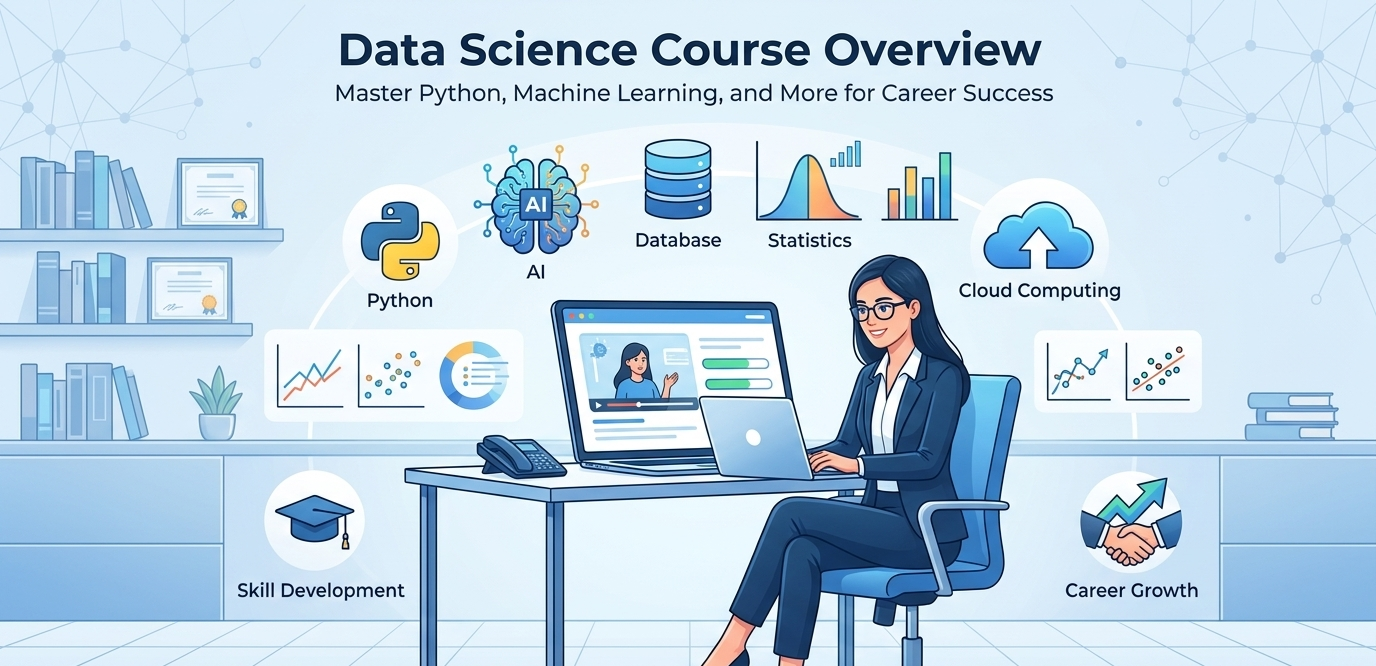
Introduction to Data Science and Its Growing Demand
In today’s digital era, data has become the backbone of every industry. From healthcare and finance to e-commerce and education, organizations rely heavily on data to make informed decisions. This is where Data Science plays a crucial role. Data Science is an interdisciplinary field that combines statistics, programming, and domain expertise to extract meaningful insights from structured and unstructured data.
With the rapid growth of digital transformation, the demand for skilled data scientists has increased significantly across the globe. Even in emerging cities like Jalandhar, the need for data science professionals is rising due to the growth of startups, IT companies, and digital businesses.
A Data Science course in Jalandhar is designed to equip students with practical skills in data analysis, machine learning, artificial intelligence, and big data technologies. These courses are tailored for beginners, working professionals, and students who want to build a career in one of the most in-demand fields.
Why Choose a Data Science Course in Jalandhar?
Jalandhar is becoming an emerging hub for technical education in Punjab. With affordable living costs and growing educational infrastructure, it is an ideal location for pursuing professional courses like Data Science.
1. Growing IT and Digital Ecosystem
Jalandhar is witnessing rapid growth in IT services, digital marketing firms, and startups. This creates a strong demand for data-driven decision-making, increasing job opportunities for data science professionals.
2. Affordable Education
Compared to metro cities, the cost of education in Jalandhar is relatively lower, making it accessible for students from different backgrounds.
3. Availability of Training Institutes
Several institutes offer Data Science training programs with hands-on projects, certifications, and placement assistance. These institutes focus on practical learning rather than just theoretical knowledge.
4. Industry-Oriented Curriculum
Most courses are designed according to industry requirements and include real-world case studies, tools, and technologies.
Key Features of the Best Data Science Course in Jalandhar
A high-quality Data Science course includes the following features:
1. Comprehensive Curriculum
The course typically covers:
-
Python programming
-
R programming
-
Statistics and probability
-
Data visualization
-
Machine learning
-
Deep learning
-
Big data technologies
Courses in Jalandhar often include modules like Python, databases, statistics, and machine learning fundamentals to build strong analytical skills .
2. Hands-On Learning Approach
Practical exposure is a key aspect of data science training. Students work on:
-
Real-world datasets
-
Case studies
-
Live projects
Many institutes emphasize project-based learning to help students understand real business problems and solutions .
3. Industry-Relevant Tools and Technologies
Students learn to use tools such as:
-
Python (NumPy, Pandas, Scikit-learn)
-
R
-
SQL
-
Tableau / Power BI
-
TensorFlow / Keras
These tools are essential for performing data analysis and building machine learning models.
4. Certification
Most institutes provide certification upon course completion. Some programs also offer globally recognized certifications, enhancing job opportunities.
5. Placement Assistance
Top institutes in Jalandhar provide:
-
Resume building sessions
-
Interview preparation
-
Job referrals
-
Internship opportunities
Some institutes even collaborate with companies to help students get placed after completing the course .
Detailed Course Curriculum
1. Introduction to Data Science
-
What is Data Science?
-
Data Science lifecycle
-
Applications in real-world industries
2. Programming for Data Science
-
Python basics
-
Data structures
-
Libraries like Pandas and NumPy
3. Statistics and Mathematics
-
Descriptive statistics
-
Probability
-
Hypothesis testing
Statistics is a core component as it helps in analyzing and interpreting data effectively .
4. Data Analysis and Visualization
-
Data cleaning
-
Exploratory Data Analysis (EDA)
-
Visualization using tools like Matplotlib and Tableau
5. Machine Learning
-
Supervised learning (Regression, Classification)
-
Unsupervised learning (Clustering)
-
Model evaluation techniques
6. Deep Learning and AI
-
Neural networks
-
Natural Language Processing (NLP)
-
Computer vision
7. Big Data Technologies
-
Hadoop
-
Spark
8. Capstone Projects
Students work on real-world projects such as:
-
Sales prediction
-
Customer segmentation
-
Fraud detection
Capstone projects help students apply their knowledge practically and build a strong portfolio .
Top Data Science Training Options in Jalandhar
While choosing the best course, students can explore:
1. Private Training Institutes
These institutes offer:
-
Short-term certification programs
-
Flexible batches (online/offline)
-
Placement support
2. University Programs
Colleges in Jalandhar also offer degree programs in Data Science and Artificial Intelligence, focusing on theoretical and practical learning.
3. Online + Hybrid Programs
Many learners prefer hybrid learning models that combine online lectures with practical sessions.
Benefits of Learning Data Science
1. High Demand Career
Data science is one of the fastest-growing career fields globally. The demand for skilled professionals continues to rise.
2. Attractive Salary Packages
Data scientists are among the highest-paid professionals in the IT industry.
3. Versatile Career Options
After completing a data science course, you can work as:
-
Data Analyst
-
Data Scientist
-
Machine Learning Engineer
-
Business Analyst
Skills You Will Gain
A data science course helps you develop:
-
Analytical thinking
-
Problem-solving skills
-
Programming expertise
-
Data visualization skills
-
Machine learning knowledge
Career Opportunities After Data Science Course
Graduates can explore job roles such as:
1. Data Analyst
Analyzing data to generate insights for business decisions.
2. Data Scientist
Building predictive models and machine learning algorithms.
3. Machine Learning Engineer
Designing and deploying ML models.
4. Business Intelligence Analyst
Creating dashboards and reports for businesses.
Industries Hiring Data Science Professionals
-
Healthcare
-
Banking & Finance
-
E-commerce
-
Education
-
Marketing
-
Manufacturing
Data science is used across industries to improve efficiency and decision-making.
Future Scope of Data Science
The future of Data Science is extremely promising due to:
1. Increase in Data Generation
Data is growing exponentially, increasing the need for skilled professionals to manage and analyze it .
2. Growth of AI and Automation
AI and machine learning are transforming industries, creating more opportunities for data scientists.
3. Expansion of Digital Economy
With more businesses going digital, the demand for data-driven strategies is increasing.
How to Choose the Best Data Science Course in Jalandhar
When selecting a course, consider:
1. Course Curriculum
Ensure it covers all essential topics.
2. Trainer Experience
Learn from industry experts.
3. Practical Exposure
Choose courses with live projects.
4. Placement Support
Check if the institute provides job assistance.
5. Reviews and Reputation
Research the institute’s credibility before enrolling.
Challenges in Learning Data Science
While Data Science is rewarding, it also comes with challenges:
-
Requires strong mathematical foundation
-
Continuous learning is necessary
-
Complex algorithms can be difficult to understand
However, with proper training and dedication, these challenges can be overcome.
Who Should Enroll in a Data Science Course?
-
Students (B.Tech, BCA, B.Sc, etc.)
-
Working professionals
-
IT professionals looking to upskill
-
Entrepreneurs and business analysts
Data Science Course in Jalandhar – Complete Course Overview
Introduction to the Course
The Data Science Course in Jalandhar is a comprehensive and industry-oriented program designed to equip learners with the essential skills required to thrive in the modern data-driven world. In today’s digital landscape, data is generated at an unprecedented rate, and organizations across all industries are seeking skilled professionals who can analyze, interpret, and derive meaningful insights from this data. This course is carefully structured to bridge the gap between theoretical knowledge and practical implementation, enabling students to become job-ready data science professionals.
Whether you are a beginner with no prior programming experience or a working professional looking to upgrade your skills, this course provides a structured pathway to mastering data science concepts. The program focuses on hands-on learning, real-world applications, and industry-relevant tools that are widely used in the field of data science.
Course Objectives
The primary goal of this Data Science course is to develop a strong foundation in data analysis, machine learning, and artificial intelligence. By the end of the course, students will be able to:
-
Understand the fundamentals of data science and analytics
-
Work with structured and unstructured datasets
-
Perform data cleaning and preprocessing
-
Apply statistical techniques to analyze data
-
Build machine learning models
-
Visualize data using modern tools
-
Solve real-world business problems using data
This course ensures that learners not only gain technical skills but also develop analytical thinking and problem-solving abilities.
Why This Course is Important
In the modern business ecosystem, decisions are increasingly driven by data. Companies use data to understand customer behavior, optimize operations, and gain a competitive advantage. As a result, data science has emerged as one of the most in-demand career fields globally.
Jalandhar, being an emerging educational and business hub, offers excellent opportunities for students to pursue data science training. With the increasing adoption of digital technologies in Punjab, there is a growing demand for skilled data professionals in the region.
Who Should Enroll in This Course
This course is suitable for a wide range of learners, including:
1. Students
Students from technical and non-technical backgrounds (B.Tech, BCA, B.Sc, B.Com, etc.) can enroll in this course to build a strong career in data science.
2. Working Professionals
Professionals in IT, marketing, finance, and other domains can upskill and transition into data science roles.
3. Beginners
Individuals with no prior experience in programming can start from scratch and gradually build expertise.
4. Entrepreneurs
Business owners who want to leverage data for better decision-making can benefit from this course.
Course Duration and Learning Format
The Data Science course in Jalandhar typically ranges from 3 to 12 months, depending on the level of depth and specialization. The course is available in multiple formats:
-
Classroom training
-
Online live sessions
-
Hybrid learning
Flexible batch timings (weekday/weekend) make it convenient for students and working professionals.
Detailed Course Curriculum
The curriculum is designed to cover all essential aspects of data science, from basics to advanced topics.
Module 1: Introduction to Data Science
-
What is Data Science?
-
Data Science lifecycle
-
Applications of data science in various industries
-
Role of a data scientist
This module provides a foundational understanding of the field and its significance.
Module 2: Python Programming
Python is one of the most widely used programming languages in data science. This module covers:
-
Python basics (variables, loops, functions)
-
Data structures (lists, tuples, dictionaries)
-
File handling
-
Libraries such as NumPy and Pandas
Students learn how to write efficient code and manipulate data using Python.
Module 3: Statistics and Probability
Statistics is the backbone of data science. This module includes:
-
Descriptive statistics
-
Inferential statistics
-
Probability distributions
-
Hypothesis testing
A strong understanding of statistics helps in making accurate data-driven decisions.
Module 4: Data Cleaning and Preprocessing
Real-world data is often messy and incomplete. This module focuses on:
-
Handling missing values
-
Data transformation
-
Feature engineering
-
Data normalization
Students learn techniques to prepare data for analysis.
Module 5: Exploratory Data Analysis (EDA)
EDA is used to understand data patterns and relationships. Topics include:
-
Data visualization
-
Correlation analysis
-
Outlier detection
-
Data storytelling
Tools such as Matplotlib and Seaborn are used for visualization.
Module 6: Machine Learning
Machine learning is a core component of data science. This module covers:
Supervised Learning
-
Linear regression
-
Logistic regression
-
Decision trees
-
Random forest
Unsupervised Learning
-
Clustering (K-means)
-
Dimensionality reduction
Students learn how to build, train, and evaluate machine learning models.
Module 7: Deep Learning
Deep learning focuses on advanced neural networks. Topics include:
-
Artificial neural networks
-
Convolutional neural networks (CNN)
-
Natural language processing (NLP)
This module introduces students to AI-based applications.
Module 8: Data Visualization Tools
Visualization is essential for presenting insights. Students learn:
-
Tableau
-
Power BI
-
Dashboard creation
Module 9: Big Data Technologies
This module introduces:
-
Hadoop
-
Apache Spark
Students understand how to handle large-scale data.
Module 10: Capstone Projects
Students work on real-world projects such as:
-
Sales forecasting
-
Customer segmentation
-
Fraud detection
These projects help in building a strong portfolio.
Tools and Technologies Covered
The course provides hands-on experience with industry-standard tools:
-
Python
-
R
-
SQL
-
Tableau
-
Power BI
-
TensorFlow
-
Excel
Teaching Methodology
The course follows a practical and interactive approach:
1. Live Training Sessions
Expert trainers conduct live classes with real-time examples.
2. Hands-On Practice
Students work on assignments and projects.
3. Case Studies
Real-world scenarios are used to enhance understanding.
4. Doubt Clearing Sessions
Regular sessions are conducted to resolve queries.
Career Opportunities After Course
After completing the Data Science course, students can explore roles such as:
-
Data Analyst
-
Data Scientist
-
Machine Learning Engineer
-
Business Analyst
Placement Support
Top institutes in Jalandhar provide placement assistance, including:
-
Resume building
-
Mock interviews
-
Job referrals
Salary Expectations
Entry-level salaries for data science professionals range from ₹3 LPA to ₹8 LPA, while experienced professionals can earn significantly higher.
Future Scope of Data Science
The future of data science is extremely bright due to:
-
Growth of artificial intelligence
-
Increasing data generation
-
Demand across industries
Benefits of This Course
-
High-demand career
-
Attractive salary packages
-
Opportunities in multiple industries
-
Continuous learning and growth
The Data Science Course in Jalandhar is an excellent opportunity for individuals looking to build a successful career in a high-growth field. With a comprehensive curriculum, hands-on training, and industry exposure, this course equips students with the skills needed to excel in the data-driven world.
Whether you are a student, a working professional, or an entrepreneur, this course provides the knowledge and practical experience required to achieve your career goals. By enrolling in this course, you are taking a significant step toward a future-proof and rewarding career in Data Science.
Real-World Applications of Data Science
One of the most powerful aspects of a Data Science course is its real-world applicability. Data Science is not limited to theory—it is actively used across industries to solve complex problems and improve decision-making processes. Through this course, students gain exposure to how data science is applied in practical scenarios.
In the e-commerce industry, data science is used to analyze customer behavior, recommend products, and optimize pricing strategies. Platforms like online shopping websites rely heavily on machine learning algorithms to enhance user experience and increase sales.
In the healthcare sector, data science plays a crucial role in disease prediction, medical imaging, and patient data analysis. Hospitals and healthcare providers use data to improve diagnosis accuracy and treatment effectiveness.
In the banking and finance industry, data science is used for fraud detection, risk analysis, and investment forecasting. Financial institutions rely on predictive models to minimize risks and maximize returns.
In digital marketing, companies use data science to analyze campaign performance, customer engagement, and conversion rates. This helps businesses create targeted marketing strategies and improve ROI.
By learning these applications during the course, students understand how to translate theoretical knowledge into practical solutions, making them highly valuable in the job market.
Importance of Portfolio Development
A strong portfolio is essential for anyone aspiring to enter the data science field. This course emphasizes building a professional portfolio that showcases your skills and expertise. Throughout the program, students work on multiple projects that demonstrate their ability to handle real-world data problems.
Portfolio projects may include:
-
Predictive analysis models
-
Data visualization dashboards
-
Machine learning applications
-
Business case studies
Having a well-structured portfolio helps students stand out during job interviews and increases their chances of getting hired. Employers often look for practical experience, and a strong portfolio serves as proof of your capabilities.
Soft Skills and Professional Development
In addition to technical skills, this course also focuses on developing essential soft skills that are crucial for career growth. Data scientists not only work with data but also communicate insights to stakeholders.
Students are trained in:
-
Communication skills
-
Presentation techniques
-
Problem-solving approaches
-
Critical thinking
These skills help learners effectively present their findings and collaborate with teams in professional environments.
Continuous Learning and Upskilling
Data Science is a rapidly evolving field, and continuous learning is essential to stay relevant. This course provides a strong foundation that enables students to keep learning even after completion.
Students are encouraged to:
-
Participate in online competitions (like Kaggle)
-
Explore advanced topics such as AI and deep learning
-
Stay updated with industry trends
This mindset of continuous learning ensures long-term career growth and success.
Internship Opportunities and Industry Exposure
Many Data Science courses in Jalandhar offer internship opportunities that provide hands-on industry experience. Internships allow students to work on live projects, interact with professionals, and understand workplace dynamics.
Industry exposure helps students:
-
Gain practical knowledge
-
Build professional networks
-
Improve job readiness
This experience plays a crucial role in bridging the gap between learning and employment.
