


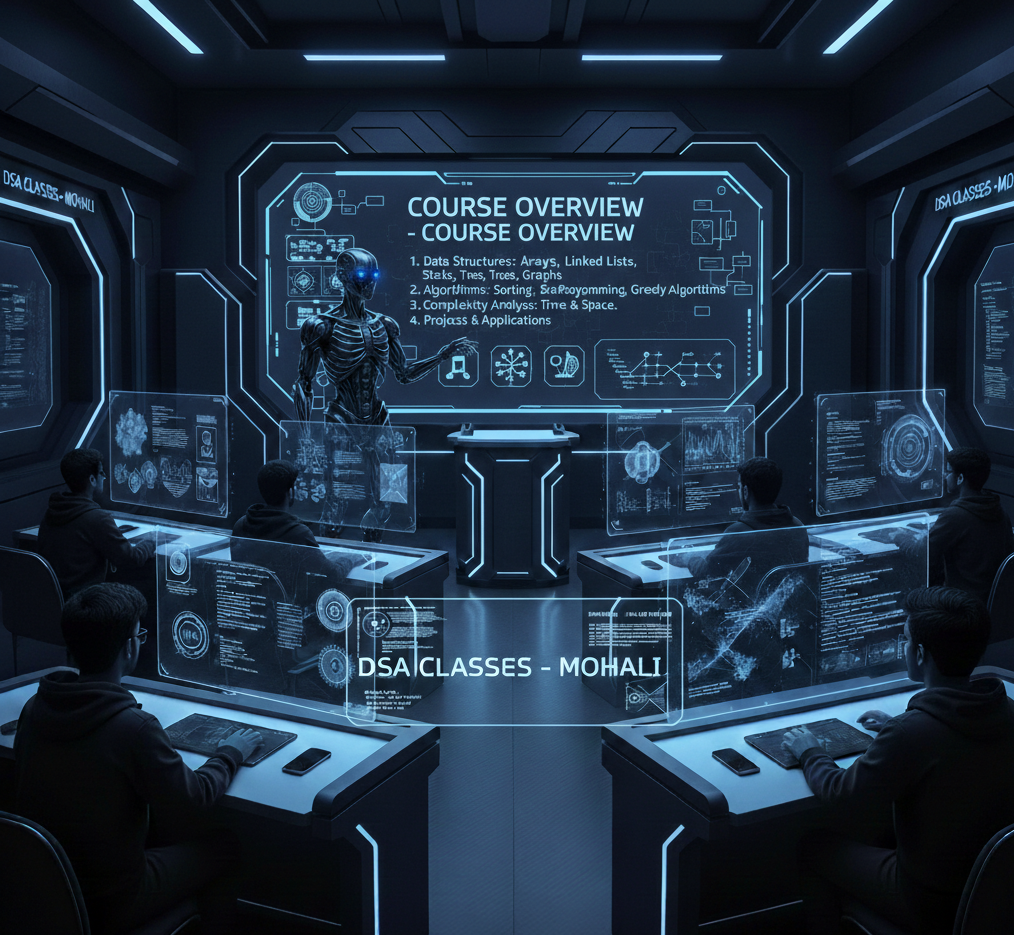
DSA Classes in Mohali – Summary
Data Structures and Algorithms (DSA) are foundational topics in computer science that focus on organizing data efficiently and solving problems optimally through well-designed algorithmic strategies. These skills are essential for software development roles, competitive programming, interviews, and graduate studies in computing. In a city like Mohali — part of the thriving Chandigarh Tricity educational and IT hub — students and professionals increasingly seek structured DSA training to build strong coding and problem-solving capabilities.
1. What Is DSA and Why It Matters
At its core, Data Structures and Algorithms helps students understand how data is stored, processed, and retrieved in computer systems.
-
Data Structures include ways to organize data — such as arrays, linked lists, stacks, queues, trees, graphs, and hash tables.
-
Algorithms are step-by-step techniques that operate on these structures — like searching, sorting, recursion, traversal, path-finding, and dynamic programming.
DSA isn’t just academic: it’s one of the most tested subjects in software interviews at major tech companies. It’s also essential for software performance optimization, as understanding time and space complexity (how fast or memory-efficient a solution is) distinguishes strong programmers from average ones.
In Mohali and nearby regions, demand is high for programs that can take students from basics to advanced problem-solving proficiency — particularly in languages like C++, Java, and Python. These courses prepare learners for campus placements, startups, competitive coding contests, government exams, or freelance technical work.
2. Core Components of DSA Courses
Most quality DSA classes — whether classroom, online, or hybrid — will cover:
a. Fundamentals of Data Structures
-
Arrays & Strings: Basics of storing and accessing collections; multidimensional arrays.
-
Linked Lists: Efficient insertion/deletion and memory structure understanding.
-
Stacks & Queues: Concepts of LIFO/FIFO behavior with real-world uses.
-
Trees & Binary Search Trees: Hierarchical data and efficient search patterns.
-
Graphs: Nodes and edges modeling real networks like social graphs and routing.
b. Algorithms and Problem Solving
-
Searching & Sorting: Linear/Binary search, Quick sort, Merge sort, Bubble sort, etc.
-
Recursion & Backtracking: Key for solving complex and branching problems.
-
Dynamic Programming: Optimization for problems with overlapping subproblems.
-
Greedy & Divide-and-Conquer: Conceptual strategies used in efficient solutions.
c. Complexity Analysis
-
Big-O notation, time vs. space trade-offs, best/worst/average case scenarios — all fundamental to evaluating algorithm performance.
These topics build analytical thinking, helping students craft solutions that work fast even with large datasets.
3. DSA Training Options in Mohali
There are several institutes and coaching centers in Mohali and the surrounding area where students can enroll for DSA training. Many offer software training, development skills, and coding practice, which often include or complement DSA modules:
Prominent Training Centers
-
Bright Career Solutions – Known for coaching that emphasizes programming fundamentals and DSA concepts with hands-on problem solving.
-
techcadd – Industrial Training – Offers industrial training potentially including algorithmic/logical problem modules useful for DSA practice.
-
Seekho Digital India Academy – Provides digital and data-focused software training that supports logical foundational skills.
-
CDAC ACSD – Part of a reputed national training network that covers software and programming education.
-
Ultimate institute of Technologies and ITM (Infotechmon pvt.ltd) – Other training hubs offering IT and coding support that can include DSA fundamentals.
These centers may not always advertise DSA explicitly; many integrate it into broader software, coding, and development programs, emphasizing practical skills and industry readiness.
4. Approaches to DSA Learning in Mohali
a. Classroom Training
In-person sessions provide routine, real-time guidance from instructors, peer discussions, and structured assessments. Institutes in Mohali may follow semester-like modules that run for weeks or months, often with small-group coding practice and regular assignments.
b. Project & Practice-Based Learning
Given the problem-solving nature of DSA, many courses incorporate daily coding exercises, mock interviews, quizzes, and platform practice (e.g., LeetCode, HackerRank). This transforms theory into application.
c. Online / Hybrid Integration
Especially post-pandemic, learners often use online resources alongside classroom sessions. This includes video lectures, interactive problem sets, and collaborative coding labs.
5. Outcomes and Career Impact
Completing DSA training equips learners to:
-
Crack technical interviews at software companies and startups.
-
Perform well in competitive programming and hackathons.
-
Write efficient, optimized code for real-world applications.
In a competitive job market, strong DSA skills significantly improve employability and open doors to roles in software engineering, QA, system design, and data-intensive computing fields.
DSA Classes in Mohali – Complete Course Overview
Introduction to the Course
Data Structures and Algorithms (DSA) form the backbone of computer science and software development. Whether someone wants to become a software engineer, crack top company interviews, excel in competitive programming, or build scalable applications, DSA is the foundation that determines technical strength.
Our DSA Classes in Mohali are designed to provide in-depth theoretical knowledge combined with intensive practical training to ensure students become confident problem solvers and industry-ready programmers.
Located in Mohali — a rapidly growing IT and education hub near Chandigarh — this course is structured to meet the needs of:
-
B.Tech / BCA / MCA students
-
Diploma students in computer science
-
Job seekers preparing for placements
-
Working professionals upgrading their coding skills
-
Competitive programming aspirants
This course focuses not just on “learning concepts” but on mastering logical thinking, optimization techniques, and structured coding practices.
Course Objectives
The primary objective of this DSA training program is to:
-
Build strong programming foundations.
-
Develop analytical and logical problem-solving skills.
-
Teach efficient data organization techniques.
-
Master algorithmic thinking and optimization.
-
Prepare students for technical interviews and coding rounds.
-
Enable students to write clean, efficient, and scalable code.
By the end of the course, students will be able to design solutions with optimized time and space complexity, analyze algorithms effectively, and confidently solve complex real-world coding problems.
Why DSA Is Important in Today’s Tech Industry
In the current technology-driven world, companies demand developers who can:
-
Handle large datasets efficiently
-
Write optimized algorithms
-
Reduce system response time
-
Improve memory utilization
-
Solve problems logically
Top product-based companies test DSA heavily during recruitment. Without a solid understanding of data structures and algorithms, cracking technical interviews becomes extremely difficult.
DSA is not just for interviews. It is used in:
-
Web development
-
Mobile applications
-
Artificial Intelligence
-
Machine Learning
-
Cybersecurity
-
Cloud computing
-
Database management
-
Game development
Thus, learning DSA is not optional—it is essential.
Course Structure
Our DSA Classes in Mohali follow a structured and progressive learning path:
Phase 1: Programming Fundamentals
Before diving into data structures, students must understand programming basics.
-
Variables and Data Types
-
Loops and Conditional Statements
-
Functions and Recursion
-
Arrays and Strings
-
Basic Input/Output
-
Memory Concepts
Languages Offered:
-
C++
-
Java
-
Python
Students can choose their preferred programming language.
Phase 2: Basic Data Structures
1. Arrays
-
1D and 2D Arrays
-
Traversal Techniques
-
Searching in Arrays
-
Sorting Techniques
-
Prefix Sum
-
Sliding Window
-
Two-Pointer Technique
2. Strings
-
String Manipulation
-
Pattern Matching
-
Anagrams
-
Palindrome Problems
-
Substring Techniques
Students practice multiple problems after each topic.
Phase 3: Intermediate Data Structures
1. Linked List
-
Singly Linked List
-
Doubly Linked List
-
Circular Linked List
-
Insertion and Deletion
-
Reverse Linked List
-
Detecting Loop
-
Merge Two Lists
2. Stack
-
Implementation using Array
-
Implementation using Linked List
-
Applications (Parenthesis Matching, Expression Evaluation)
3. Queue
-
Linear Queue
-
Circular Queue
-
Deque
-
Priority Queue
Phase 4: Advanced Data Structures
1. Trees
-
Binary Tree
-
Binary Search Tree
-
Tree Traversals (Inorder, Preorder, Postorder)
-
Level Order Traversal
-
Height and Depth
-
Lowest Common Ancestor
2. Heap
-
Min Heap
-
Max Heap
-
Heap Sort
-
Priority Queue Implementation
3. Hashing
-
Hash Functions
-
Collision Handling
-
Hash Map
-
Hash Set
4. Graph
-
Representation (Adjacency Matrix/List)
-
BFS
-
DFS
-
Shortest Path Algorithms
-
Cycle Detection
-
Topological Sort
Phase 5: Algorithms
Searching Algorithms
-
Linear Search
-
Binary Search
Sorting Algorithms
-
Bubble Sort
-
Selection Sort
-
Insertion Sort
-
Merge Sort
-
Quick Sort
Recursion & Backtracking
-
Subsets
-
Permutations
-
N-Queens
-
Sudoku Solver
Greedy Algorithms
-
Activity Selection
-
Fractional Knapsack
Dynamic Programming
-
Memoization
-
Tabulation
-
Fibonacci
-
Knapsack Problem
-
Longest Common Subsequence
Time and Space Complexity
Students will deeply understand:
-
Big O Notation
-
Worst Case Analysis
-
Best Case Analysis
-
Average Case Analysis
-
Time vs Space Trade-offs
This helps in writing optimized solutions suitable for large-scale systems.
Hands-On Practice & Coding Sessions
The course is heavily practice-oriented. Each student gets:
-
Daily coding assignments
-
Weekly tests
-
Mock interviews
-
Coding challenges
-
Live problem-solving sessions
Students solve 300+ coding problems during the course.
Interview Preparation Module
Special focus on:
-
Resume building
-
HR questions
-
Technical interview questions
-
Coding round practice
-
Whiteboard problem solving
Students learn how to explain logic clearly and efficiently.
Teaching Methodology
Our DSA classes in Mohali follow a modern teaching approach:
-
Concept Explanation
-
Visual Representation
-
Code Implementation
-
Dry Run
-
Practice Problems
-
Real-world Application
Small batch sizes ensure personal attention.
Course Duration
The duration of the course ranges between:
-
3 Months (Regular Track)
-
6 Months (Advanced Track with Placement Preparation)
Flexible batch timings:
-
Morning Batch
-
Evening Batch
-
Weekend Batch
Who Should Join This Course?
-
B.Tech Computer Science students
-
IT students preparing for placements
-
Beginners wanting strong coding skills
-
Working professionals
-
Competitive programmers
No prior advanced coding experience is required.
Real-World Applications Covered
Students understand how DSA is applied in:
-
Google Search algorithms
-
Social Media feeds
-
Navigation systems
-
E-commerce platforms
-
Banking systems
This makes learning practical and relatable.
Projects Included
Mini projects to strengthen understanding:
-
Contact Management System
-
Library Management System
-
Basic Search Engine Model
-
Path Finding Visualizer
Projects help students apply learned concepts.
Career Opportunities After Completing DSA
After completing this course, students can apply for:
-
Software Developer
-
Backend Developer
-
Frontend Developer
-
Full Stack Developer
-
System Engineer
-
Technical Analyst
Salary packages depend on skills and company type.
Benefits of Joining DSA Classes in Mohali
-
Growing IT ecosystem
-
Affordable training
-
Industry exposure
-
Placement assistance
-
Experienced trainers
Mohali’s proximity to Chandigarh IT Park creates good job opportunities.
Learning Outcomes
By the end of this course, students will:
✔ Write optimized code
✔ Analyze algorithm complexity
✔ Solve medium to hard coding problems
✔ Clear technical interviews
✔ Build confidence in programming
Placement Support
-
Interview scheduling assistance
-
Mock interview sessions
-
Industry referrals
-
Internship opportunities
Certification
Students receive a course completion certificate after:
-
Clearing final project
-
Passing evaluation test
Future Scope
After DSA, students can move towards:
-
Competitive Programming
-
System Design
-
Machine Learning
-
Artificial Intelligence
-
Cloud Computing
DSA remains useful throughout a tech career.
Advanced Learning Framework and Skill Development
In today’s competitive technical landscape, learning DSA is not only about understanding syntax or memorizing algorithms. It is about building structured thinking and developing the ability to break complex problems into manageable components. Our DSA Classes in Mohali emphasize cognitive development along with technical mastery.
Students are trained to approach every problem systematically:
-
Understand the problem statement clearly
-
Identify constraints and edge cases
-
Choose the appropriate data structure
-
Design the optimal algorithm
-
Analyze time and space complexity
-
Implement and test the solution
This structured approach makes students confident in tackling both academic and industry-level challenges.
Comprehensive Practice Ecosystem
One of the strongest aspects of this course is the dedicated practice ecosystem created for students. Learning DSA requires repetition, exposure to diverse problem types, and consistent coding practice. Therefore, the course includes:
-
Topic-wise problem sheets
-
Difficulty-based assignments (Easy, Medium, Hard)
-
Weekly coding contests
-
Peer coding sessions
-
Doubt-clearing workshops
-
Live debugging sessions
Students are encouraged to solve problems on well-known coding platforms to build confidence and familiarity with real interview environments.
Competitive Programming Preparation
For students interested in competitive coding, this course also introduces:
-
Pattern recognition techniques
-
Optimization tricks
-
Speed coding practice
-
Multi-test case handling
-
Constraint analysis
Students learn how to think under time pressure and how to write clean code quickly. Competitive programming not only strengthens DSA knowledge but also enhances analytical thinking, speed, and accuracy.
Industry-Oriented Curriculum Design
The curriculum is carefully designed based on:
-
Current hiring trends
-
Frequently asked interview questions
-
Feedback from industry experts
-
Analysis of coding rounds of top companies
Instead of outdated theoretical content, the course focuses on practical, interview-relevant topics. Students are exposed to real coding patterns commonly asked in:
-
Product-based companies
-
Service-based companies
-
Startups
-
MNCs
The syllabus evolves regularly to match modern technological demands.
Personalized Mentorship and Guidance
Every student learns at a different pace. Some grasp recursion quickly, while others need extra practice. Some struggle with graph problems, while others find dynamic programming challenging.
To address this, our DSA Classes in Mohali provide:
-
Individual doubt-clearing sessions
-
Performance tracking reports
-
Personalized feedback
-
One-on-one mentoring (in advanced batches)
-
Extra support sessions for weaker topics
Mentors monitor each student’s growth and ensure no one falls behind.
Building Problem-Solving Confidence
Many students initially feel intimidated by complex problems like dynamic programming or graph traversal. This course gradually builds confidence through:
-
Step-by-step explanation
-
Visual illustrations of data structures
-
Dry run examples
-
Multiple problem-solving approaches
-
Gradual difficulty increase
By the end of the course, students who once struggled with simple logic problems can confidently solve advanced-level algorithmic challenges.
Error Analysis and Debugging Skills
A major part of programming is debugging. Our training emphasizes:
-
Identifying logical errors
-
Handling boundary conditions
-
Testing corner cases
-
Improving code readability
-
Writing modular functions
Students learn how to think critically when their code fails and how to systematically identify mistakes.
Real-World Algorithmic Applications
Understanding how DSA works in real applications strengthens conceptual clarity. During the course, trainers explain how algorithms are used in:
-
Search engines (search ranking algorithms)
-
Navigation systems (shortest path algorithms)
-
Social media platforms (graph algorithms)
-
Banking software (hashing and secure storage)
-
E-commerce websites (sorting and filtering algorithms)
-
Gaming engines (tree and graph traversal)
This practical connection makes learning engaging and meaningful.
Soft Skills and Technical Communication
Cracking interviews requires more than writing correct code. Students must:
-
Explain logic clearly
-
Discuss time complexity
-
Justify design decisions
-
Communicate confidently
The course includes mock technical interviews where students practice explaining their solutions. This builds confidence and reduces interview anxiety.
Batch Flexibility and Learning Modes
To accommodate students and working professionals, flexible learning options are available:
-
Regular weekday batches
-
Weekend batches
-
Fast-track batches
-
Online + offline hybrid options
Students can choose according to their availability without compromising quality.
Assessment and Evaluation
Regular evaluation ensures consistent improvement. The course includes:
-
Topic completion tests
-
Mid-course assessment
-
Final evaluation exam
-
Capstone coding challenge
Performance is analyzed and shared with students to highlight strengths and areas needing improvement.
Capstone Problem-Solving Challenge
At the end of the course, students participate in a final coding challenge that integrates multiple DSA concepts. This includes:
-
Multi-concept questions
-
Optimization-based problems
-
Real-world scenario simulations
-
Time-bound coding environment
This final evaluation prepares students for real interview settings.
Internship and Placement Readiness
For students seeking job opportunities, the course includes placement preparation support such as:
-
Resume optimization
-
GitHub profile guidance
-
LinkedIn profile enhancement
-
Interview scheduling assistance
-
Company-specific preparation
Students are guided on how to showcase DSA skills effectively to recruiters.
Long-Term Career Impact
DSA knowledge provides long-term benefits throughout a software developer’s career. It helps in:
-
Writing scalable systems
-
Improving software performance
-
Designing efficient backend services
-
Reducing server costs
-
Handling large datasets
-
Preparing for senior-level technical roles
Even after years in the industry, strong DSA knowledge remains valuable.
Common Challenges Students Overcome
During the course, students typically overcome:
-
Fear of coding
-
Difficulty in recursion
-
Complexity analysis confusion
-
Graph traversal challenges
-
Dynamic programming hesitation
Through consistent practice and mentorship, these challenges become strengths.
Technology Integration
The course uses modern tools such as:
-
Online coding compilers
-
Debugging tools
-
Algorithm visualizers
-
Coding contest platforms
-
Code review systems
Technology-driven teaching improves engagement and learning speed.
Community and Networking
Students become part of a learning community where they:
-
Participate in coding groups
-
Discuss solutions
-
Compete in challenges
-
Collaborate on mini-projects
-
Share job updates
Peer learning significantly enhances growth.
Certification and Recognition
After successful completion, students receive a certification validating their proficiency in Data Structures and Algorithms. This certification can strengthen resumes and LinkedIn profiles.
Continuous Learning Path After Course Completion
Students are guided toward next steps such as:
-
Advanced System Design
-
Backend Development
-
Full Stack Development
-
Competitive Programming
-
Machine Learning
-
Cloud and DevOps
DSA serves as a stepping stone for advanced technologies.
