


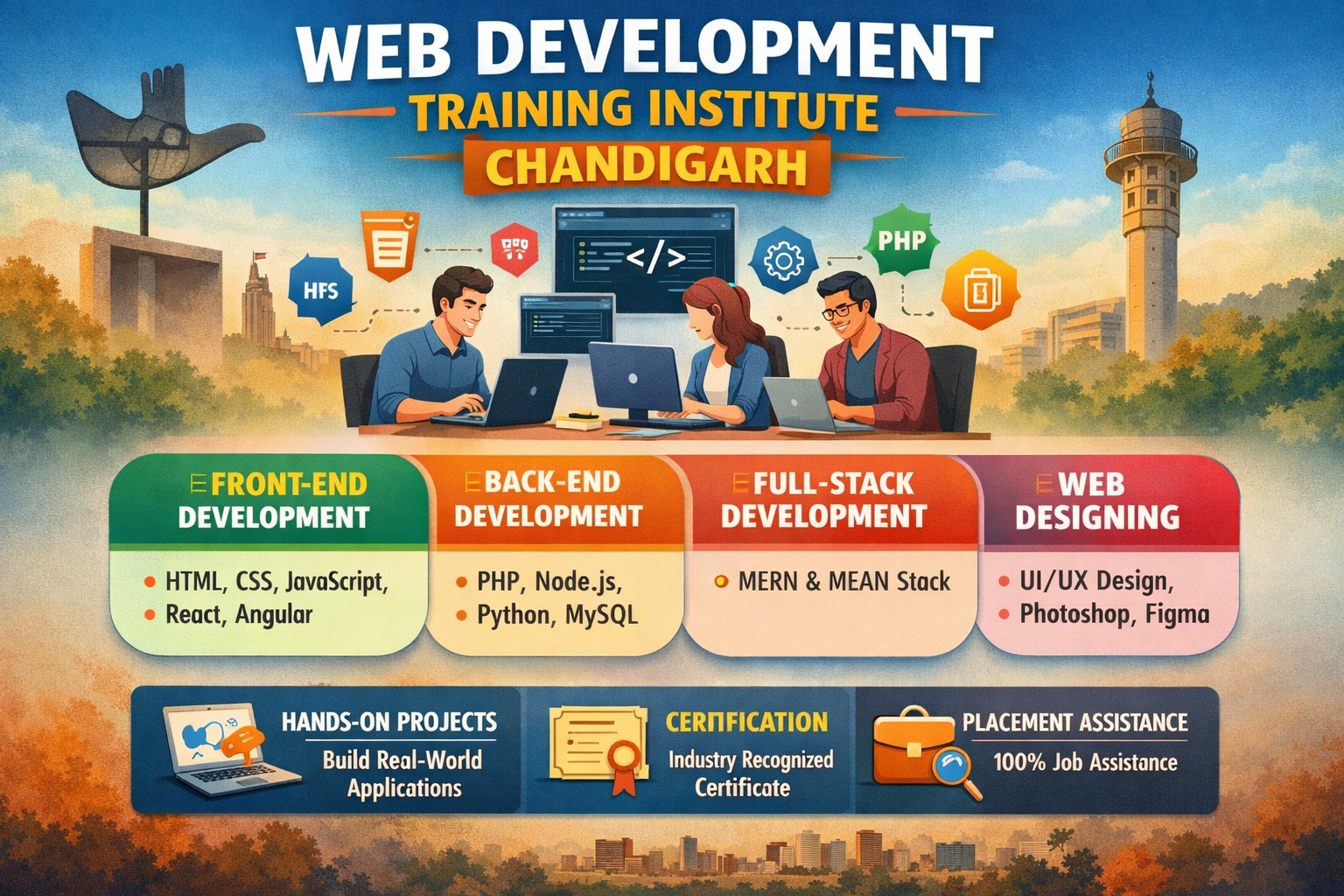
Course Overview – Web Development Training Institute in Chandigarh
Web development has become one of the most in-demand skills in today’s digital era. With businesses, startups, and organizations shifting their presence online, the need for skilled web developers is growing rapidly. A Web Development Training Institute in Chandigarh offers a comprehensive and industry-oriented course designed to equip students with the knowledge, practical skills, and confidence required to build modern, responsive, and dynamic websites and web applications.
This course is carefully structured for beginners, students, job seekers, and working professionals who want to enter the IT industry or upgrade their existing skills. Whether you have no prior coding experience or basic knowledge of programming, this course starts from the fundamentals and gradually moves toward advanced concepts, ensuring a smooth and effective learning journey.
Introduction to Web Development
The course begins with a clear understanding of what web development is and how websites function on the internet. Students learn about the structure of the web, how browsers interact with servers, and the role of different technologies used in website creation. This foundational knowledge helps learners understand the complete lifecycle of a website, from development to deployment.
The course is divided into three main segments: frontend development, backend development, and full stack development. Each segment is covered in detail to ensure that students gain a complete understanding of how web applications are built and maintained.
Frontend Development Training
Frontend development focuses on the visual and interactive part of a website that users see and interact with. In this module, students learn how to design attractive and user-friendly interfaces using modern tools and technologies.
The course starts with HTML (HyperText Markup Language), which is the backbone of any website. Students learn how to structure web pages, create headings, paragraphs, images, forms, and links. After HTML, the focus shifts to CSS (Cascading Style Sheets), where students learn how to style web pages, add colors, layouts, animations, and responsive designs.
Next, students are introduced to JavaScript, one of the most powerful programming languages for web development. JavaScript enables interactivity, allowing developers to create dynamic features such as sliders, pop-ups, form validations, and real-time updates.
The frontend module also includes modern frameworks and libraries such as Bootstrap for responsive design and React for building advanced user interfaces. Students learn how to create fast, scalable, and interactive web applications using these tools.
Backend Development Training
Backend development is responsible for the server-side logic, database management, and functionality of a website. In this module, students learn how data is processed, stored, and retrieved from servers.
The backend training begins with an introduction to server-side programming languages such as PHP. Students learn how to handle user requests, process forms, manage sessions, and create dynamic web pages.
Database management is another important part of backend development. Students learn how to work with databases like MySQL, including creating tables, inserting data, updating records, and performing queries. Understanding databases is essential for building applications such as login systems, e-commerce websites, and content management systems.
Students also gain knowledge of APIs (Application Programming Interfaces), which allow different applications to communicate with each other. This is a crucial skill for modern web development, as many applications rely on third-party services and integrations.
Full Stack Development Skills
One of the biggest advantages of this course is that it prepares students to become full stack developers. A full stack developer has knowledge of both frontend and backend technologies, making them highly valuable in the job market.
Students learn how to connect the frontend and backend, manage data flow, and build complete web applications from scratch. This includes creating login systems, dashboards, blogs, and e-commerce websites. By the end of the course, students are capable of developing fully functional websites independently.
Practical Training and Live Projects
The course emphasizes hands-on learning rather than just theoretical knowledge. Students work on multiple assignments and real-world projects throughout the training. These projects help them understand how to apply their skills in practical scenarios.
Live projects are an essential part of the course, as they simulate real industry environments. Students get experience in working on client-based projects, understanding project requirements, meeting deadlines, and collaborating with teams.
Building a strong portfolio is another key focus. Students create multiple projects that they can showcase to potential employers, increasing their chances of getting hired.
Tools and Technologies Covered
The course covers a wide range of tools and technologies that are widely used in the industry. These include:
-
HTML5 and CSS3
-
JavaScript (ES6+)
-
Bootstrap
-
React.js
-
PHP
-
MySQL
-
Git and GitHub
-
Visual Studio Code
-
APIs and JSON
Students also learn how to use version control systems like Git, which is essential for managing code and collaborating with other developers.
Responsive Design and User Experience
In today’s mobile-first world, it is important for websites to work smoothly on all devices, including smartphones, tablets, and desktops. The course includes training in responsive web design, ensuring that students can create websites that adapt to different screen sizes.
Students also learn the basics of UI/UX (User Interface and User Experience) design. This helps them understand how to create websites that are not only visually appealing but also easy to use and navigate.
Deployment and Hosting
Creating a website is only part of the process; deploying it online is equally important. In this course, students learn how to host websites on servers and make them live on the internet.
They are introduced to domain names, web hosting, and deployment platforms. Students also learn how to use GitHub for hosting projects and managing code repositories. This knowledge ensures that students can confidently launch their own websites and applications.
Career-Oriented Training
The course is designed with a strong focus on career development. Students receive guidance on resume building, interview preparation, and job placement strategies.
Mock interviews, coding tests, and soft skills training are included to help students prepare for real job interviews. Trainers also provide insights into industry trends, helping students understand what employers are looking for in candidates.
Certification
Upon successful completion of the course, students receive a certification that validates their skills and knowledge in web development. This certification adds value to their resume and increases their chances of getting hired in reputed companies.
Who Can Join This Course?
This course is suitable for a wide range of learners, including:
-
Students who want to start a career in IT
-
Graduates looking for job-oriented skills
-
Working professionals who want to switch careers
-
Entrepreneurs who want to build their own websites
-
Freelancers who want to expand their skill set
No prior coding knowledge is required, making it beginner-friendly while still being comprehensive enough for advanced learners.
Duration and Learning Format
The duration of the course typically ranges from 3 to 6 months, depending on the level and depth of training. Institutes offer flexible learning options, including classroom training, online classes, and hybrid modes.
Students get access to recorded sessions, study materials, and practice exercises, allowing them to learn at their own pace. Doubt-solving sessions and one-on-one mentoring ensure that no student is left behind.
Industry Relevance and Future Growth
The demand for web developers continues to grow as more businesses move online. From small startups to large corporations, every organization needs a strong online presence. This creates numerous job opportunities for skilled web developers.
By enrolling in a web development training institute in Chandigarh, students gain industry-relevant skills that are in high demand. The course prepares them for roles such as frontend developer, backend developer, full stack developer, web designer, and freelance developer.
Industry Projects and Internship Opportunities
An important addition to the course is the opportunity to work on industry-level projects and internships. Many web development training institutes in Chandigarh collaborate with IT companies and startups to provide students with real-time exposure. During this phase, students get a chance to work on live client requirements, understand professional workflows, and gain practical experience in handling real-world challenges. Internships help students build confidence, improve problem-solving skills, and understand how development teams function in actual work environments. This experience is highly valuable and gives students a competitive edge while applying for jobs.
Freelancing and Entrepreneurship Guidance
In addition to job-oriented training, the course also focuses on freelancing and entrepreneurship skills. Students learn how to find freelance projects, communicate with clients, manage project timelines, and deliver quality work. They are introduced to popular freelancing platforms and taught how to create strong profiles, proposals, and portfolios. For those interested in starting their own business or agency, the course provides basic guidance on handling clients, pricing projects, and scaling services. This ensures that students are not limited to job opportunities but can also explore independent career paths in web development.
Conclusion
A Web Development Training Institute in Chandigarh provides a complete learning experience for anyone looking to build a career in web development. With a well-structured curriculum, practical training, expert guidance, and career support, this course equips students with everything they need to succeed in the IT industry.
From learning basic HTML to building advanced web applications, students go through a transformative journey that prepares them for real-world challenges. The combination of technical skills, practical exposure, and career guidance makes this course an ideal choice for aspiring web developers.
Whether your goal is to get a job, start freelancing, or build your own projects, this course opens the door to endless opportunities in the ever-growing digital world.
