

Artificial Intelligence Course Eligibility: Complete Guide for Students and Professionals
Artificial Intelligence (AI) is transforming every industry, from healthcare and finance to education, manufacturing, e-commerce, and entertainment. As AI continues to create exciting career opportunities, thousands of students and professionals are looking for the best Artificial Intelligence Course Eligibility information before enrolling in a program. Understanding the Artificial Intelligence Course Eligibility helps learners choose the right training according to their educational background, technical knowledge, and career goals. Whether you are a school student, graduate, working professional, entrepreneur, or someone planning a career change, there is an AI course designed for your learning level. Today, many reputed AI Institutes offer beginner-friendly to advanced programs, making AI education accessible to everyone. This guide explains AI Course Eligibility, educational requirements, technical skills, career pathways, and frequently asked eligibility questions to help you make an informed decision.
What is Artificial Intelligence Course Eligibility?
Artificial Intelligence Course Eligibility refers to the educational qualifications, basic technical knowledge, and learning requirements needed before joining an AI training program. Unlike many traditional technical courses, modern AI programs are designed for learners from various educational backgrounds. Some beginner-level AI courses require only basic computer knowledge, while advanced certification programs may recommend programming, mathematics, or data analysis experience. The Eligibility for Artificial Intelligence Course depends largely on the course level rather than strict academic qualifications. Many institutes have introduced flexible learning paths that allow complete beginners to gradually build AI skills through structured modules covering Python, Machine Learning, Deep Learning, Generative AI, Prompt Engineering, and real-world AI applications.
Who Can Join AI Course?
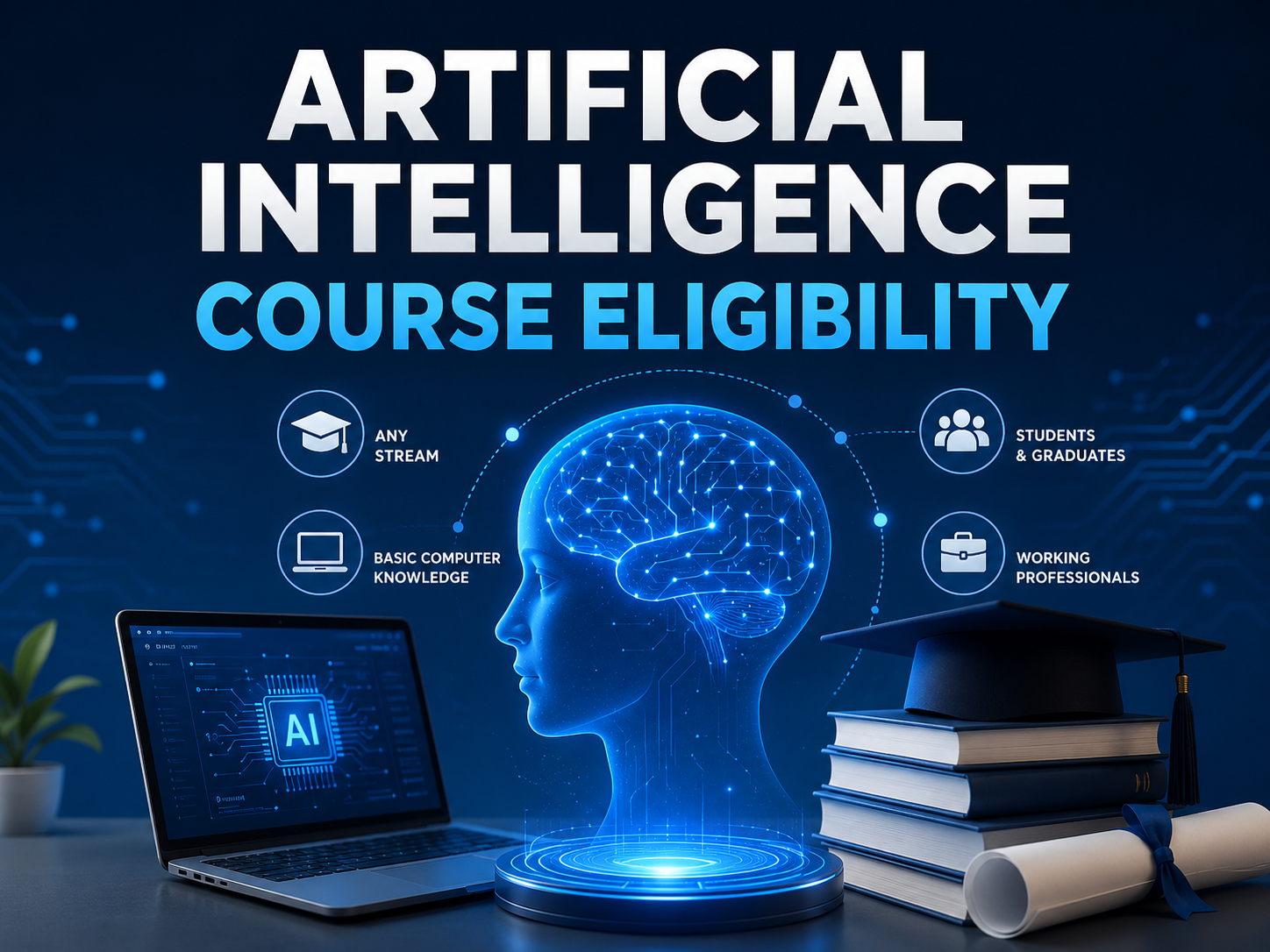
One of the biggest advantages of modern AI education is its inclusiveness. If you are wondering Who Can Join AI Course, the answer is simple—almost anyone interested in learning technology can start. School students, college students, graduates, diploma holders, software developers, engineers, digital marketers, business professionals, entrepreneurs, teachers, freelancers, and even non-technical learners can enroll in beginner AI programs. Most AI Institutes provide foundation courses that start with basic programming and gradually introduce complex AI concepts. Learners who possess curiosity, logical thinking, and willingness to practice can successfully build AI skills regardless of their previous academic discipline.
AI Course for Beginners
Many aspiring learners worry that Artificial Intelligence is only for programmers or computer science graduates. Fortunately, this is no longer true. An AI Course for Beginners is specifically designed for individuals who have little or no coding experience. These beginner-friendly courses introduce the fundamentals of Artificial Intelligence, explain machine learning concepts in simple language, teach Python programming from scratch, and gradually move toward practical AI applications. Since beginner courses focus on learning fundamentals rather than advanced research, the AI Course Eligibility usually requires only basic computer literacy and internet usage skills. With regular practice, beginners can comfortably transition into intermediate and advanced AI learning.
AI Course After 12th
Students often ask whether they can begin AI immediately after completing higher secondary education. The answer is yes. An AI Course After 12th has become one of the most popular career options for students interested in future technologies. Students from Science, Commerce, or Arts backgrounds can enroll in foundation-level AI certification programs. Although students with Mathematics may find certain concepts easier, it is not mandatory for every AI course. Many institutes first teach programming fundamentals before introducing Artificial Intelligence. Choosing an AI Course After 12th helps students build technical expertise early and prepares them for future careers in AI development, Machine Learning, Data Science, Robotics, and Automation.
AI Course After Graduation
Graduates from any stream can pursue AI education to improve career opportunities. An AI Course After Graduation is suitable for BCA, B.Tech, B.Sc, MCA, M.Tech, B.Com, MBA, BA, and many other degree holders. Technical graduates generally adapt quickly to programming-intensive modules, while non-technical graduates may begin with foundation programs before progressing to advanced topics. The Eligibility for Artificial Intelligence Course after graduation is flexible because most institutes evaluate learners based on their willingness to learn rather than their degree specialization. AI certifications after graduation can significantly enhance employability in rapidly growing technology sectors.
AI Course for Working Professionals
Professionals seeking career advancement can greatly benefit from an AI Course for Working Professionals. Employees working in IT, software development, finance, healthcare, marketing, manufacturing, HR, sales, and business management increasingly require AI knowledge to stay competitive. Working professionals usually prefer weekend, evening, or online learning schedules that fit around their jobs. The AI Training Eligibility for professionals generally requires basic computer proficiency and domain knowledge. Many AI programs emphasize practical applications, enabling professionals to automate repetitive tasks, improve business decision-making, and integrate AI into existing workflows without requiring a complete career transition.
Educational Qualification for AI Course Eligibility
The educational qualification required depends on the type of Artificial Intelligence course selected. Certificate-level AI courses usually accept learners who have completed Class 12 or equivalent education. Diploma and advanced certification programs often recommend graduation but may still admit motivated learners with practical experience. Professional AI certifications designed for software developers may expect familiarity with programming languages like Python or Java. However, many beginner-level courses intentionally remove these barriers by including foundational programming modules. Therefore, Artificial Intelligence Course Eligibility is becoming increasingly flexible as AI education expands to a broader audience.
Artificial Intelligence Course Requirements
The Artificial Intelligence Course Requirements differ between beginner, intermediate, and advanced programs. Most beginner courses require only a laptop, internet connection, basic computer knowledge, and enthusiasm for learning. Intermediate AI courses may recommend elementary programming skills, especially Python, along with basic mathematics and logical reasoning. Advanced AI certifications may require knowledge of Machine Learning, data structures, statistics, linear algebra, and data analysis. The most important requirement, however, remains consistent across all levels—a willingness to practice continuously through real-world projects and hands-on exercises.
AI Training Eligibility for Students
Students are among the largest group enrolling in AI programs today. AI Training Eligibility for students is intentionally designed to be accessible. High school students can begin with AI fundamentals, coding basics, and introductory Machine Learning. College students can directly pursue comprehensive AI certification programs aligned with their degree. Students studying Computer Science, Information Technology, Electronics, Mathematics, Data Science, or Engineering may find advanced modules easier, but learners from Commerce, Arts, and Management backgrounds can also succeed with structured learning pathways. Practical assignments and project-based learning help students develop industry-ready AI skills.
AI Certification Course Eligibility
The AI Certification Course Eligibility depends on the certification level and the organization providing the course. Entry-level certification programs generally accept learners from all educational backgrounds. Professional certification courses may recommend familiarity with Python programming, data analysis, or software development. Specialized AI certifications in Deep Learning, Computer Vision, Natural Language Processing, or Generative AI often require prior Machine Learning knowledge. Before enrolling, learners should review the curriculum carefully to ensure the certification matches their existing knowledge and future career goals.
Machine Learning Course Eligibility
Machine Learning forms the foundation of Artificial Intelligence. Therefore, understanding Machine Learning Course Eligibility is important for aspiring AI professionals. Beginner Machine Learning courses often require basic programming knowledge, especially Python, and elementary mathematics concepts like algebra and probability. Advanced Machine Learning programs may include statistics, calculus, optimization algorithms, neural networks, and predictive modeling. Students who start with introductory AI programs can gradually meet these requirements while developing confidence through practical implementation.

Comments (0)
No comments yet. Be the first to share your thoughts!