


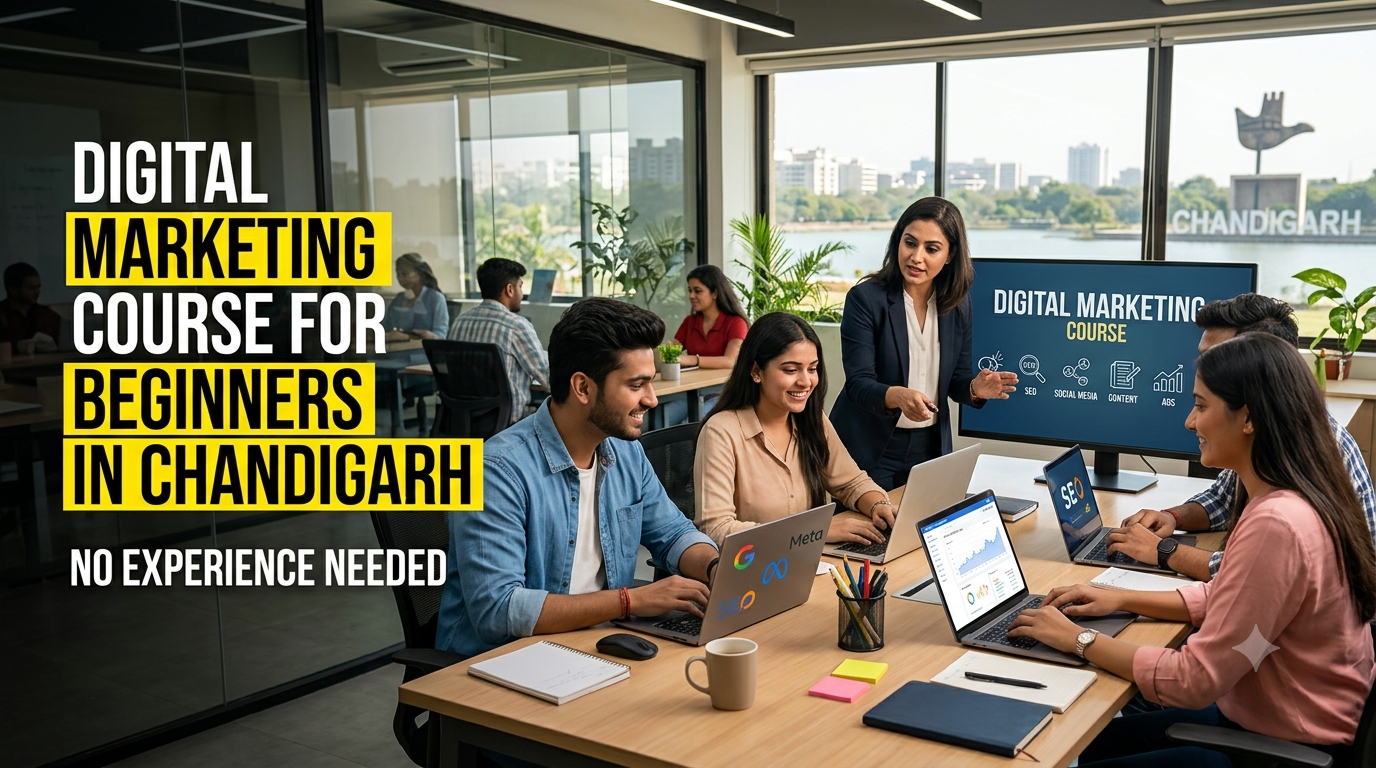
Digital Marketing Course for Beginners in Chandigarh — No Experience Needed
Digital marketing has become one of the most important skills for businesses, brands, startups, and professionals in today's internet-driven world. As more customers search for products and services online, companies need skilled professionals who can promote their businesses through search engines, social media platforms, websites, email campaigns, paid advertisements, and other digital channels. This increasing demand has created several career opportunities for students, freshers, graduates, entrepreneurs, and working professionals.
The Digital Marketing Course for Beginners in Chandigarh is designed for learners who want to start their digital marketing journey from scratch. No previous experience in digital marketing, advertising, coding, or technical subjects is required. The course follows a beginner-friendly learning approach that helps students understand fundamental concepts before moving toward advanced strategies and practical applications.
Whether you are a college student looking for a career-oriented skill, a fresher searching for your first job, a business owner wanting to promote your business online, or someone interested in freelancing, learning digital marketing can help you develop valuable and practical skills.
What Is Digital Marketing?
Digital marketing refers to promoting products, services, brands, or businesses using digital channels and internet-based platforms. Unlike traditional marketing methods such as newspapers, television, radio, and physical advertising, digital marketing allows businesses to connect with their target audience through online platforms.
Some of the major areas of digital marketing include:
-
Search Engine Optimization (SEO)
-
Search Engine Marketing (SEM)
-
Pay-Per-Click Advertising (PPC)
-
Social Media Marketing (SMM)
-
Content Marketing
-
Email Marketing
-
Affiliate Marketing
-
Influencer Marketing
-
Online Reputation Management
-
Google Analytics and performance tracking
-
Lead generation
-
Conversion optimization
A good digital marketing professional needs to understand not only individual channels but also how these channels work together to achieve business goals.
Why Choose a Beginner-Friendly Digital Marketing Course?
Many students believe that digital marketing is complicated because it involves websites, search engines, advertising platforms, analytics, and different online tools. However, beginners can learn these concepts step by step with the right training structure.
A beginner-focused course starts with fundamental concepts and gradually introduces practical techniques. Instead of assuming that students already understand SEO, Google Ads, social media algorithms, or analytics, the training explains these topics from the foundation.
The course can help beginners understand:
-
How search engines work
-
How websites receive organic traffic
-
How businesses use social media
-
How paid advertisements are created
-
How keywords are researched
-
How content attracts customers
-
How marketing campaigns are measured
-
How leads and conversions are generated
-
How digital marketing strategies are planned
This structured approach can make the learning process easier for students with no previous experience.
Digital Marketing Course in Chandigarh
Chandigarh and the surrounding Tricity region have a growing ecosystem of businesses, startups, educational institutions, service providers, e-commerce businesses, and digital agencies. These organizations increasingly use online marketing to reach customers and build their brands.
Learning digital marketing in Chandigarh can therefore be useful for students and professionals who want to develop skills relevant to the modern employment market.
A practical digital marketing course should combine theoretical understanding with hands-on activities. Students should get opportunities to work with common marketing platforms and understand how campaigns are planned, implemented, monitored, and improved.
SEO Training for Beginners
Search Engine Optimization, commonly known as SEO, is one of the most important components of digital marketing. SEO focuses on improving a website's visibility in organic search engine results.
In a beginner-level SEO module, students can learn concepts such as:
-
Keyword research
-
Search intent
-
On-page SEO
-
Off-page SEO
-
Technical SEO basics
-
Meta titles and descriptions
-
Heading optimization
-
Internal linking
-
URL optimization
-
Content optimization
-
Backlink concepts
-
Local SEO
-
SEO performance measurement
Students can practice identifying relevant keywords and creating optimized content. They can also learn how businesses use SEO to increase their visibility and attract potential customers through search engines.
Social Media Marketing
Social media platforms have become important channels for communication, branding, customer engagement, and marketing. Social Media Marketing teaches students how businesses can use social platforms to connect with their target audience.
The course may cover:
-
Social media strategy
-
Content planning
-
Audience research
-
Social media calendars
-
Organic social media marketing
-
Paid social advertising concepts
-
Engagement strategies
-
Brand awareness
-
Performance tracking
Students can learn how to create a basic social media strategy for different types of businesses and understand the importance of consistent and relevant content.
Google Ads and PPC Marketing
Paid advertising allows businesses to reach potential customers through targeted online campaigns. Pay-Per-Click marketing is an important skill for digital marketing professionals.
Beginners can learn the fundamentals of:
-
Search advertising
-
Display advertising
-
Keyword selection
-
Ad copy
-
Audience targeting
-
Campaign structure
-
Budget planning
-
Conversion tracking
-
Performance analysis
The focus should be on understanding how paid campaigns work and how marketers evaluate campaign performance rather than simply creating advertisements.
Content Marketing
Content is an important part of digital marketing because businesses use content to educate audiences, answer questions, build trust, and support conversions.
Students can learn how to create different types of content, including:
-
Blog posts
-
Website content
-
Social media posts
-
Product descriptions
-
Email content
-
Promotional content
-
Informational articles
The course can also introduce students to content planning, audience research, keyword integration, basic copywriting, and content optimization.
Email Marketing
Email marketing allows businesses to communicate directly with existing and potential customers. It can be used for newsletters, product updates, promotional campaigns, customer communication, and lead nurturing.
Beginners can learn:
-
Email marketing fundamentals
-
Subscriber lists
-
Email campaign planning
-
Subject-line basics
-
Email content
-
Call-to-action concepts
-
Campaign performance
-
Open and click-through rates
Understanding email marketing gives learners another useful skill that can be applied across different industries.
Google Analytics and Digital Marketing Analytics
Digital marketing is not only about creating campaigns. Marketers also need to understand whether their campaigns are producing results.
Analytics helps marketers evaluate website traffic, audience behavior, campaign performance, conversions, and other important metrics.
Students can be introduced to concepts such as:
-
Website traffic
-
Users and sessions
-
Traffic sources
-
Engagement
-
Conversions
-
Campaign performance
-
Key performance indicators (KPIs)
Learning analytics encourages students to make marketing decisions based on data rather than assumptions.
Practical Learning and Projects
Practical exposure is an important part of learning digital marketing. Simply studying definitions may not be enough to develop confidence. Students should get opportunities to apply their knowledge through assignments, exercises, and projects.
A practical training program may include activities such as:
-
Keyword research projects
-
SEO audits
-
Website content optimization
-
Social media planning
-
Content calendar creation
-
Basic advertising campaign exercises
-
Competitor analysis
-
Website performance analysis
-
Digital marketing strategy development
Working on practical assignments helps students understand how different concepts connect with one another.
Who Can Join This Course?
One of the biggest advantages of a beginner-level digital marketing course is that it can be suitable for learners from different educational and professional backgrounds.
The course can be useful for:
College Students
Students can learn a career-oriented skill alongside their academic studies and use their knowledge to prepare for internships and entry-level opportunities.
Freshers
Fresh graduates can develop practical marketing skills that may help them qualify for beginner-level digital marketing roles.
Working Professionals
Professionals from sales, marketing, communication, business development, or related fields can add digital marketing knowledge to their existing skill set.
Entrepreneurs and Business Owners
Business owners can understand how digital channels work and use this knowledge to improve their online presence and marketing strategies.
Freelancing Beginners
Learners interested in freelancing can develop skills in areas such as SEO, social media, content marketing, and advertising and gradually build practical experience.
Career Opportunities After Digital Marketing Training
Digital marketing includes several specialized areas, so learners can explore different career paths depending on their interests and skills.
Possible entry-level roles include:
-
Digital Marketing Executive
-
Digital Marketing Intern
-
SEO Executive
-
SEO Intern
-
Social Media Executive
-
Social Media Intern
-
PPC Executive
-
Content Marketing Executive
-
Content Writer
-
Email Marketing Executive
-
Digital Marketing Analyst
Career progression depends on practical skills, experience, specialization, performance, and continuous learning.
Benefits of Learning Digital Marketing
Learning digital marketing can provide several advantages in today's business environment.
1. Beginner-Friendly Skill
Digital marketing can be learned progressively, making it accessible to people without a technical background.
2. Multiple Career Paths
Students can specialize in SEO, PPC, social media, content, analytics, email marketing, or other areas.
3. Practical Application
The skills learned can be applied to websites, social media pages, online stores, personal brands, and business campaigns.
4. Business Opportunities
Entrepreneurs can use digital marketing knowledge to understand online customer acquisition and brand promotion.
5. Freelancing Potential
After developing sufficient skills and experience, learners may explore freelance digital marketing projects.
6. Continuous Learning
Digital marketing changes regularly, which provides opportunities to continue developing new skills and learning new tools.
Why Practical Skills Matter
Employers often look beyond certificates when evaluating candidates for digital marketing positions. Practical knowledge, communication skills, analytical thinking, creativity, and the ability to understand business objectives can be important.
For this reason, learners should focus on developing actual skills rather than only completing theoretical lessons. Creating sample projects, practicing keyword research, analyzing websites, preparing social media plans, and understanding campaign metrics can help build confidence.
How Beginners Can Succeed in Digital Marketing
Starting with no experience is not a disadvantage if you follow a structured learning process. Beginners should first understand the fundamentals and then practice each topic.
A useful learning path can be:
Step 1: Understand digital marketing fundamentals.
Step 2: Learn SEO and keyword research.
Step 3: Understand social media marketing.
Step 4: Learn content marketing and copywriting basics.
Step 5: Understand Google Ads and PPC.
Step 6: Learn analytics and performance measurement.
Step 7: Complete practical assignments and projects.
Step 8: Build a portfolio of your work.
Step 9: Apply for internships and entry-level opportunities.
Regular practice is important because digital marketing is a skill-based field.
Why Choose a Digital Marketing Course in Chandigarh?
Choosing a structured course can provide learners with a systematic learning environment. Instead of trying to learn hundreds of digital marketing concepts randomly from different sources, students can follow a planned curriculum.
A quality training program should focus on updated concepts, practical assignments, industry-relevant tools, project-based learning, and guidance from experienced trainers.
Students should also consider factors such as course curriculum, practical exposure, trainer experience, learning support, project opportunities, and career guidance before selecting a training institute.
Start Your Digital Marketing Journey Without Experience
You do not need to be an expert in technology or marketing to begin learning digital marketing. What matters most is your willingness to learn, practice, analyze results, and keep improving.
The Digital Marketing Course for Beginners in Chandigarh — No Experience Needed provides a foundation for learners who want to understand online marketing and explore career opportunities in the digital industry. From SEO and social media marketing to PPC, content marketing, email marketing, and analytics, students can gradually develop knowledge across major digital marketing channels.
With practical learning, consistent practice, and portfolio development, beginners can prepare themselves for internships, entry-level jobs, freelancing opportunities, and further specialization.
If you are a student, fresher, professional, entrepreneur, or beginner looking for a practical skill that connects creativity, technology, communication, and business, digital marketing can be a valuable area to explore. Start with the basics, practice regularly, work on real-world-style projects, and continue updating your knowledge as the digital industry evolves.


Comments (0)
No comments yet. Be the first to share your thoughts!