

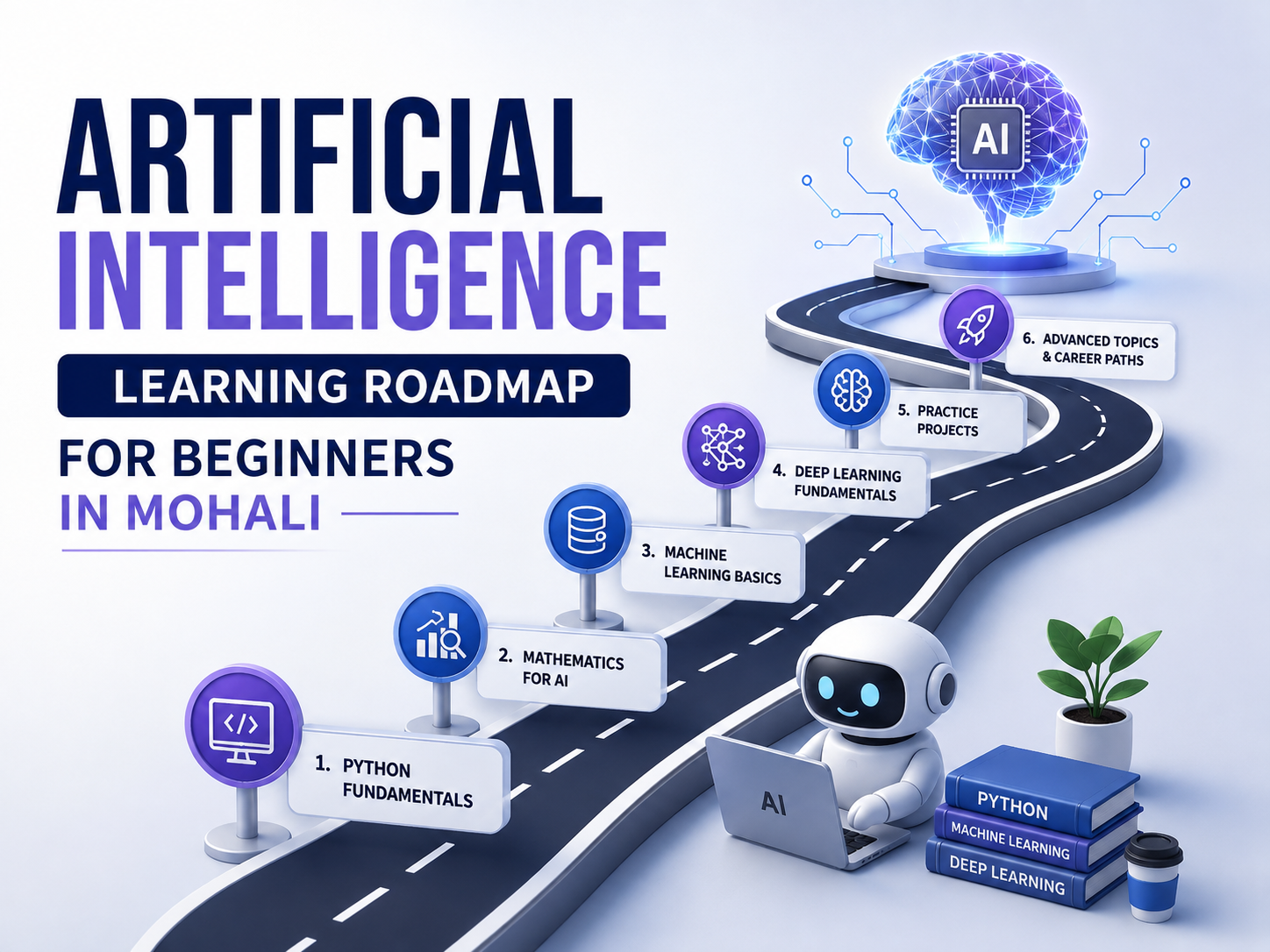
Artificial Intelligence Learning Roadmap for Beginners in Mohali
Today, AI is being used in marketing, healthcare, education, finance, software development, design, manufacturing, customer service, and almost every modern industry. For students and professionals in Mohali, learning AI can open doors to exciting career opportunities and help build practical skills for the future.
If you are completely new to Artificial Intelligence, the biggest challenge is often knowing where to start, what to learn first, which tools to practice, and how to move from basic concepts to real-world projects. A structured Artificial Intelligence Learning Roadmap for Beginners in Mohali can make this journey much easier.
This guide explains a beginner-friendly path to learning AI, from programming fundamentals to machine learning, generative AI, projects, and career preparation.
What Is Artificial Intelligence?
Artificial Intelligence refers to technologies that enable computers and software systems to perform tasks that normally require human intelligence. These tasks can include understanding language, recognizing images, identifying patterns, making predictions, generating content, and supporting decision-making.
AI is not a single technology. It includes several interconnected areas such as machine learning, deep learning, natural language processing, computer vision, generative AI, and data analysis.
For AI for beginners, it is important not to try learning everything at once. Start with the fundamentals and gradually build your knowledge.
Why Learn Artificial Intelligence in Mohali?
Mohali has developed into an important technology and education hub in Punjab. With IT companies, startups, educational institutes, and businesses adopting digital technologies, the demand for people with modern technical skills continues to increase.
Learning AI in Mohali can be especially useful for students pursuing BCA, MCA, B.Tech, engineering, computer science, data-related programs, and other technical courses. Working professionals can also learn AI to upgrade their existing skills.
An effective AI learning roadmap helps you develop knowledge step by step instead of jumping directly into advanced concepts.
Step 1: Understand AI Fundamentals
The first stage of your journey should focus on understanding what AI actually is.
Before writing complicated code, learn basic concepts such as:
- What is Artificial Intelligence?
- What is Machine Learning?
- What is Deep Learning?
- What is Generative AI?
- What is Natural Language Processing?
- What is Computer Vision?
- What are neural networks?
- How does AI learn from data?
- What are training and testing datasets?
- What is an AI model?
At this stage, you don't need advanced mathematics or programming knowledge. Your goal is to understand how different AI technologies connect with each other.
This foundation makes later topics easier to understand and gives you a clear picture of the overall AI ecosystem.
Step 2: Learn Python Programming
Python is one of the most popular programming languages used in Artificial Intelligence and machine learning. Therefore, Python should be an important part of your Artificial Intelligence Learning Roadmap for Beginners in Mohali.
Beginners should focus on practical programming rather than trying to memorize every Python feature.
Important topics include:
- Variables and data types
- Operators
- Conditional statements
- Loops
- Functions
- Lists and dictionaries
- Tuples and sets
- File handling
- Exception handling
- Object-oriented programming
- Modules and packages
Once you understand these concepts, start solving small programming problems.
For example, you can create a calculator, student marks analyzer, expense tracker, simple chatbot, or data-processing program.
These small exercises improve your logic and prepare you for machine learning.
Step 3: Build Basic Mathematics and Statistics Knowledge
You don't need to become a mathematician to begin AI, but some mathematical knowledge is helpful.
A beginner should gradually understand:
- Basic algebra
- Probability
- Statistics
- Mean, median, and mode
- Standard deviation
- Correlation
- Basic functions
- Vectors and matrices
- Basic calculus concepts
Statistics is particularly important because machine learning models work with data.
For example, when analyzing a dataset, you may need to understand averages, distributions, relationships between variables, and outliers.
Don't let mathematics stop you from starting AI. Learn the concepts alongside practical programming.
Step 4: Learn Data Handling With Python
AI systems depend heavily on data. Before training a machine learning model, you need to know how to collect, clean, explore, and prepare data.
This stage of your AI learning roadmap should introduce popular Python libraries such as NumPy and Pandas.
You should learn how to:
- Load datasets
- Inspect data
- Handle missing values
- Remove duplicates
- Filter information
- Combine datasets
- Analyze columns
- Perform basic calculations
- Prepare data for machine learning
You can practice using datasets related to sales, students, customers, products, housing, or social media.
This practical experience is one of the most valuable AI skills you can develop.
Step 5: Learn Data Visualization
Raw data can be difficult to understand. Visualization helps transform numbers into meaningful patterns.
Learn basic visualization techniques using tools and libraries such as Matplotlib and other popular visualization platforms.
You can create:
- Bar charts
- Line graphs
- Histograms
- Scatter plots
- Pie charts
- Correlation visualizations
The goal is not simply to create attractive charts. You should learn how to identify trends and communicate insights from data.
Step 6: Start Machine Learning
Machine learning allows computers to identify patterns from data and make predictions or decisions without being explicitly programmed for every individual situation.
Supervised Learning
In supervised learning, a model learns from labeled data.
Common concepts include:
- Linear Regression
- Logistic Regression
- Decision Trees
- Random Forest
- K-Nearest Neighbors
- Support Vector Machines
You can practice by predicting house prices, classifying emails, estimating sales, or identifying customer categories.
Unsupervised Learning
Unsupervised learning works with data where predefined labels may not be available.
Important concepts include:
- Clustering
- K-Means
- Dimensionality reduction
- Pattern discovery
For example, businesses can use clustering to identify different groups of customers based on their behavior.
Step 7: Understand Model Evaluation
Training a model is only one part of machine learning. You also need to determine whether your model performs well.
Learn concepts such as:
- Training data
- Testing data
- Validation data
- Accuracy
- Precision
- Recall
- F1-score
- Confusion matrix
- Mean squared error
- Overfitting
- Underfitting
Understanding evaluation helps you identify whether a model is genuinely useful or simply performing well on the data it has already seen.
Step 8: Explore Deep Learning
After developing a strong foundation in machine learning, you can explore deep learning.
Deep learning uses neural networks with multiple layers to process complex patterns. It is widely used in computer vision, speech recognition, natural language processing, recommendation systems, and other advanced applications.
Beginners can gradually learn:
- Neural network fundamentals
- Neurons and layers
- Activation functions
- Forward propagation
- Backpropagation
- Loss functions
- Model training
- Basic deep learning frameworks
You don't need to master deep learning immediately. Treat it as the next stage after becoming comfortable with machine learning.
Step 9: Learn Generative AI
Generative AI has become one of the most important areas of modern Artificial Intelligence.
Unlike traditional AI systems that primarily classify or predict information, generative AI can create new content such as text, images, audio, code, and other media.
A modern generative AI course Mohali may introduce topics such as:
- Large Language Models
- Prompt engineering
- AI content generation
- AI-assisted coding
- Text generation
- Image generation
- Retrieval-Augmented Generation
- AI assistants
- AI automation
- Responsible AI usage
For beginners, prompt engineering is a useful starting point because it teaches you how to communicate effectively with AI models and produce more reliable results.
Step 10: Work on Practical AI Projects
Theory becomes much more valuable when you apply it to real problems. That's why AI projects should be an essential part of your learning journey.
Start with small projects and gradually increase complexity.
Beginner projects can include:
- Student performance prediction
- House price prediction
- Spam email classification
- Movie recommendation system
- Customer segmentation
- Simple chatbot
- Sales prediction
- Sentiment analysis
Once your skills improve, you can explore more advanced projects involving computer vision, natural language processing, recommendation engines, or generative AI.
Projects also give you something practical to demonstrate when applying for internships or jobs.
Step 11: Build a Strong AI Portfolio
Completing a course is useful, but a portfolio can show what you can actually do.
Create a portfolio containing your best AI projects and explain:
- What problem you solved
- What dataset you used
- Which technology you selected
- How you prepared the data
- Which model you used
- What results you achieved
- What challenges you faced
- What you learned
You can use GitHub to organize your projects and maintain your code.
A well-presented portfolio can help employers understand your practical abilities much faster than a list of technologies on a resume.
Step 12: Consider AI Certification
After building foundational knowledge and practical experience, you may consider an AI certification Mohali or an online certification relevant to your career goals.
Certification can demonstrate structured learning, but it should not be the only goal.
A strong profile generally combines:
Knowledge + Practical Projects + Portfolio + Certification + Communication Skills
Employers often want people who can apply their knowledge to actual business or technical problems.
How to Choose an AI Training Institute in Mohali
Choosing the right AI training institute Mohali can make your learning experience more organized and practical.
Before enrolling, check whether the program includes:
- Python programming
- Data handling
- Machine learning
- Deep learning fundamentals
- Generative AI
- Practical assignments
- Real-world projects
- Portfolio development
- Industry-oriented tools
- Mentorship
- Career guidance
Don't select a program only because it has a long list of technologies. Look at how deeply the important concepts are taught and how much practical work is included.
Career Opportunities After Learning AI
Depending on your interests and educational background, you can explore roles such as:
- AI Engineer
- Machine Learning Engineer
- Data Analyst
- Data Scientist
- Python Developer
- AI Automation Specialist
- Generative AI Specialist
- NLP Engineer
- Computer Vision Engineer
- Junior ML Developer
Your first job does not necessarily need to have "AI" in the title. Python development, data analysis, software development, and automation roles can also provide a pathway toward an AI career.
How Long Does It Take to Learn AI?
The time required depends on your current knowledge, learning schedule, and career objective.
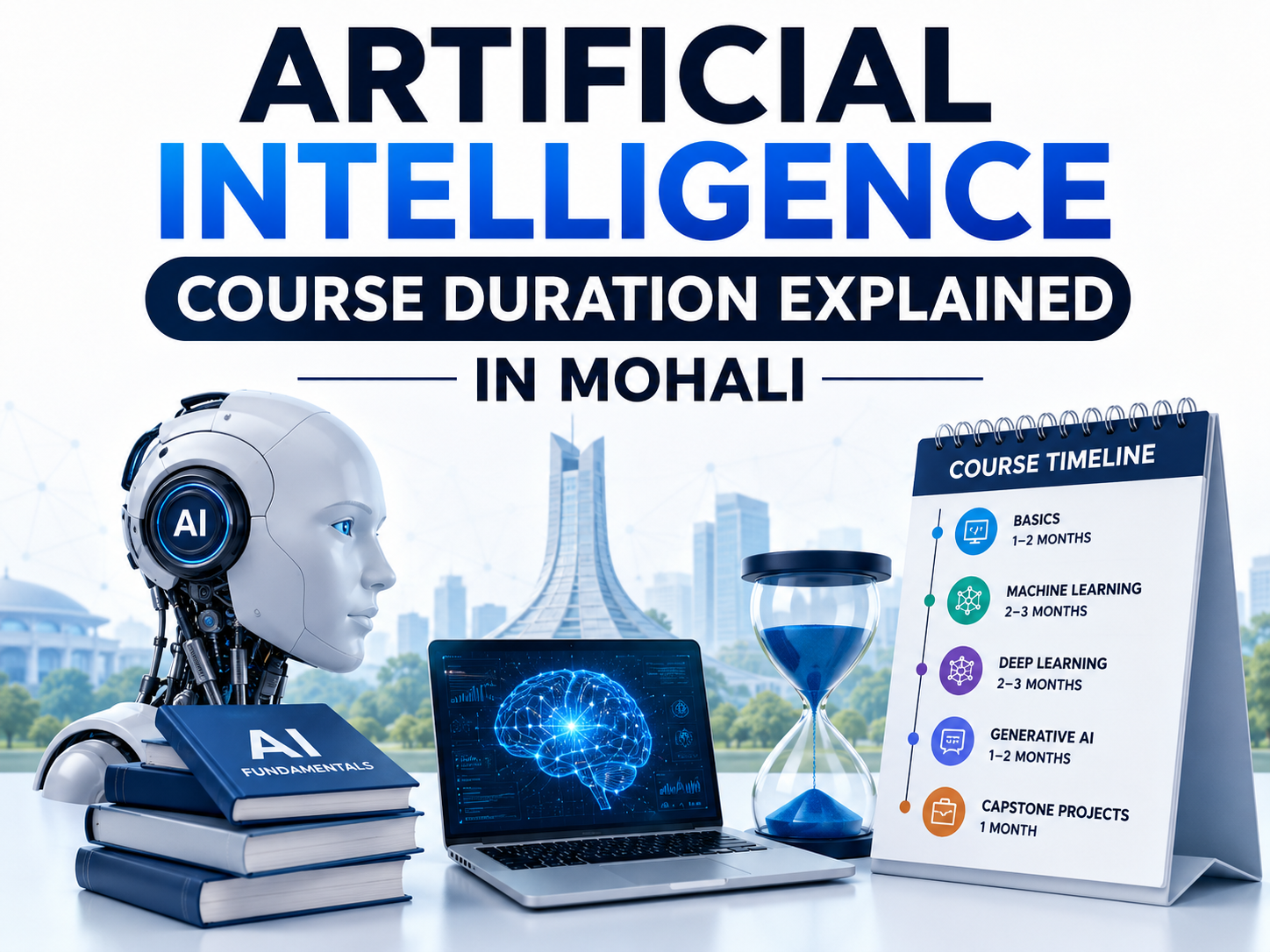
A beginner may structure the journey approximately like this:
Month 1: AI fundamentals and Python basics
Month 2: Python libraries, statistics, and data handling
Month 3: Data visualization and machine learning fundamentals
Month 4: Machine learning projects and model evaluation
Month 5: Deep learning fundamentals
Month 6: Generative AI and portfolio projects
The timeline can be adjusted depending on whether you are a student, working professional, or complete beginner.
Who Can Start Learning AI?
AI is not restricted to experienced programmers. Students from computer science and IT backgrounds can start easily, while learners from other backgrounds can also enter the field by developing programming and data skills.
If you are interested in technology, problem-solving, automation, data, or modern software, AI can be a valuable skill to explore.
The most important thing for AI for beginners is to start with realistic expectations. You don't have to become an expert in a few weeks. Build one concept at a time.
Why Practical Learning Matters
One of the biggest mistakes beginners make is watching tutorials continuously without actually building anything.
After learning a concept, try using it.
If you learn Pandas, analyze a dataset. If you learn regression, build a prediction model. If you learn NLP, create a simple text classification project. If you learn generative AI, build a useful AI-powered workflow.
This approach turns theoretical knowledge into practical AI skills.
Final Thoughts
A successful AI journey is not about learning every AI technology available. It is about developing a strong foundation and progressively applying your knowledge to real-world problems.
The right Artificial Intelligence Learning Roadmap for Beginners in Mohali can take you from basic programming and data concepts to machine learning, deep learning, generative AI, and practical projects.
If you are searching for an AI course in Mohali, compare the syllabus, practical training, projects, mentorship, and career support before choosing a program. A good Artificial Intelligence course Mohali should help you understand concepts rather than simply memorize them.
Whether you are looking for AI training in Mohali, a machine learning course Mohali, or the best AI course in Mohali, focus on building skills that you can demonstrate through projects.
Start with Python. Understand data. Learn machine learning. Explore generative AI. Build projects. Create your portfolio. Keep learning.
That is the foundation for building a meaningful and future-ready AI career.

Comments (0)
No comments yet. Be the first to share your thoughts!