


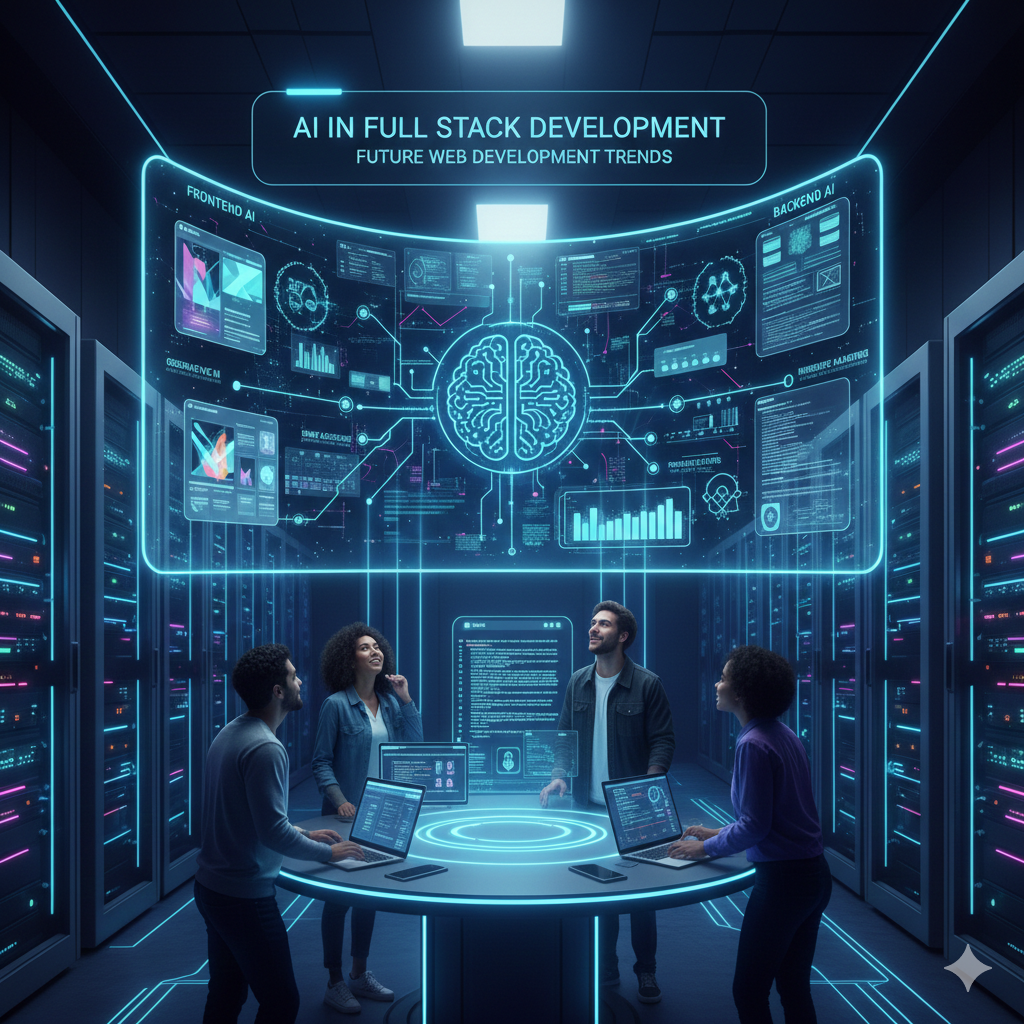
Artificial Intelligence (AI) is rapidly transforming the landscape of full stack development. Traditionally, full stack developers are responsible for handling both frontend and backend aspects of web applications, which includes UI/UX design, server-side logic, database management, and API integrations. The integration of AI into this workflow introduces intelligent automation and predictive capabilities that significantly improve efficiency, performance, and user experience.
One of the major applications of AI in full stack development is code optimization and automation. AI-powered code assistants like GitHub Copilot or Tabnine help developers write cleaner and more efficient code by suggesting functions, detecting syntax errors, and even generating entire code blocks. This not only accelerates the development process but also reduces human errors. Machine learning models can predict potential bugs or vulnerabilities before deployment, enabling proactive debugging. By automating routine coding tasks, AI allows developers to focus on problem-solving, creativity, and application logic.
AI also enhances frontend development by personalizing user experiences. Using AI algorithms, developers can create dynamic interfaces that adapt based on user behavior. For instance, AI can recommend content, predict user actions, and optimize navigation flows to maximize engagement. Chatbots and virtual assistants powered by AI are increasingly being integrated into web applications, providing real-time support and interactive experiences. AI can also analyze user interaction data to provide insights on improving usability, accessibility, and overall performance.
On the backend side, AI plays a crucial role in optimizing database queries, server performance, and application scalability. Machine learning algorithms can predict traffic patterns, allowing for dynamic resource allocation and server scaling in real-time. AI-driven analytics help developers identify bottlenecks, improve response times, and optimize algorithms for faster execution. In e-commerce applications, for example, AI can analyze purchasing behavior and dynamically adjust inventory and recommendations. In fintech applications, AI enhances fraud detection and risk analysis, contributing to both efficiency and security.
Future Web Development Trends
The future of web development is heavily influenced by emerging technologies and changing user expectations. One of the significant trends is the rise of Progressive Web Apps (PWAs) and Single Page Applications (SPAs). These frameworks deliver fast, responsive, and app-like experiences while reducing server load. Users can access applications offline or with limited connectivity, which is increasingly important in global markets. PWAs and SPAs are built with modern JavaScript frameworks like React, Angular, and Vue, and AI can enhance them further by analyzing user interactions for optimization.
Serverless architecture and cloud-native development are another trend shaping full stack development. Serverless models, such as AWS Lambda, Google Cloud Functions, or Azure Functions, allow developers to deploy applications without managing servers. This approach reduces operational complexity and enables automatic scaling. AI integration into serverless applications allows dynamic adjustments based on user demand, resource usage, and predictive analytics. Microservices architecture, which decomposes applications into independent modules, further supports scalability and flexibility, ensuring developers can update or scale specific components without affecting the entire system.
Another emerging trend is the integration of real-time analytics, AR/VR, and immersive experiences. Full stack developers increasingly implement AI-driven recommendation engines, interactive dashboards, and immersive interfaces. In education technology, for example, AI can adapt learning content dynamically based on student performance. In e-commerce, AR features allow customers to try products virtually. AI enhances these experiences by providing intelligent personalization and real-time adjustments.
Cybersecurity is also evolving as a core consideration in web development. AI-powered threat detection, anomaly identification, and automated response systems are becoming standard in modern applications. By analyzing network traffic and user behavior, AI can predict potential attacks and automatically implement preventive measures. For full stack developers, understanding AI-driven security measures is becoming essential to build robust and secure applications.
Skills and Tools for the Future
To stay relevant in this evolving landscape, full stack developers must acquire new skills and adopt AI tools. AI frameworks such as TensorFlow, PyTorch, and Scikit-learn are valuable for integrating predictive models. Natural Language Processing (NLP) tools enable chatbots, virtual assistants, and intelligent search functionalities. Knowledge of cloud platforms like AWS, Google Cloud, and Azure, combined with AI capabilities, allows developers to build scalable and intelligent applications.
Additionally, modern web frameworks (React, Angular, Vue) and backend technologies (Node.js, Django, Flask) are integrating AI tools to enhance efficiency. Full stack developers must also focus on data engineering and data handling skills, as AI applications rely heavily on structured and unstructured datasets. Skills in database optimization, API integration, and asynchronous programming will complement AI capabilities effectively.
Career Opportunities
The integration of AI into full stack development opens multiple career opportunities. Developers with AI expertise can take roles as:
-
AI-Enhanced Full Stack Developer
-
Machine Learning Engineer
-
AI Solution Architect
-
Data-Driven Application Developer
-
Product Developer with AI specialization
These roles often offer higher compensation due to their technical complexity and demand. Additionally, professionals skilled in AI-driven full stack development can explore entrepreneurship by creating intelligent applications, SaaS platforms, and AI-powered services.
Challenges and Considerations
While AI offers numerous benefits, developers must be cautious about ethical use, data privacy, and bias in AI models. Ensuring secure handling of user data, complying with regulations like GDPR, and designing fair algorithms are critical responsibilities. Full stack developers must balance performance optimization with ethical and legal compliance.
Another challenge is keeping pace with rapid technological changes. Continuous learning, staying updated with AI research, and experimenting with emerging tools are essential to remain competitive in the field.
Artificial Intelligence is increasingly being used to automate routine development tasks that were traditionally time-consuming. For full stack developers, this includes automated code review, syntax checking, test generation, and deployment monitoring. AI-based tools can analyze thousands of lines of code to detect potential bugs, inefficiencies, or security vulnerabilities. For instance, predictive AI models can flag memory leaks, detect redundant loops, and optimize database queries before the application reaches production. This reduces the need for manual debugging and accelerates development cycles significantly.
In modern web applications, continuous integration and continuous deployment (CI/CD) pipelines are becoming standard. AI integration into these pipelines allows for intelligent deployment scheduling, predictive load management, and automated rollback in case of errors. Tools like Jenkins, GitHub Actions, and GitLab CI are beginning to incorporate AI-driven analytics, helping developers anticipate failures and optimize deployment efficiency. This reduces downtime and improves reliability for end-users.
AI in Frontend Development
Frontend development, traditionally focused on designing user interfaces and ensuring responsive layouts, is now enhanced through AI-driven personalization. AI models analyze user behavior in real-time to adjust layouts, suggest relevant content, and recommend products. For example, e-commerce websites leverage AI to show users personalized product recommendations, optimizing sales and customer engagement. Similarly, content platforms utilize AI to suggest articles, videos, or courses based on individual preferences.
AI also enables the development of voice-assisted and gesture-based interfaces, which are gaining popularity with smart devices. Full stack developers are now required to integrate AI APIs, speech recognition modules, and NLP (Natural Language Processing) models into web applications. This provides users with interactive and intuitive experiences that were previously limited to native apps or specialized software.
Backend Optimization Through AI
AI is significantly improving backend performance. Machine learning algorithms can predict server load, balance requests dynamically, and optimize database queries. In high-traffic applications, AI-driven caching strategies reduce latency and prevent bottlenecks. For instance, AI can automatically prioritize frequently accessed database records or prefetch data based on usage patterns.
Furthermore, AI-powered monitoring tools track application performance metrics in real-time. Full stack developers can analyze logs, identify anomalies, and preemptively address system failures. Cloud-based services like AWS, Azure, and Google Cloud offer AI-enhanced monitoring and auto-scaling features, allowing developers to handle millions of concurrent users efficiently.
AI in Data Analytics and Decision-Making
Modern web applications are increasingly data-driven. AI enables full stack developers to analyze large datasets, uncover trends, and generate insights that improve application functionality. For example, in social media platforms, AI analyzes user interactions to recommend friends, content, or advertisements tailored to individual preferences. Similarly, AI in fintech applications predicts transaction anomalies, detects fraud, and provides risk analysis for real-time decisions.
Full stack developers need to integrate data pipelines, machine learning models, and predictive analytics into web applications. This requires knowledge of data preprocessing, model deployment, API integration, and backend optimization. DSA (Data Structures and Algorithms) knowledge complements this by ensuring efficient data handling and quick processing.
Emerging Frontend and Web Development Trends
The future of web development is heavily influenced by several emerging trends that intersect with AI:
-
Progressive Web Apps (PWAs): PWAs combine the best of web and mobile apps, offering offline functionality, push notifications, and fast load times. AI enhances PWAs by analyzing user behavior and adjusting content dynamically for personalization.
-
Single Page Applications (SPAs): SPAs provide smooth user experiences without page reloads. AI can optimize SPA performance by predicting user actions and preloading resources, improving responsiveness.
-
Serverless Architecture: Serverless frameworks reduce infrastructure management by delegating backend processing to cloud providers. AI integration allows dynamic resource allocation and predictive scaling, ensuring smooth performance during peak loads.
-
Microservices: Microservices architecture breaks applications into modular components. AI can optimize inter-service communication, monitor performance, and manage dependencies efficiently.
-
AR/VR and Immersive Experiences: Web-based AR and VR applications are gaining traction in education, e-commerce, and entertainment. AI enables real-time object recognition, gesture tracking, and adaptive content delivery, making these experiences more engaging and personalized.
-
Cybersecurity Integration: AI-driven security tools detect anomalies, prevent attacks, and enforce encryption protocols. Full stack developers are increasingly expected to incorporate these intelligent security measures within web applications.
Career Opportunities in AI-Powered Full Stack Development
As AI integration becomes standard, the demand for AI-capable full stack developers is rising sharply. Career paths include:
-
AI-Enhanced Full Stack Developer: Combining frontend, backend, and AI integration skills.
-
Machine Learning Engineer: Focusing on implementing predictive models in web applications.
-
Data Engineer: Handling large datasets efficiently and integrating analytics pipelines.
-
AI Product Developer: Building intelligent products such as chatbots, recommendation engines, or AR/VR experiences.
-
Solution Architect: Designing scalable, AI-driven applications with optimal performance.
The salary potential for these roles is high, with AI expertise adding significant value. Full stack developers who combine traditional programming skills with AI knowledge are likely to be preferred candidates in both startups and MNCs.
Challenges and Ethical Considerations
While AI offers many benefits, developers must navigate challenges including:
-
Data Privacy: Ensuring user data is collected and stored securely while complying with regulations such as GDPR.
-
Algorithmic Bias: AI models must be trained on diverse datasets to prevent biased decision-making.
-
Maintenance: AI systems require continuous monitoring and updating to remain effective.
-
Complexity: Integrating AI increases system complexity, demanding advanced problem-solving and system design skills.
Full stack developers must balance efficiency, personalization, and ethical responsibility while implementing AI features.
AI integration in full stack development relies on a combination of programming languages, frameworks, and tools that enable developers to build intelligent, responsive, and scalable applications. Python is one of the most popular languages because of its extensive AI and machine learning libraries like TensorFlow, PyTorch, Keras, and Scikit-learn. These frameworks allow full stack developers to implement predictive models, recommendation engines, and automated decision-making features.
On the frontend, frameworks such as React, Angular, and Vue.js are increasingly being combined with AI-powered tools to provide dynamic user interfaces. AI can analyze user interactions in real-time to personalize the UI, adjust layouts, and suggest content. Developers also use TensorFlow.js and ONNX.js to run machine learning models directly in the browser, making web applications faster and more interactive without heavy backend dependency.
Backend frameworks like Node.js, Django, and Flask allow developers to integrate AI models with server-side logic. This enables features such as predictive analytics, intelligent caching, traffic load forecasting, and automated error detection. Cloud platforms like AWS, Azure, and Google Cloud provide additional AI services, including Natural Language Processing (NLP), computer vision APIs, recommendation engines, and auto-scaling servers. Using these services, developers can integrate AI capabilities quickly without developing complex models from scratch.
Real-World Applications of AI in Full Stack Development
AI in full stack development is no longer theoretical; it is powering some of the most widely used applications in the world. For instance:
-
E-Commerce Platforms: AI-driven recommendation engines analyze user purchase history and browsing patterns to suggest relevant products, increasing sales and customer engagement. Predictive algorithms manage inventory and forecast demand.
-
Social Media: AI powers content suggestions, friend recommendations, and automated moderation to filter harmful content. Full stack developers integrate these models to enhance user engagement and maintain platform safety.
-
Finance and Banking: AI algorithms detect fraudulent transactions, predict credit risk, and provide automated customer support through chatbots. Backend AI systems process millions of transactions efficiently.
-
Healthcare Applications: Full stack developers use AI to implement telemedicine platforms that provide symptom analysis, appointment scheduling, and personalized care recommendations.
-
Education Technology: AI-driven learning platforms adapt to student performance, offering personalized lessons, quizzes, and feedback in real-time. Full stack developers integrate AI APIs with frontend dashboards to visualize student progress.
Emerging Web Development Trends
AI integration is closely linked with emerging web development trends, shaping the future of applications:
-
Progressive Web Apps (PWAs): PWAs provide mobile-like experiences directly from the web. AI enhances them by personalizing content, managing offline data efficiently, and analyzing user engagement patterns.
-
Single Page Applications (SPAs): SPAs provide smoother, faster interactions without page reloads. AI improves SPAs by predicting user actions, preloading data, and adjusting interface behavior dynamically.
-
Serverless Architecture: Serverless frameworks like AWS Lambda or Azure Functions eliminate the need for managing physical servers. AI-driven serverless applications can auto-scale based on predicted traffic, optimizing cost and performance.
-
Microservices Architecture: Microservices break applications into independent modules. AI optimizes service orchestration, monitors performance, and predicts potential failures in real-time, ensuring high availability.
-
AR/VR and Immersive Experiences: Augmented and virtual reality applications, increasingly delivered via web platforms, rely on AI for object recognition, gesture tracking, and adaptive content generation. This is particularly relevant for online gaming, retail try-on experiences, and virtual education labs.
-
Real-Time Analytics and Dashboards: AI enhances real-time data visualization by detecting trends, predicting anomalies, and offering actionable insights. Businesses leverage these dashboards for operational efficiency and decision-making.
-
Cybersecurity: AI-powered threat detection is critical for web applications handling sensitive data. Algorithms detect abnormal user behavior, phishing attempts, or network attacks, allowing developers to implement proactive defenses.
Career Opportunities in AI-Focused Full Stack Development
Full stack developers who integrate AI skills are highly sought after in the job market. Some prominent career paths include:
-
AI-Enhanced Full Stack Developer: Combines traditional full stack skills with AI integration, offering predictive and personalized web solutions.
-
Machine Learning Engineer: Focuses on deploying ML models within full stack applications for real-time decision-making.
-
Data Engineer: Designs pipelines for collecting, storing, and analyzing large datasets that power AI models.
-
AI Product Developer: Creates intelligent applications such as recommendation engines, chatbots, and virtual assistants.
-
Solutions Architect: Oversees system architecture, integrating AI models with scalable backend and interactive frontend frameworks.
The salary and growth prospects for these roles are significantly higher compared to conventional full stack roles because of the specialized AI expertise involved.
Ethical and Practical Considerations
While AI offers many advantages, developers must navigate ethical and practical challenges:
-
Bias in AI Models: AI models can inherit biases present in training data, leading to unfair predictions or recommendations. Full stack developers must ensure models are tested for fairness and inclusivity.
-
Data Privacy: Handling sensitive data requires compliance with regulations like GDPR and local data protection laws. AI models often rely on large datasets, making privacy a critical consideration.
-
Security Risks: Integrating AI adds complexity, increasing the attack surface for malicious actors. Developers must implement secure coding practices, encryption, and anomaly detection.
-
Maintenance: AI models require ongoing updates, retraining, and monitoring to maintain accuracy and reliability in production applications.
Preparing for the Future
To stay competitive in this evolving landscape, full stack developers should focus on:
-
Learning AI and Machine Learning Frameworks: Tools like TensorFlow, PyTorch, and Keras are essential for integrating AI into applications.
-
Mastering Cloud Services: AWS, Azure, and Google Cloud provide scalable infrastructure and AI services for real-time applications.
-
Practicing Data Handling: Efficient database management, preprocessing, and API integration are crucial for AI-powered applications.
-
Adopting Modern Web Frameworks: React, Angular, and Vue.js, combined with AI tools, enable dynamic and interactive user interfaces.
-
Continuous Learning: Staying updated with AI trends, cybersecurity developments, and emerging frameworks ensures relevance in a fast-paced industry.
Predictions for the Future
Looking ahead, AI will continue to shape the full stack development field:
-
Increased Automation: Routine development and testing tasks will be largely automated, allowing developers to focus on higher-level design and innovation.
-
Intelligent UX/UI: Web applications will provide real-time, personalized experiences powered by AI analytics.
-
Integration of AR/VR: Immersive experiences delivered through web applications will become commonplace, particularly in education, entertainment, and e-commerce.
-
Global Remote Opportunities: AI knowledge will allow developers in Mohali and other cities to compete for international roles without relocating.
-
Hybrid AI-Human Development Teams: Developers will increasingly collaborate with AI systems, where AI handles optimization and monitoring while humans focus on creativity and problem-solving.
Conclusion
The convergence of AI and full stack development is redefining modern web applications. Intelligent automation, predictive analytics, dynamic personalization, immersive experiences, and enhanced security are now core expectations. Developers who combine AI knowledge with full stack skills are prepared to meet global industry demands and create next-generation web applications.
Emerging trends such as PWAs, SPAs, serverless computing, microservices, AR/VR, and AI-powered dashboards will continue to dominate the web development landscape. Full stack developers in Mohali and worldwide who embrace these technologies will enjoy a competitive edge, higher salaries, career flexibility, and opportunities for innovation.
AI is not just a tool for optimization—it is becoming the foundation for how web applications will be built, scaled, and maintained in the future. The developers who adapt, learn continuously, and integrate AI into full stack workflows are the ones who will lead the next wave of technological innovation.


Comments
No comments yet. Be the first to comment.
Leave a Comment