


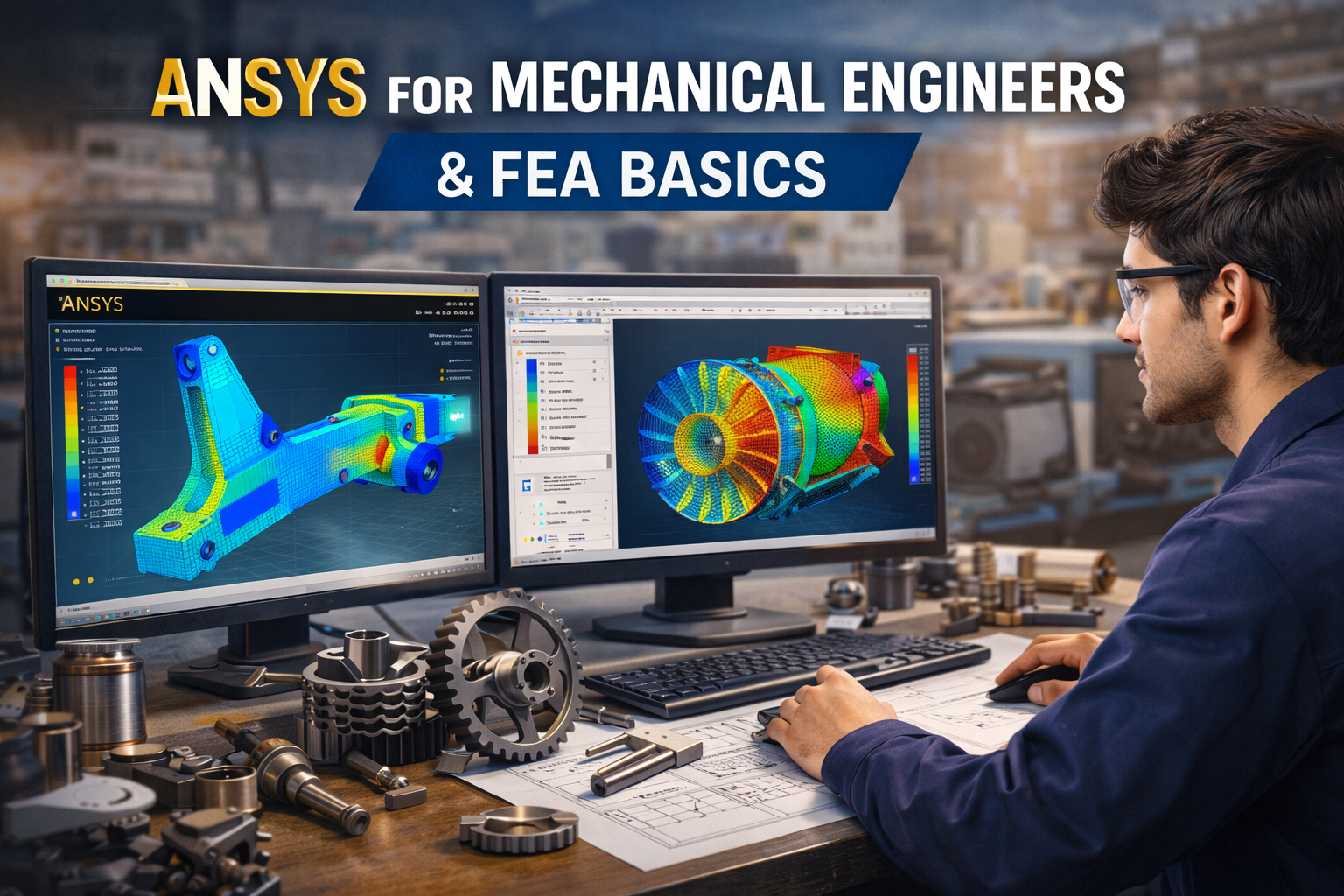
ANSYS for Mechanical Engineers: Applications & FEA Basics for Beginners
In today’s competitive engineering world, simulation skills are as important as design knowledge. ANSYS is one of the most powerful engineering simulation software tools widely used by mechanical engineers. It helps analyze product performance before manufacturing, saving time and cost.
If you are new to simulation, understanding FEA basics for beginners is the first step toward mastering ANSYS.
What is ANSYS?
ANSYS is an advanced engineering simulation software used for:
-
Structural analysis
-
Thermal analysis
-
Fluid flow simulation
-
Vibration analysis
-
Electromagnetic analysis
Mechanical engineers use ANSYS to test and validate designs virtually before production.
What is FEA (Finite Element Analysis)?
Finite Element Analysis (FEA) is a numerical method used to solve complex engineering problems. It breaks a large structure into smaller elements (called finite elements) and calculates how each element behaves under given conditions.
Simple Example:
If you want to test how a metal bracket behaves under load, FEA helps you determine:
-
Stress distribution
-
Deformation
-
Safety factor
-
Weak points
This prevents failure in real-life applications.
FEA Basics for Beginners
If you are starting with ANSYS, you should understand these core concepts:
1️⃣ Pre-Processing
-
Import or create geometry
-
Define material properties
-
Apply boundary conditions (loads, supports)
-
Generate mesh
2️⃣ Solution
-
ANSYS calculates equations based on applied conditions
3️⃣ Post-Processing
-
View results (stress, strain, deformation, temperature)
-
Analyze graphical reports
These three steps form the foundation of simulation.
ANSYS Applications in Mechanical Engineering
ANSYS has wide applications across industries:
🔹 Structural Analysis
Used in machine parts, frames, automotive components, bridges, and pressure vessels.
🔹 Thermal Analysis
Used in heat exchangers, engines, boilers, and electronic cooling systems.
🔹 Fluid Dynamics (CFD)
Used in aerodynamics, HVAC systems, pipelines, and turbines.
🔹 Vibration & Modal Analysis
Used in rotating machinery, automotive parts, and aerospace structures.
🔹 Fatigue & Failure Analysis
Used to predict product life and durability.
Why Mechanical Engineers Should Learn ANSYS?
Learning ANSYS provides:
-
Better design validation skills
-
Higher job opportunities
-
Industry-ready expertise
-
Competitive advantage in core companies
Many industries prefer candidates with simulation knowledge because it reduces physical testing costs.
Career Opportunities After Learning ANSYS
After mastering ANSYS, you can work as:
-
FEA Engineer
-
CAE Analyst
-
Simulation Engineer
-
Design Validation Engineer
-
CFD Engineer
Simulation-based roles are in high demand in automotive, aerospace, manufacturing, and energy sectors.
Conclusion
ANSYS is an essential tool for modern mechanical engineers. Understanding FEA basics for beginners helps you build a strong foundation in simulation. With practical training and real-world projects, you can become industry-ready and open doors to high-paying engineering roles.
If you want to build expertise in mechanical simulation, start learning ANSYS today.


Comments
No comments yet. Be the first to comment.
Leave a Comment