

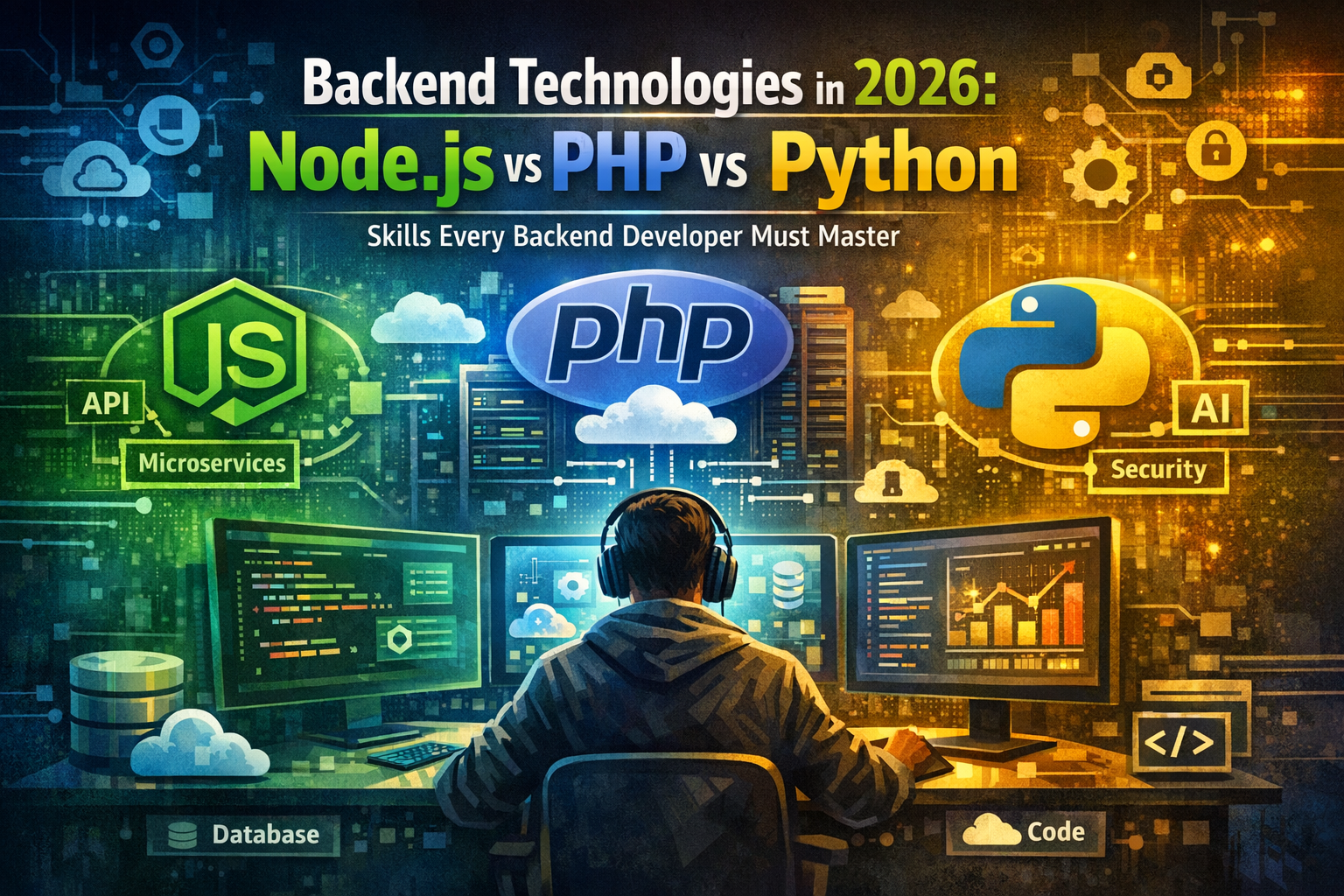
Backend Technologies in 2026: Node.js vs PHP vs Python – Skills Every Backend Developer Must Master
Choosing the right backend technology is one of the most important decisions for any developer, startup, or enterprise. With multiple powerful server-side programming languages available today, the debate around Node.js vs PHP vs Python continues to evolve.
Each technology has matured, built strong ecosystems, and powers some of the world’s biggest platforms. But which one should you learn? Which offers better performance, scalability, job demand, and long-term career growth in 2026?
In this comprehensive guide, we’ll compare Node.js, PHP, and Python across performance, scalability, security, ecosystem, job opportunities, salary trends, and real-world use cases — while also highlighting the essential backend developer skills you must master.
What Are Backend Technologies?
Backend technologies power the server-side of web applications. They handle:
-
Database interactions
-
Authentication and authorization
-
Business logic
-
API development
-
Payment processing
-
Cloud deployment
-
Security management
When you use an eCommerce website, stream a video, or log into a SaaS platform, the backend processes those requests behind the scenes.
Modern backend development often involves:
-
RESTful APIs
-
Microservices architecture
-
Cloud computing (AWS, Azure, GCP)
-
Containerization (Docker, Kubernetes)
-
Database management (SQL & NoSQL)
-
CI/CD pipelines
Now let’s dive into the three most popular backend technologies.
1. Node.js
Overview
Node.js is a JavaScript runtime built on Chrome’s V8 engine. It allows developers to use JavaScript for server-side development, enabling full-stack development with a single language.
It has become extremely popular for building:
-
Real-time applications
-
REST APIs
-
Chat applications
-
Streaming services
-
Microservices
Popular Frameworks
-
Express.js
-
NestJS
-
Fastify
-
Koa
Performance
Node.js uses a non-blocking, event-driven architecture, making it highly efficient for I/O-heavy operations such as:
-
Chat apps
-
Real-time dashboards
-
API gateways
-
Streaming platforms
However, it may not be ideal for CPU-intensive tasks without worker threads.
Scalability
Node.js excels in microservices architecture. Its lightweight nature makes it perfect for scalable cloud-native applications deployed on AWS or Kubernetes.
Security
Security depends heavily on package management. Since Node.js uses npm (one of the largest ecosystems), developers must carefully manage dependencies to avoid vulnerabilities.
Real-World Companies Using Node.js
-
Netflix
-
LinkedIn
-
PayPal
-
Uber
When to Choose Node.js
Choose Node.js if:
-
You want full-stack JavaScript (MERN/MEAN stack)
-
You're building real-time applications
-
You need high concurrency handling
-
You're working in a startup environment
2. PHP
Overview
PHP has powered the web for decades and remains one of the most widely used backend technologies.
Over 70% of websites historically relied on PHP, largely due to platforms like:
-
WordPress
-
Drupal
-
Joomla
Modern PHP (PHP 8+) is significantly faster and more secure than earlier versions.
Popular Frameworks
-
Laravel
-
Symfony
-
CodeIgniter
Performance
PHP traditionally followed a synchronous execution model. However, with PHP 8 improvements and frameworks like Laravel, performance has improved significantly.
It performs exceptionally well in:
-
CMS-based websites
-
Content-driven platforms
-
eCommerce systems
Scalability
While historically criticized for scalability, modern PHP applications using Laravel with proper caching and cloud infrastructure can scale effectively.
Security
PHP has matured considerably. Frameworks like Laravel offer built-in:
-
CSRF protection
-
Input validation
-
Authentication scaffolding
-
Encryption tools
Real-World Companies Using PHP
-
Facebook (initially built in PHP)
-
Wikipedia
-
Slack (early backend components)
When to Choose PHP
Choose PHP if:
-
You want fast web development
-
You're building CMS or content-heavy platforms
-
You work with WordPress or eCommerce
-
You want strong freelance opportunities
3. Python
Overview
Python is one of the most versatile programming languages. It dominates not only backend development but also:
-
Artificial Intelligence
-
Machine Learning
-
Data Science
-
Automation
-
Cybersecurity
Its simplicity and readability make it beginner-friendly while remaining powerful for enterprise applications.
Popular Frameworks
-
Django
-
Flask
-
FastAPI
Performance
Python is not as fast as Node.js in raw I/O performance, but frameworks like FastAPI significantly improve response times.
Python performs well in:
-
AI-powered applications
-
Data-driven platforms
-
Complex business logic systems
Scalability
Django supports scalable architecture, and Python works seamlessly with cloud platforms like AWS and Google Cloud.
Security
Django provides strong built-in security features:
-
SQL injection protection
-
CSRF protection
-
XSS prevention
-
Secure authentication
Real-World Companies Using Python
-
Instagram
-
Spotify
-
Dropbox
-
Reddit
When to Choose Python
Choose Python if:
-
You're interested in AI or machine learning
-
You want easy-to-read code
-
You're building data-heavy platforms
-
You want strong enterprise adoption
Node.js vs PHP vs Python: Direct Comparison
| Feature | Node.js | PHP | Python |
|---|---|---|---|
| Performance | High (I/O intensive) | Moderate to High | Moderate |
| Learning Curve | Moderate | Easy | Easy |
| Scalability | Excellent | Good | Very Good |
| Real-Time Apps | Excellent | Limited | Good |
| AI/ML Integration | Limited | Very Limited | Excellent |
| Community | Huge | Massive | Massive |
| Job Demand 2026 | Very High | High | Extremely High |
Backend Developer Skills You Must Master in 2026
Regardless of the language you choose, modern backend developers need more than just syntax knowledge.
1. API Development
-
RESTful APIs
-
GraphQL
-
API authentication (JWT, OAuth)
2. Database Management
-
SQL (PostgreSQL, MySQL)
-
NoSQL (MongoDB, Redis)
-
Database optimization
3. Cloud Computing
-
AWS
-
Azure
-
Google Cloud
-
Serverless architecture
4. DevOps Basics
-
Docker
-
Kubernetes
-
CI/CD pipelines
-
Git & GitHub
5. Security Best Practices
-
HTTPS & SSL
-
Rate limiting
-
Data encryption
-
OWASP standards
6. System Design
-
Microservices
-
Load balancing
-
Caching strategies
-
High availability systems
Job Demand and Salary Trends in 2026
Node.js Developers
-
High demand in startups
-
Popular in fintech and SaaS
-
Competitive salaries globally
PHP Developers
-
Strong freelance demand
-
CMS-based development market
-
Stable but slower growth
Python Developers
-
Extremely high demand
-
AI/ML industry growth
-
Higher average salary due to versatility
Python currently has the strongest cross-industry demand because it spans backend, AI, and data science.
Which Backend Technology Should You Choose?
Choose Node.js if:
-
You love JavaScript
-
You want full-stack development
-
You aim to build real-time applications
Choose PHP if:
-
You want quick website development
-
You plan to work with WordPress
-
You prefer traditional web development
Choose Python if:
-
You want long-term career flexibility
-
You’re interested in AI & data
-
You prefer readable, clean syntax
Future of Backend Development
In 2026 and beyond, backend technologies are evolving toward:
-
Serverless computing
-
Edge computing
-
AI-integrated backend systems
-
Cloud-native microservices
-
API-first architecture
The future is less about choosing one “best” language and more about understanding scalable system design and cloud infrastructure.
Final Verdict: There Is No Single Winner
The debate of Node.js vs PHP vs Python doesn’t have a universal winner. Each technology has strengths depending on your goals.
If your goal is startup scalability → Node.js
If your goal is rapid web deployment → PHP
If your goal is versatility & AI growth → Python
The most important factor isn’t the language — it’s mastering core backend developer skills, understanding architecture, and building real-world projects.
Conclusion
Backend technologies continue to evolve rapidly. Whether you choose Node.js, PHP, or Python, focus on:
-
Writing clean, maintainable code
-
Understanding databases deeply
-
Learning cloud deployment
-
Building secure APIs
-
Practicing system design
The best backend developer in 2026 won’t just know a language — they’ll understand how to build scalable, secure, high-performance systems that power the modern web.
Backend Framework Ecosystem Comparison
When evaluating Node.js vs PHP vs Python, it’s not just about the language — the backend frameworks ecosystem plays a major role in productivity, maintainability, and scalability.
Node.js Framework Ecosystem
The Node.js ecosystem thrives because of npm (Node Package Manager), the largest open-source package repository in the world. Popular frameworks include:
-
Express.js – Minimalist and flexible
-
NestJS – Enterprise-ready and TypeScript-first
-
Fastify – High-performance alternative to Express
These frameworks are ideal for building:
-
RESTful APIs
-
GraphQL APIs
-
Microservices architecture
-
Serverless applications
Node.js is particularly strong in API-first development and modern SaaS products.
PHP Framework Ecosystem
Modern PHP development is heavily framework-driven. The most dominant framework is:
-
Laravel – Elegant syntax, built-in authentication, strong ORM (Eloquent)
-
Symfony – Enterprise-grade modular components
-
CodeIgniter – Lightweight and beginner-friendly
Laravel has transformed PHP’s reputation by enabling:
-
Rapid application development
-
MVC architecture
-
Built-in security features
-
Easy database migrations
For developers focusing on eCommerce development, CMS customization, or custom business applications, PHP frameworks remain highly practical.
Python Framework Ecosystem
Python’s backend ecosystem is clean, structured, and powerful:
-
Django – Full-featured, batteries-included framework
-
Flask – Lightweight and flexible
-
FastAPI – High-performance, async-friendly
Django is ideal for:
-
Enterprise web applications
-
Scalable SaaS platforms
-
Secure authentication-heavy systems
FastAPI is increasingly popular for:
-
High-performance APIs
-
AI-powered backend services
-
Microservices architecture
Because Python integrates easily with machine learning libraries, it has a strong advantage in AI-powered backend systems.
Backend Development Trends in 2026
To stay competitive as a backend developer, understanding current trends is essential for SEO relevance and career growth.
1. API-First Development
Modern applications rely heavily on APIs. Backend developers must master:
-
REST architecture
-
GraphQL APIs
-
API documentation tools (Swagger/OpenAPI)
-
API versioning strategies
Companies now build backend systems before frontend applications — making API design a critical backend skill.
2. Microservices Architecture
Instead of building monolithic applications, companies are adopting microservices architecture.
Benefits include:
-
Independent service deployment
-
Improved scalability
-
Better fault isolation
-
Cloud-native compatibility
Node.js and Python perform exceptionally well in microservices environments.
3. Cloud-Native Backend Development
Cloud computing is now standard in backend development. Skills in the following are highly in demand:
-
AWS (EC2, Lambda, RDS)
-
Microsoft Azure
-
Google Cloud Platform
-
Docker containerization
-
Kubernetes orchestration
A backend developer without cloud knowledge in 2026 is at a serious disadvantage.
4. Serverless Architecture
Serverless computing allows developers to focus on code without managing infrastructure.
Popular tools include:
-
AWS Lambda
-
Azure Functions
-
Google Cloud Functions
Node.js and Python are the most commonly used languages in serverless environments.
5. DevOps Integration
Modern backend developers are expected to understand DevOps basics:
-
Continuous Integration (CI)
-
Continuous Deployment (CD)
-
GitHub Actions
-
Infrastructure as Code
Backend development is no longer isolated from deployment pipelines.
Database Technologies Backend Developers Must Know
A strong backend developer in 2026 must understand both SQL and NoSQL databases.
SQL Databases
-
MySQL
-
PostgreSQL
-
Microsoft SQL Server
SQL databases are ideal for:
-
Financial systems
-
Enterprise applications
-
Structured data
NoSQL Databases
-
MongoDB
-
Redis
-
Cassandra
NoSQL databases work well for:
-
Real-time analytics
-
Large-scale distributed systems
-
Flexible schema applications
Understanding database indexing, optimization, caching, and transactions is critical for backend performance.
Soft Skills That Make a Great Backend Developer
Technical knowledge alone is not enough. High-paying backend roles require:
-
Problem-solving skills
-
System architecture thinking
-
Communication skills
-
Debugging expertise
-
Code review ability
-
Documentation skills
Companies increasingly value developers who can design scalable systems — not just write endpoints.
Freelancing vs Full-Time Backend Careers
Choosing between freelancing and full-time employment also affects your backend technology choice.
Freelancing
PHP remains strong in freelance marketplaces due to:
-
WordPress development
-
WooCommerce customization
-
Small business websites
Full-Time Enterprise Roles
Python and Node.js dominate enterprise hiring due to:
-
SaaS platforms
-
AI-powered systems
-
Cloud-native applications
If your goal is high-paying remote backend jobs, Python currently offers the widest opportunity range.
Backend Developer Roadmap for 2026
Here is a practical roadmap for becoming a successful backend developer:
Step 1: Learn One Core Backend Language
Choose Node.js, PHP, or Python.
Step 2: Master One Framework
-
Express or NestJS (Node)
-
Laravel (PHP)
-
Django or FastAPI (Python)
Step 3: Learn Databases
-
SQL + NoSQL
-
Query optimization
-
Database design principles
Step 4: Build Real Projects
-
Authentication system
-
REST API
-
eCommerce backend
-
SaaS dashboard
Step 5: Learn Cloud Deployment
Deploy projects on AWS or similar platforms.
Step 6: Study System Design
Understand scaling, caching, load balancing, and distributed systems.

Comments
No comments yet. Be the first to comment.
Leave a Comment