


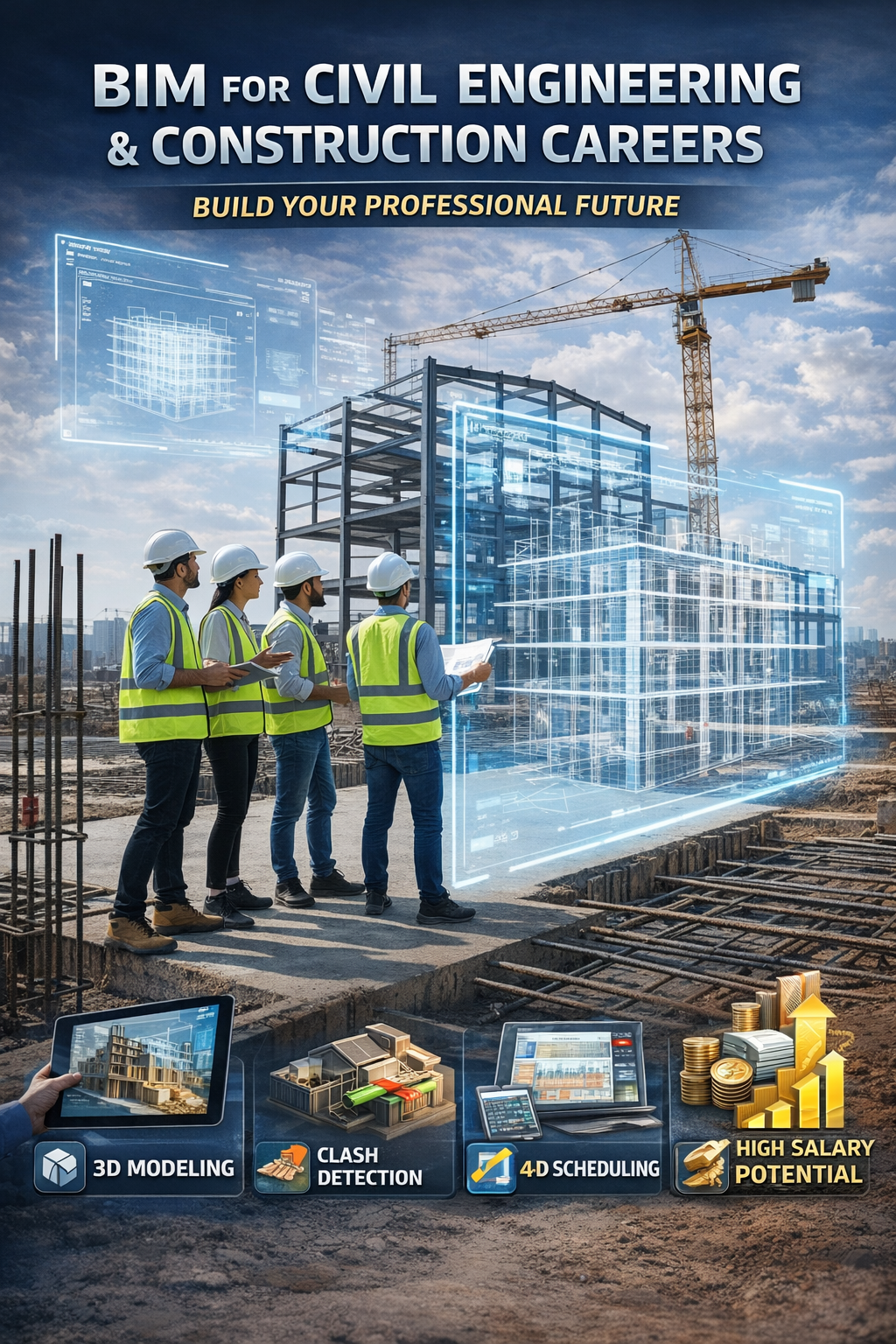
COURSE OBJECTIVE
By the end of this course, participants will:
-
Understand the fundamentals of BIM and its role in civil engineering and construction.
-
Develop architectural, structural, and MEP BIM models.
-
Perform clash detection and coordination across disciplines.
-
Create 4D construction schedules and 5D cost estimation models.
-
Apply BIM in infrastructure projects including roads, bridges, tunnels, and metro systems.
-
Manage BIM projects professionally and use BIM for facility management.
-
Learn emerging technologies such as digital twins, AI, and AR/VR integration in BIM.
COURSE STRUCTURE & SYLLABUS
MODULE 1: INTRODUCTION TO BIM
Theory:
-
Evolution of construction practices
-
Limitations of traditional CAD
-
Need for digital transformation
-
BIM definition and lifecycle approach
-
BIM vs CAD
-
Industry 4.0 and BIM
-
Government mandates & global adoption
Practical Example:
-
Residential building modeled in BIM: walls, floors, slabs, doors, and windows
Applications:
-
Visualization, planning, cost analysis, lifecycle management
MODULE 2: BIM CONCEPTS & DIMENSIONS
Theory:
-
2D vs 3D vs 4D vs 5D vs 6D vs 7D BIM
-
Digital twin concept
-
BIM maturity levels (Level 0–3)
-
Integration across project lifecycle
Example:
-
4D BIM for bridge construction showing weekly progress of piers
Applications:
-
Time scheduling, risk management, cost planning, sustainability
MODULE 3: BIM SOFTWARE OVERVIEW
Theory:
-
BIM authoring, coordination, visualization, analysis, and management tools
-
Parametric modeling, object families, constraints
-
Model interoperability: IFC, Open BIM, file exchange, federated models
Example:
-
Federated BIM model combining architecture, structure, and MEP
Applications:
-
Collaboration, clash detection, multi-disciplinary coordination
MODULE 4: ARCHITECTURAL BIM MODELING
Theory:
-
Project setup, units, levels, grids, project templates
-
Walls, floors, roofs, doors, windows, stairs, railings
-
Advanced features: curtain walls, facades, parametric families, materials, lighting
Example:
-
Hospital ward modeling ensuring circulation, accessibility, and room layouts
Applications:
-
Layout planning, visualization, area calculation, material estimation
MODULE 5: STRUCTURAL BIM MODELING
Theory:
-
Structural systems, load paths, grids, analytical models
-
Concrete: columns, beams, slabs, footings, shear walls
-
Steel: beams, columns, trusses, connections
-
Reinforcement detailing: rebar, cover, schedules
Example:
-
High-rise building structural model exported to analysis software
Applications:
-
Structural safety, detailing, quantity takeoff, clash prevention
MODULE 6: MEP BIM MODELING
Theory:
-
HVAC: duct layout, airflow, pressure
-
Plumbing: water supply, drainage, stormwater
-
Electrical: power, lighting, cable trays
-
Firefighting: sprinklers, pumps, alarms
Example:
-
Duct clashing with a beam detected digitally
Applications:
-
Clash detection, layout optimization, maintenance planning
MODULE 7: BIM COORDINATION & CLASH DETECTION
Theory:
-
Model federation, shared coordinates, review workflows
-
Clash types: hard clashes, soft clashes, workflow & reporting
-
Issue management, markups, revision control
Example:
-
Pipe-beam clash resolved before site execution
Applications:
-
Reduced rework, faster approvals, better site coordination
MODULE 8: 4D BIM (CONSTRUCTION TIME MANAGEMENT)
Theory:
-
Construction schedule creation, dependencies, milestones
-
Linking 3D elements with time
-
Simulation of construction sequences
Example:
-
Animated sequence: foundation → columns → slabs → finishes
Applications:
-
Construction planning, resource optimization, delay analysis
MODULE 9: 5D BIM (COST MANAGEMENT)
Theory:
-
Quantity extraction from BIM model
-
Linking cost databases to model elements
-
Budget forecasting, cost control, claim management
Example:
-
Concrete volume automatically multiplied by rate per m³
Applications:
-
BOQ generation, cost control, financial planning
MODULE 10: BIM FOR INFRASTRUCTURE
Theory:
-
Roads, highways, bridges, tunnels, metro systems, airports
-
Terrain modeling, alignment, utility coordination, earthwork calculations
Example:
-
Highway alignment designed to minimize earthwork
-
Tunnel model showing excavation & lining sequence
Applications:
-
Infrastructure design, planning, construction efficiency
MODULE 11: BIM FOR PROJECT MANAGEMENT
Theory:
-
BIM Execution Plan (BEP), standards, roles, deliverables
-
Collaboration platforms, cloud-based workflows
-
Risk identification & mitigation
Example:
-
Cloud-based BIM collaboration platform for hospital project
-
Real-time issue tracking & approvals
Applications:
-
Decision-making, communication, project control
MODULE 12: BIM FOR FACILITY MANAGEMENT
Theory:
-
Asset data management, preventive & predictive maintenance
-
Lifecycle management, operational efficiency
-
Integration with IoT and sensors
Example:
-
Hospital BIM model storing service schedules for equipment
-
Smart building energy monitoring
Applications:
-
Maintenance planning, space management, lifecycle cost optimization
MODULE 13: BIM STANDARDS & LEGAL ASPECTS
Theory:
-
ISO 19650, national standards, Level of Detail (LOD)
-
BIM in contracts, employer requirements, deliverables, responsibilities
Example:
-
BIM clause in tender requiring 3D/4D/5D deliverables
Applications:
-
Legal clarity, professional accountability, standardization
MODULE 14: BIM & EMERGING TECHNOLOGIES
Theory:
-
Digital twins, AI, AR/VR, IoT integration
-
Real-time monitoring, predictive analysis, virtual walkthroughs
Example:
-
Metro station using digital twin for operational simulation
Applications:
-
Smart construction, predictive maintenance, data-driven decisions
MODULE 15: BIM CASE STUDIES
Example 1: Residential High-Rise
-
Clash reduction: 40%
-
Cost saving: 15%
Example 2: Metro Station
-
Utility conflicts avoided
-
Faster construction, coordinated handover
Applications:
-
Demonstrates practical use of BIM in real projects
MODULE 16: PROFESSIONAL PRACTICE & CAREER
Theory:
-
Roles: BIM Modeler, Engineer, Coordinator, Manager
-
Skills: Software proficiency, project management, collaboration
-
Certifications: Autodesk, Revit, Navisworks, ISO standards
Applications:
-
Career path, professional development, industry readiness
30–90 DAY TRAINING PLAN
30-Day Fast Track
-
Week 1: BIM Basics, 3D Architectural Modeling
-
Week 2: Structural & MEP BIM
-
Week 3: Clash Detection, 4D Scheduling, Quantity Takeoff
-
Week 4: Project Work, Case Study, Certification
60-Day Professional
-
Month 1: Fundamentals, Architecture, Structure, MEP
-
Month 2: Coordination, 4D/5D, Infrastructure BIM, Project Execution
90-Day Master
-
Month 1: Fundamentals, Architectural & Structural BIM
-
Month 2: MEP, Coordination, 4D/5D
-
Month 3: Infrastructure, Facility Management, Digital Twin, Final Project
Advantages and Benefits of BIM on Construction Sites
Building Information Modeling (BIM) is transforming civil engineering by bridging the gap between design and execution. On construction sites, BIM offers real-time insights, coordination, and efficiency, improving both productivity and project quality.
1. Improved Coordination Between Teams
Advantage:
BIM allows architects, engineers, contractors, and site managers to work on a single federated model, reducing miscommunication.
Benefit:
-
Ensures all stakeholders are on the same page
-
Reduces conflicts between design and construction
-
Speeds up approvals on site
Example:
During a hospital construction, BIM helped coordinate structural, MEP, and architectural teams. Clashes were resolved digitally before installation, reducing on-site rework.
2. Clash Detection and Error Minimization
Advantage:
BIM software identifies clashes between structural, electrical, plumbing, and mechanical elements before construction begins.
Benefit:
-
Prevents costly on-site rework
-
Improves safety by reducing unexpected construction errors
-
Saves material and labor costs
Example:
A water pipe was clashing with a beam in a building project. BIM highlighted it digitally, allowing rerouting before installation.
3. Accurate Quantity Takeoff & Material Planning
Advantage:
BIM extracts material quantities automatically from the 3D model.
Benefit:
-
Precise material orders
-
Reduced wastage
-
Optimized storage and delivery schedules
Example:
Concrete, steel, and finishing materials are automatically calculated from the model, reducing excess procurement.
4. Efficient 4D Scheduling (Time Management)
Advantage:
BIM links project elements to a schedule, creating a 4D construction simulation.
Benefit:
-
Visualizes construction sequence step by step
-
Prevents scheduling conflicts on site
-
Optimizes labor and machinery use
Example:
A bridge construction was simulated week by week. Cranes and materials were scheduled efficiently, reducing idle time.
5. Cost Control with 5D BIM
Advantage:
BIM integrates costs with model elements for accurate budgeting.
Benefit:
-
Helps avoid budget overruns
-
Tracks variations and material costs in real time
-
Supports financial decision-making on site
Example:
Automatic cost updates when design changes occurred in a high-rise project prevented unexpected budget issues.
6. Enhanced Visualization for On-Site Teams
Advantage:
3D BIM models provide realistic visualization of structures and systems.
Benefit:
-
Easy understanding of complex designs by on-site teams
-
Faster decision-making
-
Reduced errors due to misinterpretation
Example:
Walkthrough of a hospital floor allowed construction workers to understand ducting and pipe layouts before installation.
7. Improved Safety on Site
Advantage:
BIM identifies potential hazards in construction planning.
Benefit:
-
Helps plan safe access and working zones
-
Reduces accidents and site injuries
-
Enables safety audits digitally before execution
Example:
A tunnel project used BIM to simulate worker pathways and machine access, minimizing risk during excavation.
8. Better Collaboration with Off-Site Teams
Advantage:
Cloud-based BIM allows real-time updates from design offices to site.
Benefit:
-
Immediate communication of changes
-
Reduced delays in implementing revisions
-
Keeps all contractors informed
Example:
A metro station design change was updated in the cloud; on-site contractors received instructions instantly, avoiding work stoppage.
9. Sustainable Construction Planning
Advantage:
BIM allows material, energy, and waste analysis before site work begins.
Benefit:
-
Optimized use of resources
-
Reduced environmental impact
-
Supports green building certification
Example:
Concrete usage and waste were minimized in a road project using BIM’s predictive analysis.
10. Long-Term Facility Management
Advantage:
BIM models provide data for as-built documentation and post-construction maintenance.
Benefit:
-
Quick access to asset data
-
Simplifies maintenance and renovation planning
-
Reduces lifecycle costs
Example:
A hospital used BIM for managing mechanical and electrical systems post-construction, improving operational efficiency.
Summary Table: Advantages vs Benefits on Site
| Advantage (What BIM Provides) | Benefit (On-Site Impact) |
|---|---|
| Improved Coordination | Reduced conflicts, faster approvals |
| Clash Detection | Less rework, safer site |
| Accurate Quantity Takeoff | Less wastage, efficient procurement |
| 4D Scheduling | Optimized labor & machinery usage |
| 5D Cost Integration | Budget control, accurate estimates |
| Realistic Visualization | Better understanding by workers |
| Safety Planning | Reduced accidents & hazards |
| Cloud Collaboration | Instant updates, minimal delays |
| Sustainability Analysis | Eco-friendly and cost-efficient |
| Facility Management | Efficient maintenance & lifecycle savings |
Conclusion for Site Advantages
Implementing BIM on a construction site transforms how teams collaborate, plan, and execute projects. It ensures:
-
Reduced errors and rework
-
Optimized material and labor usage
-
Safer and more efficient site operations
-
Cost savings and improved productivity
-
Sustainability and long-term operational benefits
By integrating BIM into construction sites, civil engineering projects are completed faster, safer, and more accurately, bridging the gap between design and execution while enhancing overall project quality.
BIM Career Salary Overview (India)
1. BIM Intern
-
Role: Entry-level training/assistance
-
Typical Salary: ₹10,000 – ₹15,000 per month (₹1.2 – ₹1.8 LPA)
-
Good starting point during or immediately after course completion.
2. BIM Modeler / Revit Technician
-
Experience: 0–2 years
-
Annual Salary: ₹3 – 6 LPA
-
Responsible for creating detailed 3D models using tools like Revit.
3. BIM Engineer
-
Experience: 2–5 years
-
Annual Salary: ₹6 – 10 LPA (often higher for civil/MEP specialization)
-
Works on coordination, model development, and clash detection.
4. BIM Coordinator
-
Experience: 3–8 years
-
Annual Salary Range: ₹4 – 24 LPA (common average ₹8 – 16 LPA)
-
Key role coordinating different discipline models (architectural, structural, MEP).
5. Senior BIM Engineer / BIM Specialist
-
Experience: 5–8+ years
-
Annual Salary: ₹10 – 20 LPA or more
-
Leads technical BIM tasks, trains juniors, manages complex coordination.
6. BIM Manager / Head of BIM
-
Experience: 8+ years
-
Annual Salary: ₹15 – 30 LPA+ (high-end roles even higher)
-
Oversees BIM implementation, develops standards, and manages teams.
Factors Influencing BIM Salaries
Salaries vary based on:
-
City/location (metros pay more than smaller cities)
-
Industry (infrastructure, MNC CONSULTING vs local firms)
-
Skill set (Revit, Navisworks, clash detection, 4D/5D expertise)
-
Certification & portfolio strength
International BIM Salaries (General Trends)
While Indian salaries are strong, international BIM roles—especially in the Middle East, UK, USA, and Europe—often pay significantly more:
UAE / Middle East
-
BIM Modeler: ~AED 150K–250K/year
-
BIM Engineer: ~AED 200K–300K/year
-
BIM Manager: ~AED 380K–500K/year (tax‑free!)
UK
-
BIM Modeler: £28K–£40K
-
BIM Engineer: £30K–£40K
-
BIM Manager: £50K+
USA
-
BIM Modeler: ~$50K–$75K
-
BIM Engineer: ~$70K–$85K
-
BIM Manager: ~$90K–$130K (sometimes $150K+)
(Exact figures vary widely by region, company size, and project scale.)
📈 BIM vs Regular Civil Engineering Salaries (India)
| Role | Average Salary (Civil Engineer) | Average Salary (BIM Professional) |
|---|---|---|
| Fresher | ₹1.8 – ₹3 LPA | ₹3 – ₹6 LPA |
| Mid-Level (3–5 yrs) | ₹3.5 – ₹6 LPA | ₹6 – ₹10 LPA |
| Senior (7+ yrs) | ₹6 – ₹10 LPA | ₹12 – ₹25+ LPA |
BIM roles generally pay 30–100% more than traditional civil engineer roles with equivalent experience.
Conclusion
Building Information Modeling (BIM) has fundamentally transformed civil engineering and construction. It is not merely a 3D modeling tool but a holistic process that integrates geometry, data, schedules, cost, and operations into a single intelligent platform.
With BIM, civil engineers and construction professionals can:
-
Design smarter and safer structures
-
Coordinate multidisciplinary teams effectively
-
Detect clashes and reduce rework
-
Visualize construction sequences in 4D
-
Integrate cost data in 5D for accurate budgeting
-
Manage infrastructure projects from planning to maintenance
-
Implement sustainable and energy-efficient practices


Comments
No comments yet. Be the first to comment.
Leave a Comment