


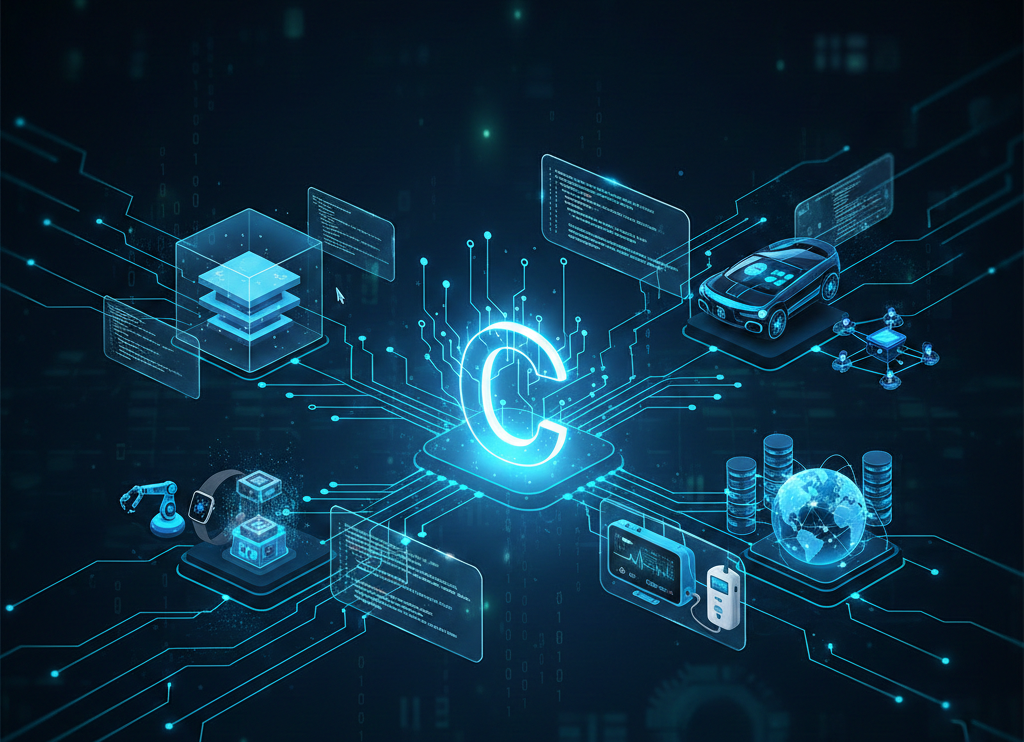
C Programming Applications, C Language Uses & Real-Life Uses of C
Complete Industry Guide by Techcadd Mohali
C programming is one of the most powerful and influential programming languages in the history of computing. Developed in the early 1970s by Dennis Ritchie at Bell Labs, C was originally designed to build system software. Over the decades, it has evolved into a foundational language that powers operating systems, embedded devices, networking infrastructure, databases, compilers, and high-performance applications.
Even in 2026, C remains one of the most relevant languages in the software industry. Its unmatched control over memory, hardware-level access, execution speed, and portability make it the preferred choice for critical system development.
At Techcadd Mohali, we believe mastering C programming builds the strongest foundation for any technical career. In this detailed guide, we will explore:
-
C Programming Applications
-
C Language Uses in Industry
-
Real-Life Uses of C
-
Why C is Still Important Today
-
Career Scope and Industry Demand
1. Introduction to C Programming
C is a structured, procedural programming language that provides low-level access to memory while maintaining high-level readability. It acts as a bridge between machine-level programming and high-level languages.
Key characteristics of C:
-
Fast execution speed
-
Direct memory manipulation using pointers
-
Portability across platforms
-
Structured programming support
-
Small runtime footprint
Because of these features, C became the backbone of system software and remains essential for performance-critical applications.
2. Major Applications of C Programming
2.1 Operating Systems Development
One of the biggest applications of C is operating system development.
Famous operating systems built largely in C include:
-
Linux
-
Windows (core components)
-
macOS (low-level layers)
Why is C used for operating systems?
-
Direct hardware interaction
-
Memory management control
-
Efficient process scheduling
-
Low-level system calls
An operating system must manage CPU, memory, disk, and devices. C provides the control required to build these core components efficiently.
2.2 Embedded Systems
Embedded systems are one of the largest real-world uses of C programming.
Embedded systems exist in:
-
Microcontrollers
-
IoT devices
-
Automotive control units
-
Smart appliances
-
Industrial machines
Examples of real-life embedded applications:
-
Anti-lock braking systems (ABS)
-
Smart refrigerators
-
Air conditioners
-
Fitness trackers
-
Traffic control systems
C is preferred because:
-
It consumes minimal memory
-
It executes quickly
-
It allows hardware register manipulation
-
It works efficiently in resource-constrained environments
Most firmware in embedded devices is written in C.
2.3 Database Management Systems
High-performance database engines rely heavily on C.
Examples:
-
MySQL
-
PostgreSQL
-
Oracle Database
Why C for databases?
-
Efficient memory handling
-
Faster query processing
-
Optimized data storage
-
Performance-critical backend operations
Databases must process millions of records quickly. C ensures high efficiency and low overhead.
2.4 Compiler Development
C is widely used to build compilers and interpreters.
One of the most important compiler systems:
-
GCC
Many programming languages have interpreters written in C because it allows:
-
Efficient lexical analysis
-
Fast parsing
-
Direct memory management
-
Optimized runtime systems
C is sometimes described as the “mother language” because many languages are implemented using C.
2.5 Networking Applications
C plays a major role in networking systems.
Applications include:
-
Protocol implementation
-
Network drivers
-
Routers and switches firmware
-
Packet processing systems
The TCP/IP protocol stack is commonly implemented in C in many systems. Since networking requires high-speed packet handling, C provides the required performance.
2.6 Game Development
While modern game engines use C++, many early and performance-critical games used C.
Classic example:
-
Doom
C allows:
-
Direct graphics memory access
-
Real-time processing
-
Efficient game loop handling
-
Performance optimization
Game engines require high frame rates and real-time responsiveness — C supports this level of performance.
2.7 Device Drivers
Device drivers are system programs that allow operating systems to communicate with hardware devices.
Examples:
-
Printer drivers
-
Graphics drivers
-
Network card drivers
-
Storage drivers
C is used because drivers must:
-
Access hardware registers
-
Manage interrupts
-
Handle memory buffers
-
Operate at kernel level
2.8 IoT (Internet of Things)
IoT devices run on small processors with limited memory. C is ideal because:
-
It uses minimal resources
-
It runs efficiently on microcontrollers
-
It supports real-time processing
Applications include:
-
Smart home automation
-
Wearable devices
-
Industrial IoT systems
-
Smart agriculture
3. Real-Life Uses of C Programming
Many people think C is only for software developers, but its real-life impact is massive.
Here are real-world examples where C is actively used:
3.1 ATM Machines
ATM software systems use C for:
-
Secure transaction processing
-
Hardware interaction
-
Real-time operation
3.2 Medical Equipment
Devices such as:
-
ECG machines
-
MRI scanners
-
Patient monitoring systems
require reliable and fast software — often developed in C.
3.3 Automotive Systems
Modern cars contain dozens of microcontrollers running C-based firmware.
Systems include:
-
Engine control units
-
Airbag systems
-
Cruise control
-
Parking assistance
3.4 Aerospace & Defense
C is used in:
-
Flight control systems
-
Satellite systems
-
Radar systems
-
Missile guidance systems
Because C offers precision, speed, and hardware-level control.
3.5 Smart Home Devices
Devices like:
-
Smart TVs
-
Washing machines
-
Microwave ovens
-
Security cameras
use embedded C programming.
4. Why C Programming is Still Relevant in 2026
Despite newer languages like Python and Java, C remains essential.
4.1 Performance
C is extremely fast because:
-
It compiles directly to machine code
-
No heavy runtime environment
-
Minimal abstraction
4.2 Memory Control
C provides:
-
Manual memory allocation (malloc, calloc)
-
Direct pointer manipulation
-
Stack and heap management
This is critical for embedded and system programming.
4.3 Foundation for Other Languages
Many modern languages are influenced by C syntax and structure.
Examples include:
-
C++
-
Java
-
Python
-
C#
Learning C makes it easier to learn other programming languages.
5. Industrial Demand for C Programmers
C developers are in demand in:
-
Embedded systems companies
-
Automotive industries
-
Semiconductor companies
-
Robotics firms
-
Defense organizations
-
IoT startups
High-demand roles:
-
Embedded Systems Engineer
-
Firmware Developer
-
Systems Programmer
-
Kernel Developer
-
Device Driver Developer
6. Advantages of Learning C Programming
6.1 Strong Programming Foundation
C teaches:
-
Pointers
-
Data structures
-
Memory management
-
Recursion
-
Algorithm development
6.2 Logical Thinking Development
C forces programmers to think about:
-
How memory works
-
How programs execute
-
How hardware interacts with software
6.3 Better Understanding of Computer Architecture
Students who learn C understand:
-
CPU functioning
-
RAM usage
-
Stack vs Heap
-
Compilation process
7. C Programming in Education
C is widely used in universities and engineering colleges because:
-
It introduces programming fundamentals
-
It builds strong coding logic
-
It prepares students for advanced languages
Most computer science degrees start with C programming.
8. Challenges in C Programming (And Why They Matter)
C requires careful programming due to:
-
Manual memory management
-
No automatic garbage collection
-
Risk of buffer overflows
-
Pointer misuse
But these challenges make programmers stronger and more disciplined.
9. Future Scope of C Programming
C will continue to be important in:
-
Embedded AI devices
-
Autonomous vehicles
-
Robotics
-
High-performance computing
-
Real-time systems
As long as hardware exists, C will remain relevant.
10. Why Learn C at Techcadd Mohali?
At Techcadd Mohali, we provide industry-oriented C programming training designed to build strong technical foundations.
Our training focuses on:
-
Practical lab sessions
-
Real-time embedded examples
-
Pointer mastery
-
Memory optimization techniques
-
Interview preparation
-
Industry-based projects
We ensure students understand not just syntax, but real-world applications of C programming.
11. Core Features of C Programming Language
Understanding why C is powerful requires looking at its core features.
11.1 Structured Programming
C follows a structured programming approach:
-
Functions
-
Loops
-
Conditional statements
-
Modular programming
This improves:
-
Code readability
-
Maintenance
-
Debugging
Structured programming makes large-scale system development manageable.
11.2 Pointers – The Power Feature of C
Pointers are one of the most important concepts in C.
They allow:
-
Direct memory access
-
Dynamic memory allocation
-
Efficient array and string handling
-
Data structure implementation
Real-world importance:
-
Linked lists
-
Stacks
-
Queues
-
Trees
-
Graphs
Without pointers, system-level programming is nearly impossible.
11.3 Dynamic Memory Management
C provides functions like:
-
malloc()
-
calloc()
-
realloc()
-
free()
This allows developers to allocate memory at runtime.
Why it matters:
-
Embedded systems have limited RAM
-
High-performance applications require optimized memory
-
Real-time systems cannot waste memory
11.4 Portability
Programs written in C can run on different systems with minimal modification.
This is why systems like Linux became widely adopted across multiple architectures.
12. C Programming in High-Performance Computing (HPC)
High-performance computing requires maximum speed and optimized execution.
C is used in:
-
Scientific simulations
-
Weather modeling
-
Physics engines
-
Computational mathematics
-
Space research
Why?
-
Minimal runtime overhead
-
Direct CPU instruction access
-
Efficient use of system resources
Many scientific libraries are written in C for performance reasons.
13. Role of C in Cybersecurity
C plays a crucial role in cybersecurity.
Applications include:
-
Encryption tools
-
Security protocols
-
Penetration testing tools
-
Firewall software
Many security tools and operating system kernels rely on C.
Understanding C also helps in:
-
Understanding buffer overflow vulnerabilities
-
Learning exploit development
-
Secure coding practices
For cybersecurity professionals, knowledge of C is highly valuable.
14. C Programming in Robotics
Robotics systems require:
-
Real-time sensor input processing
-
Motor control
-
Low-level hardware communication
C is commonly used because:
-
It allows precise timing control
-
It works well with microcontrollers
-
It ensures predictable performance
Industrial robots often use embedded C firmware.
15. C Language Uses in Semiconductor Industry
Chip manufacturers and semiconductor companies use C for:
-
Firmware development
-
Hardware testing tools
-
Device configuration software
-
Driver development
Since semiconductor systems work close to hardware, C is ideal.
16. Comparison: C vs Modern Languages
Many students ask: Why learn C when Python or Java exist?
Here is the difference:
| Feature | C | Python |
|---|---|---|
| Execution Speed | Very Fast | Slower |
| Memory Control | Manual | Automatic |
| Hardware Access | Direct | Limited |
| Embedded Systems | Yes | Rare |
| System Programming | Yes | No |
Languages like Python are great for rapid development, but C is unbeatable in low-level programming.
17. Real-Life Case Study: How C Runs Your Daily Life
You may not see C directly, but it runs behind the scenes.
When you:
-
Start your laptop → OS core in C
-
Withdraw cash from ATM → Embedded system in C
-
Use Wi-Fi router → Firmware in C
-
Drive a modern car → Control units in C
-
Use a smart TV → Embedded firmware in C
C operates silently in mission-critical environments.
18. Industries That Rely on C Programming
C is heavily used in the following industries:
1. Automotive Industry
Engine control systems, braking systems, dashboard software
2. Healthcare Industry
Medical imaging devices, monitoring systems
3. Telecommunications
Network switching systems, communication protocols
4. Defense & Aerospace
Flight systems, satellite controls
5. Consumer Electronics
Smartphones (low-level layers), smart devices
6. Manufacturing
Industrial automation and robotics
19. Career Opportunities After Learning C
Learning C opens doors to multiple technical domains.
Popular job roles:
-
Embedded Systems Engineer
-
Firmware Developer
-
Systems Programmer
-
Kernel Developer
-
Network Engineer
-
IoT Developer
-
Device Driver Engineer
Companies hiring C programmers include:
-
Automotive manufacturers
-
Semiconductor companies
-
IoT startups
-
Robotics firms
-
System software companies
C developers are often highly paid due to specialized skills.
20. Skills You Develop by Learning C
At Techcadd Mohali, students gain:
Strong Programming Logic
C forces logical thinking and structured problem solving.
Debugging Skills
Because C does not hide errors behind abstraction layers.
Memory Management Expertise
Critical for high-performance systems.
Deep Technical Understanding
You understand how software interacts with hardware.
21. Why C is Called the “Mother of Programming Languages”
C influenced many modern languages including:
-
C++
-
Java
-
C#
-
Objective-C
-
Go
Its syntax and structural design became the template for future languages.
Learning C makes transitioning to other languages easier and faster.
22. C Programming for Students and Beginners
C is ideal for:
-
B.Tech students
-
BCA / MCA students
-
Polytechnic students
-
Electronics students
-
Beginners in programming
Because it teaches core concepts without hiding complexity.
23. Advanced Concepts in C Used in Industry
Professional C developers work with:
-
Bitwise operations
-
Multi-threading
-
Process synchronization
-
File handling
-
Socket programming
-
Memory-mapped I/O
-
Interrupt handling
These advanced topics are used in real-time systems and operating system design.
24. Importance of C in Competitive Programming
C is fast and efficient, which makes it suitable for:
-
Algorithm competitions
-
Data structure implementation
-
Performance-critical coding
Although C++ is more common today, understanding C improves algorithmic thinking.
25. Why C Will Never Become Obsolete
Technology evolves, but hardware will always exist.
As long as we need:
-
Operating systems
-
Embedded devices
-
Real-time control systems
-
High-speed applications
C will remain essential.
New languages may rise, but C continues to power the core of computing infrastructure.


Comments
No comments yet. Be the first to comment.
Leave a Comment