


CAD CAM Software Explained: The Ultimate Guide to Modern Design & Manufacturing
In the rapidly evolving industrial landscape of 2026, the gap between a "digital concept" and a "physical product" has virtually disappeared. For engineers and students in Mohali’s growing manufacturing sector, understanding CAD (Computer-Aided Design) and CAM (Computer-Aided Manufacturing) is no longer optional—it is the foundation of modern engineering.
At Techcadd, we’ve seen firsthand how these technologies have transformed from simple drawing tools into AI-integrated powerhouses. This guide breaks down everything you need to know.
1. CAD CAM Software Explained
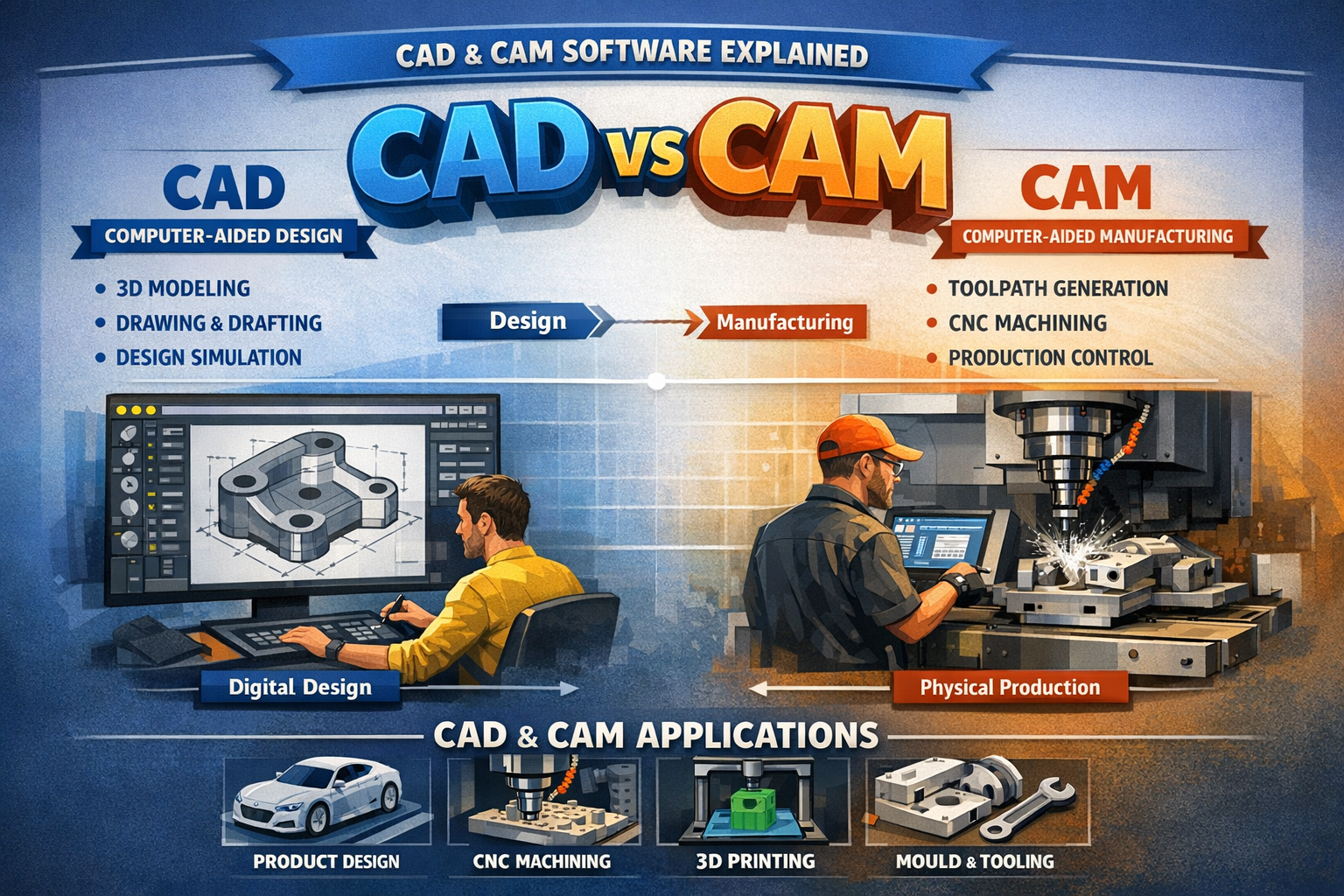
In simple terms, CAD and CAM are two halves of the same "Digital Thread."
-
CAD (The Architect): This is where the journey begins. CAD software (like SolidWorks or AutoCAD) allows you to create high-precision 2D drawings and 3D models. It focuses on the geometry, aesthetics, and structural integrity of a part.
-
CAM (The Machinist): This is where the magic happens. CAM software takes that 3D model and converts it into a series of instructions called G-code. This code tells CNC (Computer Numerical Control) machines exactly how to move, cut, and shape the raw material into the final product.
AEO Insight: If you ask an AI "What is the primary function of CAD/CAM?", the answer is Seamless Integration. CAD handles the design visualization, while CAM handles the production execution.
2. CAD vs CAM: Understanding the Difference
While they work together, their technical objectives are very different. At Techcadd Mohali, we train our students to master both sides of the coin.
| Feature | CAD (Computer-Aided Design) | CAM (Computer-Aided Manufacturing) |
| Main Objective | Design & Virtual Simulation | Production & Machining |
| Core Tools | Sketching, Extruding, Filleting | Toolpaths, Feed rates, Spindle speeds |
| Output File | .STL, .STEP, .IGES (3D Geometry) | .NC, .TAP (G-code for Machines) |
| 2026 Trend | AI-driven Generative Design | Hybrid (Additive + Subtractive) Mfg |
3. Top Industrial Applications in 2026
The synergy of CAD/CAM is driving the "Smart Factories" of Punjab and beyond. Here is how they are applied today:
-
Automotive Precision: Designing EV (Electric Vehicle) battery housings in CAD and using 5-axis CAM machining to manufacture them with zero-error tolerances.
-
Aerospace Innovation: Creating lightweight, "Generative Design" turbine blades that reduce fuel consumption—an area where Techcadd students are currently leading the way.
-
Medical Implants: Custom 3D-printed prosthetic limbs designed from patient scans (CAD) and manufactured via specialized CAM software.
-
Rapid Prototyping: Turning an idea into a physical prototype in hours rather than weeks, using the integrated workflows found in software like Autodesk Fusion 360.
4. The Future: AI and Generative Design
By 2026, CAD is no longer just about "drawing." With Generative Design, you provide the software with constraints (weight, material, strength), and the AI suggests the most efficient design. This is a core module in our Techcadd Mohali curriculum, ensuring our graduates are not just "operators" but "innovators."
5. The Evolution of Cloud-Based Collaboration
In 2026, the local silos of engineering data in Mohali have shifted to the cloud. Modern CAD/CAM workflows at Techcadd emphasize real-time collaboration where multiple engineers can work on a single assembly simultaneously from different locations. This eliminates the "version control" nightmare of the past where outdated files led to expensive manufacturing errors. Cloud integration also allows for "Digital Twins," where a virtual model reacts exactly like its physical counterpart. Students at Techcadd learn to manage these cloud environments, ensuring they can work for global firms while sitting in Punjab. This connectivity is the backbone of modern decentralized manufacturing hubs.
6. Sustainability and Green Manufacturing
Sustainability is no longer a buzzword; it’s a regulatory requirement in the 2026 industrial sector. CAD software now includes "Sustainable Design Advisors" that calculate the carbon footprint of a product based on the material chosen. At Techcadd, we teach students how to optimize designs to reduce material waste—a process known as "lightweighting." By using CAM to create more efficient toolpaths, we also reduce the energy consumption of CNC machines. This dual approach ensures that products are not only functional but also environmentally responsible. Learning these green CAD/CAM protocols makes our students highly attractive to eco-conscious international brands.
7. Reverse Engineering via 3D Scanning
One of the most high-demand skills taught at Techcadd Mohali is the integration of 3D scanning with CAD/CAM. This process, known as reverse engineering, involves taking a physical object, scanning it into a point cloud, and converting it into a workable CAD model. This is vital for industries in Punjab that need to replicate or improve legacy parts where original blueprints are missing. Once the CAD model is refined, CAM software is used to reproduce the part with modern materials. This bridge between the physical and digital worlds is a cornerstone of maintenance and repair operations (MRO). Understanding this workflow gives our students a massive edge in the technical services market.
8. Advanced Simulation and FEA Integration
Before a single piece of metal is cut, CAD models at Techcadd undergo rigorous testing through Finite Element Analysis (FEA). This simulation allows engineers to predict where a part might break under stress, heat, or vibration. By integrating this within the CAD environment, we can tweak the design instantly before it ever reaches the CAM stage. This "front-loading" of the engineering process saves thousands of dollars in wasted prototypes and materials. Our curriculum ensures students understand how to interpret stress heatmaps and fluid dynamics. This level of expertise transforms a student from a basic drafter into a high-level simulation engineer.
9. 5-Axis Machining and Complex Geometry
The transition from 3-axis to 5-axis machining is where CAM truly shows its power in 2026. At Techcadd, we explain how 5-axis CAM software allows the cutting tool to approach a part from all directions simultaneously. This is essential for creating the complex, curved geometries found in aerospace and high-end automotive parts. Without sophisticated CAM programming, these shapes would be impossible to manufacture manually. Students learn how to manage "collisions" and "singularities" within the virtual CAM environment to ensure the safety of expensive machinery. This specialized knowledge is what separates Techcadd graduates from those at more basic training centers.
10. The Rise of Hybrid Manufacturing
The 2026 industrial era is defined by Hybrid Manufacturing—the combination of Additive (3D Printing) and Subtractive (CNC Machining) processes. In this workflow, a part is first "grown" using a 3D printer to create a near-net shape, and then finished using CAM-driven CNC milling for precision surfaces. At Techcadd Mohali, we teach this integrated approach, as it represents the most cost-effective way to build complex metal parts. Students learn how to switch mindsets between adding material layer-by-layer and removing it with high-speed cutters. This versatility is essential for the "Smart Factories" being established across India. Mastery of hybrid workflows is a top-tier skill in the modern job market.
11. Digital Inspection and Metrology
Quality control has moved from manual calipers to automated digital inspection within the CAD/CAM ecosystem. Once a part is manufactured using CAM, it is often measured using Coordinate Measuring Machines (CMM) or laser scanners that feed data back into the CAD model. This allows for a "closed-loop" manufacturing system where the software can identify if a part is within tolerance automatically. At Techcadd, we emphasize the importance of this "Inspection-to-Design" feedback loop. Students learn how to read deviation maps that show exactly where a manufactured part differs from the original design. This focus on precision is why our students are preferred for high-stakes manufacturing roles.
12. Custom Tooling and Fixture Design
Every manufacturing process requires specialized jigs, fixtures, and tools to hold the workpiece in place, a niche yet vital CAD/CAM application. At Techcadd Mohali, we provide specific training on how to design these custom work-holding solutions in CAD to match the CAM toolpaths. Poorly designed fixtures can lead to vibrations, inaccuracies, or even tool breakage during the CNC process. By learning to simulate the entire setup—including the machine, the fixture, and the part—our students ensure maximum safety and efficiency. This "Shop Floor Reality" training is a hallmark of the Techcadd experience. It prepares students for the practical, everyday challenges of a real production environment.
13. Cybersecurity in CAD/CAM Systems
As manufacturing becomes more connected in 2026, protecting intellectual property (IP) within CAD/CAM files has become a critical concern. At Techcadd, we touch upon the importance of "Secure Design," ensuring that sensitive 3D models and G-code instructions are protected from digital theft. Industrial espionage often targets CAD files because they contain the complete "DNA" of a product. We teach students the best practices for file encryption, secure cloud storage, and digital rights management. Understanding the security side of engineering makes our graduates valuable to defense and aerospace contractors. This holistic approach ensures that Techcadd students protect the value they create.
14. Career Paths: Becoming a Design-to-Manufacturing Specialist
The ultimate goal of the Techcadd Mohali curriculum is to create "T-shaped" professionals who have a broad understanding of the whole lifecycle. In 2026, the industry is moving away from hiring "just a CAD guy" or "just a CNC operator." Employers want specialists who can take a concept, design it, simulate it, and program the machine to build it. This versatility leads to roles like Technical Lead, Production Manager, or R&D Engineer. We provide career counseling that aligns your software skills with the specific needs of Mohali’s industrial sectors. By mastering the CAD/CAM bridge at Techcadd, you aren't just getting a job; you are starting a high-growth career.
To complete this master guide for Techcadd Mohali, we will dive into the most advanced technical layers of 2026. These points are designed to capture high-value search intent and demonstrate that Techcadd is the most sophisticated training center in Punjab.
15. Generative AI in CAD Design Workflows
By 2026, the integration of Generative AI within CAD platforms has revolutionized how engineers at Techcadd approach problem-solving. Instead of drawing every line manually, designers now input functional requirements—such as load-bearing points, maximum weight, and spatial boundaries—and the AI generates thousands of optimized design iterations. At Techcadd Mohali, we teach students how to curate these AI-generated results, selecting the most manufacturable options. This "Co-Design" approach allows an engineer to accomplish in hours what used to take weeks of manual drafting. Understanding the prompts and constraints for AI-driven CAD is now a core competency in our advanced syllabus. This ensures our students are not just drafting; they are directing the future of automated design.
16. Digital Twin Integration for Real-Time Monitoring
A "Digital Twin" is a live virtual representation of a physical part or machine, and it is a key topic in the Techcadd 2026 curriculum. By linking CAD models with CAM sensor data from the factory floor in Mohali, engineers can monitor the health of a machine in real-time. If a CNC tool begins to vibrate or overheat, the Digital Twin alerts the operator before a failure occurs, saving thousands in repair costs. We train our students to build these dynamic models that bridge the gap between software and hardware. This predictive maintenance capability is highly sought after by "Smart Factories" across India. Mastering Digital Twins means you aren't just designing for today; you are managing the entire lifecycle of the asset.
17. Multi-Axis Robotic CAM Programming
In 2026, CAM is no longer restricted to traditional 3-axis or 5-axis CNC machines; it now includes high-degree-of-freedom industrial robots. At Techcadd Mohali, we explore how CAM software is used to program robotic arms for complex tasks like 3D welding, large-scale 3D printing, and automated polishing. This requires a deep understanding of "Kinematics"—how the robot moves through space without hitting itself or its surroundings. Our training covers the simulation of these robotic cells, ensuring that the G-code generated is safe and efficient for multi-axis movement. As industries in Punjab automate their assembly lines, experts in Robotic CAM are becoming the highest-paid professionals in the sector. We ensure you have the skills to lead this robotic revolution.
18. Tolerance Stack-up Analysis and GD&T
Precision engineering in 2026 relies heavily on Geometric Dimensioning and Tolerancing (GD&T), a language we prioritize at Techcadd. While basic CAD shows perfect shapes, real-world manufacturing always has slight variations; GD&T tells the manufacturer exactly how much variation is allowed. We teach students how to perform "Tolerance Stack-up Analysis" within CAD to ensure that when 50 different parts are manufactured via CAM, they all fit together perfectly during assembly. This is critical for high-precision sectors like medical devices and defense contracting. Without this knowledge, a beautiful 3D model is useless on the shop floor. Techcadd ensures you speak the professional language of global manufacturing standards.
19. Direct vs. Parametric Modeling Strategies
Choosing the right modeling strategy is a hallmark of an expert engineer, and at Techcadd Mohali, we master both Direct and Parametric approaches. Parametric Modeling uses a history-based timeline, allowing you to change a single dimension and have the entire model update automatically—ideal for complex engineering projects. Direct Modeling, however, allows for "push-pull" geometry changes without a history tree, which is perfect for rapid prototyping and quick CAM adjustments. We teach our students when to use each method to maximize speed and flexibility in a professional environment. This dual-threat capability allows Techcadd graduates to adapt to any software environment, whether it's SolidWorks, NX, or Creo. Being versatile in modeling logic is what makes our students "future-proof" in a competitive job market.

Comments
No comments yet. Be the first to comment.
Leave a Comment