

Introduction: Your Journey into the Data World
The fields of data science and data analytics have emerged as some of the most exciting and rewarding career paths in the modern economy. With organizations across every industry racing to become data-driven, the demand for skilled professionals has never been higher. But for beginners, the question is always the same: "Where do I start?"
The path to becoming a data scientist or data analyst can seem overwhelming. There are countless tools to learn, concepts to master, and skills to develop. Without a clear data science roadmap or data analytics roadmap, it's easy to get lost, waste time on the wrong things, or become discouraged.
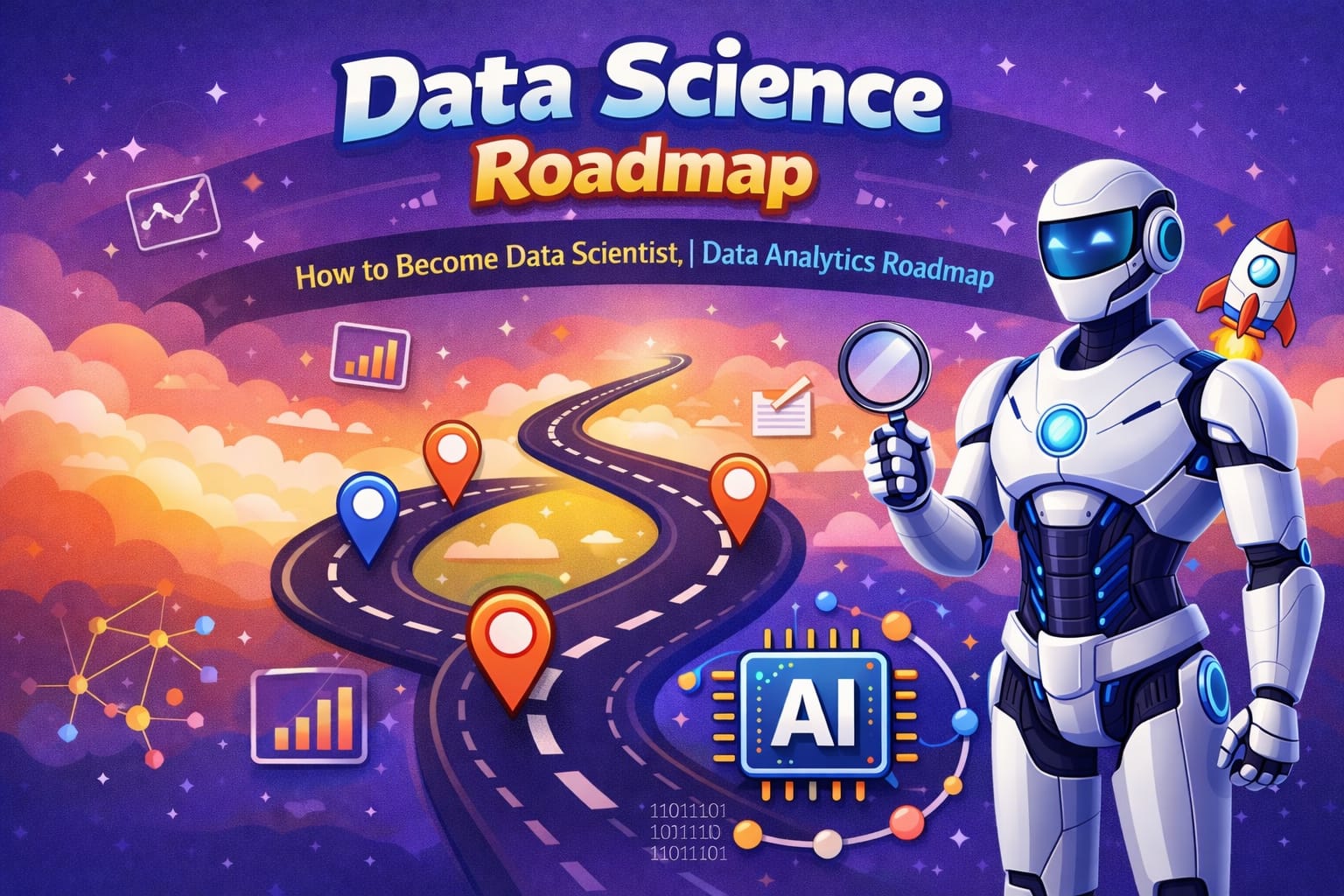
This comprehensive guide provides a clear, step-by-step data science roadmap and data analytics roadmap to help you navigate your learning journey. Whether you're a complete beginner wondering how to become a data scientist, or someone considering which path to choose, this guide will give you a structured approach to achieving your goals.
-
Clear roadmap: Step-by-step learning path for both fields
-
Beginner-friendly: No prior knowledge assumed
-
Practical focus: Skills, tools, projects at each stage
-
Time estimates: Realistic timelines for each phase
-
Career guidance: How to transition from learning to earning
Section 1: Data Analytics Roadmap – Complete Step-by-Step Guide
1.1 What is Data Analytics?
Data analytics is the process of examining raw data to draw conclusions, identify patterns, and support business decision-making. Data analysts work with existing data to answer questions like "What happened?" "Why did it happen?" and "What might happen next based on past trends?"
The data analytics roadmap is designed for those who want to enter the field quickly and work closely with business stakeholders. It's an excellent starting point for beginners, with a clear learning path that can be completed in 3-6 months.
Time to job-ready: 3-6 months with focused effort
Difficulty level: Beginner-friendly, no advanced math required
Target roles: Data Analyst, Business Analyst, BI Analyst
1.2 Phase 1: Foundations (Weeks 1-4)
Excel Mastery
Excel is the universal language of business and the foundation of data analytics. Start here:
-
Learn: Basic formulas (SUM, AVERAGE, COUNT), cell referencing, data sorting and filtering
-
Move to: Logical functions (IF, AND, OR), lookup functions (VLOOKUP, INDEX-MATCH)
-
Master: Pivot tables, charts, and basic dashboards
-
Practice: Build a sales dashboard using sample data
Resources: Built-in Excel tutorials, YouTube tutorials, practice datasets
Goal: Create a complete dashboard from raw data independently
Statistics Fundamentals
You don't need advanced math, but basic statistics is essential:
-
Descriptive statistics: Mean, median, mode, standard deviation, variance
-
Data distributions: Normal distribution, skewness, outliers
-
Basic probability: Concepts of probability, conditional probability
-
Practice: Calculate statistics on real datasets, identify distributions
-
Time: 3-4 weeks
-
Skills gained: Excel proficiency, statistical thinking
-
Projects: Sales dashboard, statistical summary report
1.3 Phase 2: Data Manipulation (Weeks 5-10)
SQL (Structured Query Language)
SQL is how you talk to databases. It's the most tested skill in data interviews:
-
Learn: SELECT statements, WHERE filters, ORDER BY sorting
-
Move to: GROUP BY aggregations, HAVING filters, JOINs (INNER, LEFT, RIGHT)
-
Master: Subqueries, Common Table Expressions (CTEs), window functions
-
Practice: Write queries on sample databases, analyze business questions
Resources: SQLZoo, LeetCode SQL problems, practice databases
Goal: Extract any data you need from a database independently
Python Basics
Python is the most popular language for data work. Start with fundamentals:
-
Learn: Variables, data types, loops, conditionals, functions
-
Move to: Lists, tuples, dictionaries, sets – when to use each
-
Practice: Write small programs, solve coding challenges
Resources: Python.org tutorials, Codecademy, practice exercises
Goal: Write basic Python programs comfortably
-
Time: 5-6 weeks
-
Skills gained: SQL proficiency, Python basics
-
Projects: SQL database queries, Python data processing scripts
1.4 Phase 3: Data Analysis with Python (Weeks 11-14)
Pandas for Data Manipulation
Pandas is the essential library for data work in Python:
-
Learn: Series and DataFrames, reading data (CSV, Excel)
-
Move to: Data cleaning – handling missing values, duplicates
-
Master: Filtering, grouping, merging, pivoting data
-
Practice: Clean and analyze messy real-world datasets
NumPy for Numerical Computing
-
Learn: Arrays, array operations, broadcasting
-
Practice: Mathematical operations on large datasets
Data Visualization
-
Learn: Matplotlib basics – line plots, scatter plots, bar charts
-
Move to: Seaborn for statistical visualizations – heatmaps, pair plots
-
Practice: Create visualizations that tell stories with data
-
Time: 4 weeks
-
Skills gained: Data cleaning, manipulation, visualization
-
Projects: Exploratory data analysis on real datasets
1.5 Phase 4: Business Intelligence Tools (Weeks 15-17)
Power BI
-
Learn: Connecting to data sources, data modeling
-
Move to: Creating visualizations, building interactive dashboards
-
Master: DAX formulas, calculated columns, measures
-
Practice: Build dashboards for business scenarios
Tableau
-
Learn: Connecting to data, creating worksheets
-
Move to: Building dashboards, storytelling with data
-
Practice: Create compelling visual stories
-
Time: 3 weeks
-
Skills gained: Professional dashboard creation
-
Projects: Interactive business dashboards
1.6 Phase 5: Portfolio and Job Preparation (Weeks 18-20)
Build Your Portfolio
-
Create 8-10 projects showcasing different skills
-
Host code on GitHub
-
Write clear project documentation
-
Create a LinkedIn profile highlighting your work
Interview Preparation
-
Practice SQL questions daily
-
Review Python coding challenges
-
Prepare case study approaches
-
Practice explaining your projects
Job Search
-
Target entry-level data analyst roles
-
Apply to companies in your area and remote positions
-
Leverage your training institute's placement support
-
Time: 3-4 weeks
-
Outcome: Job-ready portfolio and interview skills
-
Next step: Start applying for data analyst positions
Section 2: Data Science Roadmap – Complete Step-by-Step Guide
2.1 What is Data Science?
Data science is a broader, more advanced field that encompasses predicting future outcomes and building intelligent systems. Data scientists build models that forecast trends, classify data, and make recommendations. They work with both structured and unstructured data, including text, images, and video.
The data science roadmap builds on analytics foundations and adds advanced mathematics, machine learning, and deep learning. It requires more time and deeper learning but leads to higher earning potential and more advanced roles.
Time to job-ready: 9-12 months with focused effort
Difficulty level: Advanced, requires mathematical aptitude
Target roles: Data Scientist, Machine Learning Engineer, AI Specialist
2.2 Phase 1: Foundations (Months 1-2)
Complete the Data Analytics Roadmap First
Before diving into data science, you need the foundations. Complete all phases of the data analytics roadmap:
-
Excel mastery
-
SQL proficiency
-
Python programming
-
Pandas and data manipulation
-
Statistics fundamentals
Deepen Your Python Skills
-
Object-oriented programming
-
Error handling and debugging
-
Working with external libraries
-
Writing clean, efficient code
Strengthen Mathematics Foundation
-
Linear algebra: Vectors, matrices, matrix operations – essential for understanding machine learning algorithms
-
Calculus: Derivatives, gradients, partial derivatives – foundation for optimization
-
Probability: Probability distributions, Bayes' theorem, random variables
-
Time: 2 months
-
Skills gained: Strong programming, mathematical foundation
-
Prerequisite: Comfort with high school mathematics
2.3 Phase 2: Machine Learning Fundamentals (Months 3-5)
Machine Learning Theory
-
Types of learning: supervised, unsupervised, reinforcement
-
The machine learning workflow
-
Bias-variance tradeoff, overfitting, underfitting
-
Model evaluation metrics
Supervised Learning Algorithms
-
Regression: Linear regression, polynomial regression, regularization (Ridge, Lasso)
-
Classification: Logistic regression, decision trees, random forests, support vector machines
-
Practice: Build and evaluate models using scikit-learn
Unsupervised Learning Algorithms
-
Clustering: K-means, hierarchical clustering
-
Dimensionality reduction: PCA, t-SNE
-
Practice: Customer segmentation, pattern discovery
Model Evaluation and Selection
-
Cross-validation techniques
-
Hyperparameter tuning (grid search, random search)
-
Model comparison and selection
-
Time: 3 months
-
Skills gained: Core machine learning algorithms
-
Projects: Prediction models, classification systems
2.4 Phase 3: Deep Learning (Months 6-7)
Neural Networks Fundamentals
-
Perceptrons and activation functions
-
Forward propagation and backpropagation
-
Gradient descent optimization
-
Loss functions
Deep Learning Architectures
-
Deep Neural Networks: Multi-layer networks, regularization techniques
-
Convolutional Neural Networks (CNNs) : For image data, computer vision
-
Recurrent Neural Networks (RNNs) : For sequence data, time series, NLP
Deep Learning Frameworks
-
TensorFlow and Keras
-
PyTorch basics
-
Building and training neural networks
-
Time: 2 months
-
Skills gained: Deep learning implementation
-
Projects: Image classification, sentiment analysis
2.5 Phase 4: Advanced Topics (Month 8)
Big Data Technologies
-
Introduction to distributed computing
-
Apache Spark basics (RDDs, DataFrames, Spark SQL)
-
Working with large datasets
Cloud Platforms
-
AWS for data science (S3, SageMaker)
-
Azure Machine Learning
-
Google Cloud AI Platform
MLOps and Model Deployment
-
Building REST APIs for models
-
Containerization with Docker
-
Model monitoring and maintenance
-
Time: 1 month
-
Skills gained: Big data, cloud, deployment
-
Projects: Deployed models, scalable data pipelines
2.6 Phase 5: Portfolio and Job Preparation (Month 9)
Build Your Data Science Portfolio
-
15-20 projects showcasing full range of skills
-
End-to-end machine learning projects
-
Deep learning applications
-
Deployed models with APIs
-
Host everything on GitHub with excellent documentation
Interview Preparation
-
Practice machine learning concepts and algorithms
-
Solve coding challenges (Python, SQL)
-
Prepare case study approaches
-
Review statistical concepts
-
Practice explaining complex models simply
Job Search
-
Target data scientist roles (entry-level, junior)
-
Apply to product companies, startups, consulting firms
-
Leverage placement support and alumni network
-
Time: 1 month
-
Outcome: Job-ready data scientist
-
Next step: Launch your data science career
Section 3: How to Become a Data Scientist – Step-by-Step Action Plan
3.1 Step 1: Assess Your Starting Point
Before beginning your journey, honestly assess your current skills:
Background Type A: Non-Technical (Commerce, Arts, Business)
-
Start with data analytics roadmap (6 months)
-
Build strong foundations before attempting data science
-
Expect 12-15 months total to become job-ready
Background Type B: Technical (Engineering, Math, Stats, CS)
-
You may have some foundations already
-
Assess your math and programming skills
-
Likely need 9-12 months of focused learning
Background Type C: Working Professional
-
Consider part-time learning (weekends, evenings)
-
Expect 12-18 months to transition
-
Leverage domain expertise as advantage
3.2 Step 2: Choose Your Learning Path
Option A: Self-Learning
-
Free resources available online
-
Requires strong self-discipline
-
No structured support or placement
-
Takes longer, higher dropout rate
Option B: Structured Training (Recommended)
-
Comprehensive curriculum
-
Guided learning with expert faculty
-
Peer learning and networking
-
Placement support
-
Faster, more efficient learning
Option C: University Degree
-
2-3 year commitment
-
Expensive
-
Theoretical focus
-
May still need practical training
3.3 Step 3: Master the Fundamentals (Months 1-3)
-
Complete Excel, SQL, and Python basics
-
Build 5-6 small projects
-
Create GitHub account and start documenting
-
Join data communities (LinkedIn, Reddit, Discord)
3.4 Step 4: Dive Deep into Analytics/Science (Months 4-8)
-
For analytics: BI tools, statistics, dashboard projects
-
For science: Machine learning algorithms, deep learning
-
Build 10-15 projects
-
Participate in Kaggle competitions
-
Network with professionals
3.5 Step 5: Build Your Portfolio (Month 9)
-
Select 8-10 best projects for portfolio
-
Write clear documentation
-
Create project walkthrough videos
-
Optimize LinkedIn and GitHub
-
Prepare project presentations
3.6 Step 6: Interview Preparation (Month 10)
-
Daily SQL and Python practice
-
Review machine learning concepts
-
Practice case studies
-
Mock interviews
-
Update resume
3.7 Step 7: Job Search (Month 11-12)
-
Start applying to companies
-
Attend placement drives
-
Network with alumni
-
Learn from rejections, keep improving
-
Accept offer and launch career
-
Total time: 9-12 months for data science
-
Total time: 3-6 months for data analytics
-
Key success factors: Consistency, projects, networking
-
Remember: Learning never stops in data

Section 4: Data Science vs Data Analytics – Which Roadmap to Choose?
4.1 Choose Data Analytics If:
-
You want to enter the field quickly (3-6 months)
-
You enjoy working with business stakeholders
-
You prefer structured problems with clear answers
-
You enjoy visualization and communication
-
You're from a non-technical background
-
You want numerous job opportunities at entry-level
4.2 Choose Data Science If:
-
You have strong mathematical aptitude
-
You enjoy coding and building algorithms
-
You're comfortable with ambiguity and exploration
-
You want to work on cutting-edge technology
-
You have engineering/math/stats background
-
You're willing to invest 9-12 months in deeper learning
-
You want higher earning potential long-term
4.3 Can You Switch Paths?
Yes, switching is possible and common:
Analytics → Science: After working as an analyst for 1-2 years, many deepen their skills and transition to data science. Your business context becomes an advantage.
Science → Analytics: Less common, but possible. Scientists moving to analytics often find the work less technically challenging but more directly business-impacting.
Hybrid Roles: Many organizations have roles that blend both. The boundaries are blurring as both fields evolve.
-
Analytics: Faster entry, business focus, numerous roles
-
Science: Higher ceiling, technical depth, advanced work
-
No wrong choice: Both in high demand, both rewarding
-
Your background: Choose based on your strengths

Comments
No comments yet. Be the first to comment.
Leave a Comment