

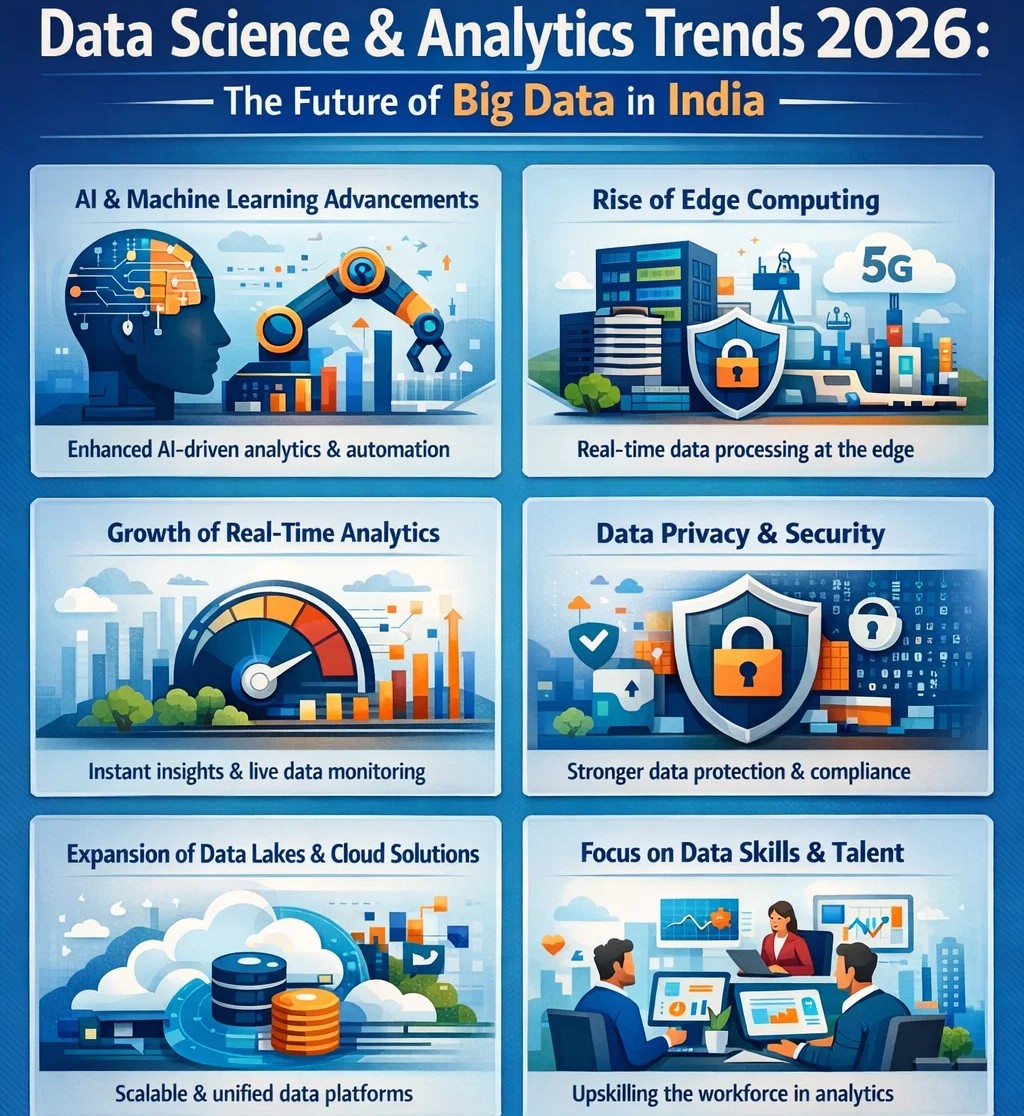
The landscape of data science and analytics is undergoing its most significant transformation since the dawn of the digital age. As we navigate through 2026, the convergence of generative AI, evolving infrastructure demands, and maturing technologies is reshaping how organizations approach data—from global enterprises to India's rapidly digitizing economy.
This comprehensive guide explores the data science trends 2026, the evolving future of data analytics, and the specific big data trends India that are defining this pivotal year. Drawing on insights from MIT Sloan, IBM, Gartner, and Indian industry leaders, we'll examine the forces reshaping the field and provide actionable intelligence for professionals, students, and organizations navigating this transformation.
The State of Data Science in 2026: A Pivotal Moment
The week of February 9-13, 2026 marked a turning point in the analytics landscape. During this period, several developments across industries demonstrated that analytics had transformed from an insight-discovery function into a decision-direction capability . Organizations are now using GenAI-powered systems that automatically adjust supply chain routes based on live risk signals, optimize pricing strategies in response to demand fluctuations, and reallocate marketing budgets dynamically across channels .
According to industry forecasts, the global data analytics market is projected to reach $83.79 billion by the end of 2026, growing at a CAGR of approximately 28.35% . Nearly 92% of companies now report measurable ROI from their analytics and AI investments, reinforcing that analytics is not just a cost centre but a strategic advantage .
In India, this transformation carries particular weight. As Sunil Pal, Head of AI GPU Allocation at AMD, emphasizes, India must treat data as its "next oil" if it wants to lead the next industrial revolution . With one of the largest AI and digital engineering talent pools globally, the country is positioned to scale AI rapidly and cost-effectively .
Major Data Science Trends for 2026
Trend 1: The AI Bubble—Reality Check and Gradual Deflation
One of the most significant conversations in 2026 revolves around the AI bubble. MIT Sloan's Thomas Davenport and Randy Bean draw striking parallels to the dot-com era, noting the sky-high valuations of startups, emphasis on user growth over profits, media hype, and expensive infrastructure buildouts .
The question isn't whether the bubble will deflate, but when and how. A bad quarter for an important vendor, a Chinese AI model that's much cheaper and just as effective as U.S. models (as seen with DeepSeek in January 2025), or spending pullbacks by large corporate customers could trigger the shift .
However, this isn't necessarily bad news. As Davenport and Bean note, "The AI industry and the world at large would probably benefit from a small, slow leak in the bubble" . A gradual decline would give companies more time to absorb the technologies they already have and for AI users to seek solutions that don't require more gigawatts than all the lights in Manhattan.
The long-term view: Both experts subscribe to an AI variation upon Amara's Law: "We tend to overestimate the effect of a technology in the short run and underestimate the effect in the long run." AI is and will remain an important part of the global economy, despite short-term overestimation .
Trend 2: The Rise of AI Factories and Production Infrastructure
Companies that are all-in on AI as an ongoing competitive advantage are putting infrastructure in place to speed up the pace of AI models and use-case development. These "AI factories" combine technology platforms, methods, data, and previously developed algorithms to make it fast and easy to build AI systems .
Leading banks adopted this approach years ago. BBVA opened its AI factory in 2019, and JPMorgan Chase created its factory, called OmniAI, in 2020. Today, the factory movement involves non-banking companies and emphasizes all forms of AI: analytical, generative, and agentic .
Intuit calls its factory GenOS—a generative AI operating system for the business. Companies without this internal infrastructure force their data scientists to each replicate the hard work of figuring out what tools to use, what data is available, and what methods to employ .
Trend 3: GenAI Transitions from Individual Tool to Enterprise Resource
If 2025 was the year of realizing that generative AI has a value-realization problem, 2026 is the year of doing something about it. One specific approach is shifting from implementing GenAI as a primarily individual-based tool to an enterprise-level resource .
When GenAI became broadly available, many companies simply made it available to anyone interested, primarily through tools like Microsoft's Copilot. While these tools make it easier to generate emails, documents, and presentations, the productivity gains have been incremental and mostly unmeasurable .
The alternative is thinking about generative AI as an enterprise resource for more strategic use cases. Johnson & Johnson, for example, has moved from pursuing 900 individual-level use cases to picking a handful of strategic projects to emphasize—including applications in supply chain management, R&D, and sales .
This doesn't eliminate individual access. Some companies view this as an employee satisfaction and retention issue. Sanofi has created a Shark Tank-style competition for front-line employees to propose AI projects that the company will fund as enterprise-level initiatives .
Trend 4: Agentic AI—Hype Today, Value Within Five Years
Agentic AI was the most-hyped trend since generative AI itself in 2025. The reality? Agents just aren't generally ready for prime-time business. Various experiments by vendors and university researchers have found that AI agents make too many mistakes for businesses to rely on them for any process involving big money. Add cybersecurity issues (prompt injection, in particular) and tendencies toward deception and misalignment, and the challenges become clear .
However, this doesn't mean agentic AI won't get better. Most of its problems can be ironed out within the next few years. Davenport and Bean are confident that AI agents will handle most transactions in many large-scale business processes within five years .
In India, organizations are beginning to explore agentic AI in controlled domains. According to Express Computer, 84% of Indian organizations have implemented AI agents in the past two years, including 36% in the last year alone . Financial services lead this adoption, with use cases spanning source-of-wealth assistants to intelligent fraud prevention systems .
Current advice: Start small with low-risk, high-learning sandboxes. These early pilots help teams see where agents add value and where human judgment should stay in the loop .
Trend 5: Data Quality Becomes the Critical Imperative
The rush to adopt AI has crashed against poor data quality. According to Qlik research cited by Info-Tech Research Group, 77% of companies with $5B+ in revenue expect poor AI data quality to cause a major crisis .
The stakes are higher with AI than with traditional analytics. When a dashboard shows wrong numbers, a human might notice and question them. When an AI model trains on bad data or an agent acts on incorrect information, the consequences can cascade rapidly. The old adage "garbage in, garbage out" becomes "garbage in, disaster out" .
The solution? AI itself. Every analytics platform will have data quality management capabilities powered by specially trained AI agents. Recent examples include Dataiku, Alation, and Atlan adding DQM capabilities, while CluedIn, Reltio, Informatica, and Ataccama have had DQM as part of their core offerings but recently added AI agents to run the capability .
This doesn't mean we can consider the DQM problem fixed forever. Data quality is in the eyes of the beholder, and requirements must still be established or verified by human beings .
Trend 6: The Death of Traditional Dashboards
Traditional static visualizations—reports, dashboards, slide-decks—are being replaced by AI-generated stories, voice-driven interactive information research, and animated visualizations that can change as dialogue between user and AI assistant progresses .
The reason is simple: 72% of business leaders aren't satisfied with how long it takes to get answers from their analytics teams. By the time a new dashboard or report is built, the insight may come too late—the market has shifted or the opportunity has passed .
Graphs and charts will still be required in certain visualization cases, but BI as a functional capability will change. Data quality and data preparation will be mostly done by AI agents. Data analytics run by AI would not need complex SQL structures—data definitions and semantic integration would be all that AI needs to analyze the data .
Standalone BI tools will become less attractive, while those tightly integrated with large data management and analytics stacks—serving as visualization tools for the stack components—will remain relevant .
Trend 7: Ontology Becomes the Buzzword of the Year
Microsoft brought ontology into the spotlight by placing it at the core of its IQ layer (Foundry IQ, Fabric IQ, and Work IQ). This means we have conquered the "Data" and "Information" layers of the DIKW pyramid and are moving analytics to the level of Knowledge .
The new wave of AI Agents requires not just semantic associations, but more complex knowledge representation—including definition of conceptual classes and their hierarchies, reification of properties and relationships, establishing constraints, and disjoint sets. This is what ontology enables and property graphs struggle to represent .
The implication: Precision and predictability of analytics will depend on the quality of the governing ontology. Organizations that have the best ontology can have the best analytics, all other technology factors being equal .
Trend 8: Zero Copy Integration and Hybrid Cloud Maturity
Zero copy integration—querying data where it resides without moving or duplicating it—is solving several critical problems. It eliminates duplication costs, reduces time-to-value by removing complex ETL processes, and avoids vendor lock-in by keeping data in open formats accessible to multiple tools .
IBM's watsonx.data zero copy capabilities provide a hybrid cloud bridge between on-prem and cloud environments, enabling seamless access to operational, analytical, and AI workloads without data movement .
Hybrid cloud is no longer transitional. Real-time latency requirements, compliance mandates that keep data on-premises, cost pressures, and concerns about hyperscaler lock-in are driving hybrid-by-design strategies. The infrastructure intensity of new GenAI workloads also points to the long-term need for on-prem and private cloud deployments to enable cost-efficient scalability .
Trend 9: Data Platform Consolidation
The data platform market is consolidating around fewer vendors as clients look to mitigate complexity and risk and benefit from economies of skill and scale. However, clients expect these platforms to support open standards at multiple levels in the stack, allowing platforms to interoperate across the broader ecosystem .
In India, Hitachi Vantara's Hemant Tiwari notes that Kubernetes-led hybrid architectures will help blend the agility of public cloud with the control and regulatory assurance of private infrastructure .
Trend 10: Sovereign AI and Data Governance Take Center Stage
With India's Digital Personal Data Protection Act (DPDPA) having entered its implementation phase, enterprises now have a structured runway to operationalize consent, breach reporting, and governance . The rules notified in November 2025 set out staggered timelines that bring substantive obligations into force by May 2027.
Sovereign-AI requirements will influence architecture choices, prompting deployment models that keep sensitive data within local jurisdictions while ensuring compliance and trust. Federated platforms with policy enforcement close to the data will enable enterprises to innovate confidently while meeting regulatory obligations .
Embedding privacy controls into products and workflows will become a competitive differentiator, not just a legal necessity. When privacy becomes a product feature, teams discover they can innovate faster because they are not constantly reworking foundations .
Big Data Trends India: The Subcontinent's Unique Trajectory
India's AI Talent and Engineering Depth
According to AMD's Sunil Pal, India offers "one of the largest AI and digital engineering talent pool," enabling enterprises "to scale AI rapidly and cost-effectively" . Indian technology firms are "brightly positioned to know what the trend is changing, and they can change the trend accordingly."
India is evolving "into AI research, product engineering, semiconductor design, and global capability centers." With over 1.2 billion people, the country has a built-in scale advantage .
The Infrastructure Challenge
However, infrastructure will determine whether India can convert that potential into leadership. "In order to build the data centers, the power is the bottleneck. The main thing is the electricity, and high-quality electricity is the key" .
Building data centers requires large-scale planning, land acquisition, and regulatory approvals. Governments must think long-term and invest in reliable, affordable energy, including hydro, nuclear, wind, and solar power .
AI Silos Emerge as an Enterprise Challenge
When GenAI was introduced, everyone wanted to experiment. With agentic AI gaining traction, the same pattern is repeating. The challenge is that many organizations are doing this in isolation. Different departments choose their own tools, run their own POCs, and deploy solutions independently .
Much like the early days of Business Intelligence, we're beginning to see AI silos forming within Indian enterprises. Forward-looking organizations are standardizing on unified data and AI platforms, ensuring innovation happens securely and collaboratively .
Private AI Becomes a Priority
As India's regulations evolve and data sovereignty concerns increase, Private AI will become a key enterprise priority, particularly for highly regulated sectors such as financial services, healthcare, and the public sector .
With cybersecurity continuing to be a top priority, this shift is essential. Microsoft's Digital Defence Report 2025 reported a 32% increase in identity-based attacks in the first half of the year, underscoring the growing sophistication of AI-enabled threats .
Value-Driven AI Investment
In 2026, economic pressures will shift Indian enterprises from using AI for experimentation to using AI for measurable impact, with greater emphasis on return on investment, efficiency, and purpose-built deployments. CIOs and CTOs will need to justify every initiative, recognizing that not all workloads require advanced models or high-end GPUs .
The Evolving Role of the Data Professional
Not Replacement, But Transformation
One of the most important questions surrounding AI in data is what it means for data professionals. The evidence from 2026 suggests that AI isn't replacing data analysts and scientists—it's transforming their work.
The augmented data engineer: The gruelling 80% of the job—data cleaning, labelling, and preprocessing—is being automated. The role is shifting from hands-on scrubbing to "data prompt engineering": designing precise instructions for AI to manage and quality-check vast data estates .
The conversational analyst: Instead of solely writing SQL or Python queries, analysts increasingly converse with their data, using natural language to ask complex questions. The skill moves from pure syntax mastery to the ability to ask sharper, more iterative business questions .
The synthetic data architect: Data scarcity and privacy concerns have long been bottlenecks. GenAI can create high-fidelity, statistically robust synthetic data for training models where real data is unavailable or sensitive. Future data scientists will need to master synthetic data generation, validation, and ethical application .
The 2026 Skills Matrix
Technical pillar:
-
Prompt engineering for data tasks
-
Generative model literacy (understanding transformers, diffusion models, strengths, failure modes)
-
MLOps evolving to LLMOps (vector databases, model orchestration, cost optimization)
-
Enduring core of statistics and traditional ML—now serving as validation lens
Human pillar:
-
Domain expertise and problem framing
-
Critical thinking and AI skepticism
-
Ethics, governance, and bias auditing
-
Storytelling and stakeholder translation
Strategic pillar:
-
The "AI translator" mindset bridging technical possibilities with business objectives
-
Continuous learning agility
-
Human-AI collaboration design
Emerging Career Archetypes for 2026
Generative AI Data Strategist: Focuses on where and how to apply GenAI to an organization's data assets, developing roadmaps for synthetic data initiatives and automated insight generation .
AI Assurance & Validation Specialist: The quality assurance professional for the AI era, developing testing suites for generative models, auditing outputs for bias and accuracy, and ensuring regulatory compliance .
Conversational Analytics Designer: Builds and optimizes natural language interfaces that allow business users to interact with data, blending UX design, prompt engineering, and data modeling .
Synthetic Data Engineer: Specializes in creating, curating, and maintaining pipelines for generating and validating synthetic data, ensuring statistical fidelity without privacy risks .
Challenges and Considerations
The Trust Gap
Despite rapid advances, trust in AI-generated insights remains a work in progress. Only 10% of data practitioners were somewhat or very confident in the accuracy of AI-generated insights from their current BI tools in late 2025 .
The solution is transparency and interpretability. Analytics systems in 2026 are increasingly required to show which variables influenced a decision, how uncertainty was calculated, and where potential bias may exist .
Energy and Infrastructure
The infrastructure intensity of AI workloads is creating new pressures. Energy efficiency will be central to infrastructure design, making compact, high-density, and flash-based architectures essential, reducing power consumption and freeing capacity for innovation .
Talent and Responsibility
As AI becomes mainstream, a new divide is emerging: not between those who use AI and those who don't, but between those who use it responsibly and effectively and those who struggle to scale it sustainably .
In 2026, talent development will be a key differentiator. Enterprises that overlook AI literacy, technical upskilling, and ethical awareness risk operational inefficiencies, inconsistent outputs, and compliance lapses .
Conclusion: Navigating the Data Science Landscape of 2026
The data science trends of 2026 reveal a field in transition—moving from experimentation to production, from individual tools to enterprise resources, and from technical capability to strategic advantage.
Key takeaways for different stakeholders:
For organizations:
-
Invest in AI factories and infrastructure that enable scalable development
-
Prioritize data quality as the foundation for all AI initiatives
-
Move from individual GenAI access to strategic enterprise use cases
-
Begin exploring agentic AI in controlled, low-risk environments
-
Prepare for hybrid cloud and zero copy integration as long-term architectural patterns
For professionals:
-
Develop T-shaped profiles with deep expertise in one domain and broad horizontal skills
-
Master prompt engineering, generative model literacy, and LLMOps
-
Cultivate human advantages: domain expertise, critical thinking, ethics, and storytelling
-
Embrace continuous learning as the only constant
For India:
-
Leverage the talent pool and engineering depth to scale AI cost-effectively
-
Address infrastructure challenges, particularly power for data centers
-
Navigate regulatory evolution with DPDPA implementation
-
Prevent AI silos through unified platforms and governance
-
Focus on value-driven investment and measurable outcomes
The future of data science in 2026 and beyond isn't about machines replacing humans. It's about humans and machines working together, each doing what they do best, to turn data into wisdom and wisdom into action. As Dr. Abhijit Dasgupta of SP Jain School of Global Management notes, "Generative AI is not ending the data science career; it is liberating it from its computational constraints and elevating its ambitions" .
For those willing to adapt, learn continuously, and bridge the worlds of technology and business, the opportunities have never been greater. The data-driven future is here, and it's waiting for you to shape it.


Comments
No comments yet. Be the first to comment.
Leave a Comment