


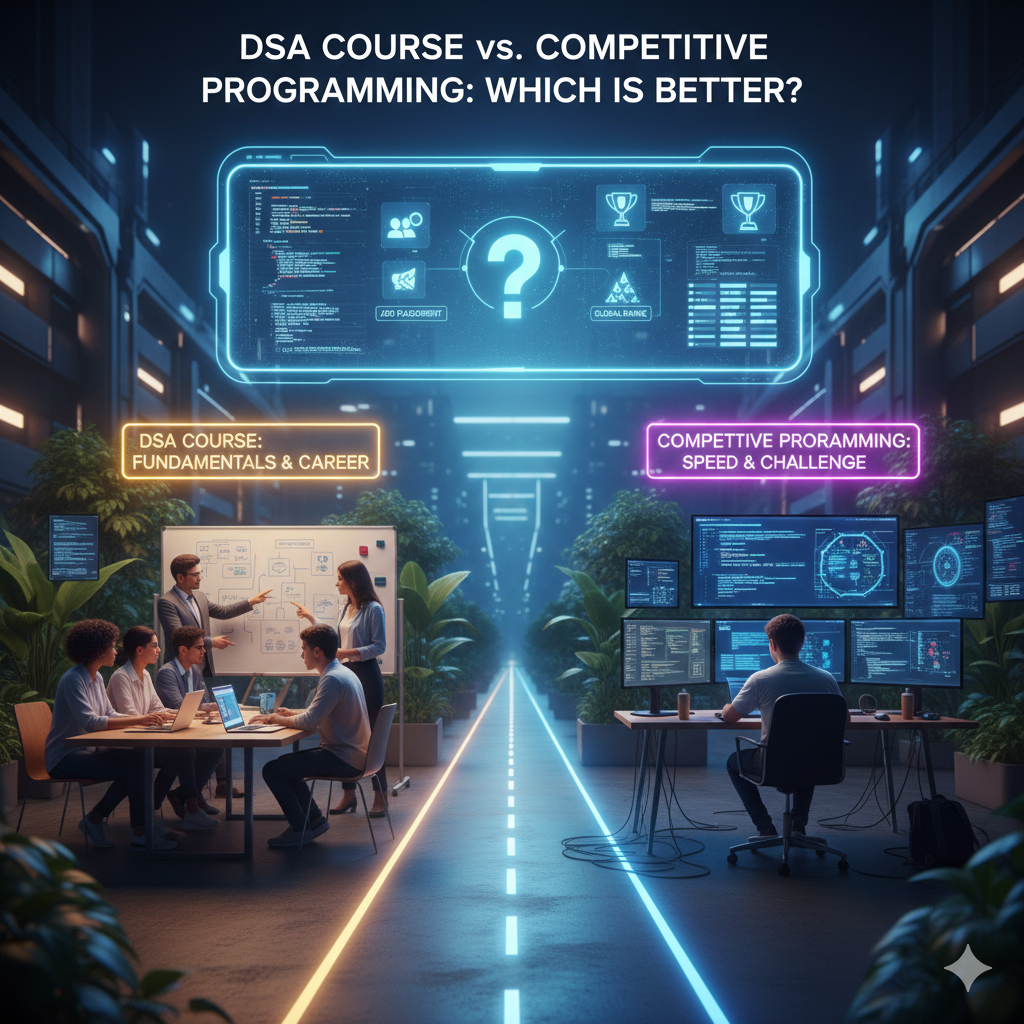
In the modern tech industry, strong programming skills and problem-solving abilities are essential for securing software development roles, cracking competitive exams, and excelling in coding contests. Two major paths often discussed for improving programming and analytical abilities are Data Structures and Algorithms (DSA) courses and Competitive Programming (CP). While both focus on improving logical thinking and coding capabilities, they have different approaches, objectives, and long-term benefits. This article examines these two pathways in depth, compares them, and helps students and professionals make informed choices.
Understanding DSA Courses
Data Structures and Algorithms (DSA) form the backbone of computer science. A DSA course teaches the fundamental structures and techniques required to solve problems efficiently.
Core Concepts Covered
A typical DSA course covers:
-
Arrays: Basic data storage, traversal, and manipulation.
-
Linked Lists: Efficient memory usage and dynamic data storage.
-
Stacks and Queues: LIFO and FIFO data structures for managing tasks and operations.
-
Trees: Binary trees, binary search trees, AVL trees, and segment trees for hierarchical data.
-
Graphs: Directed, undirected, weighted, and unweighted graphs for networks and connections.
-
Hashing: Efficient searching and indexing.
-
Recursion and Backtracking: Problem-solving techniques for combinatorial and logical challenges.
-
Dynamic Programming (DP): Optimization for complex problems by storing intermediate results.
-
Sorting and Searching Algorithms: Binary search, quicksort, mergesort, and heap sort for data management.
-
Complexity Analysis: Understanding time and space complexity using Big-O notation.
Benefits of a DSA Course
-
Strong Foundation: DSA courses ensure that students understand the “why” and “how” behind algorithms, not just their implementation.
-
Interview Readiness: Most software engineering interviews at companies like Google, Amazon, Microsoft, and Infosys heavily test DSA concepts.
-
Real-World Applications: Knowledge of DSA is critical for building scalable applications, handling large datasets, and optimizing performance.
-
Systematic Learning: Courses are structured to gradually introduce concepts, often including assignments, projects, and mock interviews.
-
Placement Focused: Many institutes combine DSA learning with placement assistance, offering resume support, mock interviews, and guidance on coding rounds.
Challenges of DSA Courses
-
Conceptual Overload: Beginners may feel overwhelmed by abstract concepts like recursion and graphs.
-
Limited Time for Speed: Traditional courses emphasize understanding over speed, which may leave students slower in competitive coding scenarios.
-
Application Gap: Without practice, students may struggle to apply concepts to real-world or contest-like problems.
Understanding Competitive Programming
Competitive Programming (CP) is an activity where programmers solve algorithmic challenges under time constraints on online platforms like Codeforces, CodeChef, HackerRank, and LeetCode. It focuses on problem-solving speed, efficiency, and logical creativity.
Core Concepts Covered
While CP requires knowledge of DSA, it emphasizes:
-
Algorithmic Thinking: Applying algorithms creatively to solve unusual or complex problems.
-
Time Management: Solving problems within tight time limits.
-
Advanced Algorithms: Graph algorithms, dynamic programming, segment trees, union-find, and number theory.
-
Problem Patterns: Recognizing recurring problem structures and applying solutions quickly.
-
Optimized Implementation: Writing concise, efficient code to meet time and space constraints.
Benefits of Competitive Programming
-
Enhanced Problem-Solving Speed: CP trains developers to think quickly and implement solutions efficiently.
-
Advanced Algorithm Exposure: Participants encounter rare and complex problems that deepen algorithmic knowledge.
-
Global Recognition: Competitive programmers often participate in contests such as ICPC, Google Code Jam, and Kick Start, gaining visibility.
-
Mental Agility: CP develops analytical thinking, pattern recognition, and the ability to handle high-pressure situations.
-
Job Opportunities in Elite Companies: Many top tech companies hire based on CP performance, sometimes even bypassing traditional interviews.
Challenges of Competitive Programming
-
Steep Learning Curve: Advanced CP problems require mastery of numerous algorithms and optimization techniques.
-
Time-Intensive: Success in CP demands consistent practice and participation in contests, which can be time-consuming.
-
Limited Practical Application: Not all problems encountered in CP directly translate to real-world software development.
-
Stressful Environment: Continuous timed challenges can be mentally exhausting for beginners.
Key Differences Between DSA Courses and Competitive Programming
| Aspect | DSA Course | Competitive Programming |
|---|---|---|
| Focus | Conceptual clarity, understanding data structures and algorithms | Problem-solving speed and efficiency under constraints |
| Goal | Building foundation for software development and interviews | Excelling in contests and advanced coding challenges |
| Learning Approach | Systematic, structured learning with assignments and projects | Hands-on problem-solving on online platforms, contest-based learning |
| Time Requirement | Moderate; progress at learning pace | High; requires daily practice and contest participation |
| Practical Application | High relevance in real-world coding, app development, and system design | Focused on algorithmic challenges; less direct real-world application |
| Career Advantage | Essential for technical interviews, placements, and building software | Excellent for high-level coding roles, contest recognition, and fast coding jobs |
| Skills Gained | Deep understanding of DSA concepts, algorithmic design, optimization | Speed, accuracy, creative problem-solving, advanced algorithms |
Which One is Better?
The answer depends on your goals, career aspirations, and current skill level.
When to Choose a DSA Course
-
Placement-Oriented: If your priority is securing a software engineering role or internship.
-
Beginner-Friendly: Ideal for students who need a systematic understanding of algorithms and data structures.
-
Real-World Application: Necessary for backend development, app development, or building scalable systems.
-
Interview Preparation: Helps in clearing coding rounds and technical assessments at top IT companies.
When to Choose Competitive Programming
-
High-Level Coding Contests: If you aim to participate in ICPC, Google Kick Start, or Codeforces competitions.
-
Algorithmic Mastery: For experienced coders wanting exposure to advanced problem patterns and optimization techniques.
-
Time-Constrained Problem Solving: Improves speed, accuracy, and handling of high-pressure coding scenarios.
-
Specialized Roles: Useful for roles that prioritize coding competitions, algorithm-heavy projects, or top-tier global companies.
Combining Both for Maximum Benefit
For most students and professionals, the best approach is a combination of DSA courses and Competitive Programming:
-
Step 1: Start with a DSA course to gain conceptual clarity and foundational knowledge.
-
Step 2: Apply concepts by solving problems on CP platforms. This hones speed, creativity, and advanced algorithmic thinking.
-
Step 3: Participate in contests or mock interviews regularly to simulate real-world problem-solving scenarios.
-
Step 4: Use DSA knowledge to optimize CP solutions and apply CP experience to technical interviews.
This approach ensures solid fundamentals, practical problem-solving ability, and competitive readiness, covering all aspects required for both placements and global coding challenges.
Advantages of Combining DSA and CP
-
Strong Foundation + Speed: DSA provides knowledge; CP builds agility and implementation speed.
-
High Placement Success: Most technical interviews test DSA and problem-solving under time constraints, both of which are covered.
-
Global Recognition: CP participation can lead to scholarships, internships, and job offers from multinational tech firms.
-
Adaptability: Developers trained in both can solve real-world problems efficiently while excelling in algorithmic challenges.
-
Entrepreneurial Edge: Building AI-driven or data-intensive applications requires both algorithmic knowledge and problem-solving agility.
Real-World Examples
-
Google and Amazon Hiring: Both companies evaluate candidates on algorithmic problem-solving (DSA knowledge) and coding speed (CP skills).
-
Startups: Developers working in startups benefit from DSA knowledge to design scalable backend systems and CP skills for handling complex algorithmic features.
-
Open Source Contribution: CP experience helps contributors solve complex issues in open-source projects faster and more efficiently.
-
Freelancing: DSA knowledge ensures robust software design, while CP skills enable faster problem-solving for client projects.
Challenges and Considerations
-
Time Commitment: Mastering both DSA and CP requires consistent effort, sometimes spanning months or years.
-
Mental Fatigue: CP’s intensive problem-solving can lead to burnout if not balanced with structured learning.
-
Application Gap in CP: Some advanced CP problems may never be directly applied in real-world projects.
-
Overemphasis on Speed: Focusing solely on CP may compromise conceptual clarity in DSA.
Recommendations for Students
-
Beginners: Start with a DSA course to build strong fundamentals.
-
Intermediate Learners: Once comfortable with DSA, start practicing CP problems regularly.
-
Advanced Learners: Participate in contests, online hackathons, and competitive platforms to polish speed and creativity.
-
Balance: Dedicate time to projects and real-world coding to bridge CP and DSA knowledge with practical skills.
While both DSA courses and Competitive Programming aim to enhance coding abilities, the type of skills developed differs significantly.
Skills from DSA Courses:
-
Conceptual Clarity: DSA courses focus on understanding why algorithms work, when to use specific data structures, and how to optimize them. This helps in software design, backend development, and large-scale system architecture.
-
Problem-Solving Frameworks: Students learn structured approaches to solving problems, such as breaking down complex tasks into smaller steps, applying recursion, or using dynamic programming.
-
Code Optimization: By learning about time and space complexity, students can write efficient, maintainable, and scalable code.
-
Technical Interview Preparedness: Many top-tier companies assess candidates’ DSA knowledge in their coding interviews. Knowledge gained from DSA courses directly improves chances of passing these rounds.
-
Project Application: DSA concepts can be applied to real-world projects, such as building search engines, recommendation systems, e-commerce apps, or data analytics platforms.
Skills from Competitive Programming:
-
Speed and Accuracy: CP requires solving multiple problems under strict time constraints, training developers to think and code quickly.
-
Advanced Algorithm Exposure: CP problems often go beyond basic DSA, requiring mastery of graph algorithms, number theory, computational geometry, string algorithms, and combinatorial optimization.
-
Pattern Recognition: With repeated exposure, programmers learn to quickly identify patterns in problems and apply known techniques effectively.
-
Handling Pressure: CP contests simulate high-pressure coding scenarios, enhancing mental resilience and problem-solving confidence.
-
Coding Creativity: Developers learn to approach problems in multiple ways, optimizing solutions based on constraints.
Tools and Platforms for Learning
To effectively learn DSA and CP, students can leverage modern tools and platforms:
For DSA Learning:
-
GeeksforGeeks: Provides tutorials, problem sets, and structured DSA courses.
-
LeetCode: Offers categorized problems aligned with technical interview patterns.
-
Educative.io: Interactive platform with in-depth DSA courses and visualizations.
-
Books: “Introduction to Algorithms” by Cormen, “Data Structures and Algorithms in Java/Python” by Goodrich.
For Competitive Programming:
-
Codeforces: Offers regular contests and a community for discussing solutions.
-
CodeChef: Monthly contests with various difficulty levels.
-
AtCoder & HackerRank: Competitive coding platforms for timed problem-solving.
-
TopCoder: Focused on algorithmic competitions and real-world challenges.
Using these tools together allows learners to bridge DSA concepts with practical CP applications.
Career Impact
The choice between DSA and CP influences career paths differently, though there is significant overlap.
DSA Career Benefits:
-
Software Developer Roles: Strong DSA knowledge helps in backend, frontend, and full stack development roles.
-
Data Science & AI Roles: Algorithms are foundational for machine learning and AI.
-
Tech Interviews: Core DSA knowledge is often the basis for coding rounds at Google, Microsoft, Amazon, and Infosys.
-
Project Development: DSA knowledge helps in designing efficient algorithms for real-world software, improving performance and scalability.
Competitive Programming Career Benefits:
-
Contest-Based Hiring: Companies like Google, Facebook, and competitive coding startups often consider CP performance for selection.
-
Global Recognition: High ratings on CP platforms can attract recruiters and internship offers worldwide.
-
Algorithm-Heavy Roles: Roles requiring advanced problem-solving, optimization, and high-frequency data handling benefit from CP expertise.
-
Scholarships and Competitions: Outstanding CP performance can lead to sponsorships, scholarships, or invitations to global contests like ICPC.
Combining DSA and CP for Optimal Results
The synergy of DSA and CP is where most top developers find success. A recommended pathway:
-
Foundation First: Begin with a DSA course to understand the logic behind algorithms and data structures.
-
Practical Application: Solve problems on LeetCode or GeeksforGeeks, applying learned concepts.
-
Speed Training: Participate in CP contests on Codeforces or CodeChef to enhance speed and precision.
-
Advanced Problem-Solving: Solve higher-difficulty problems involving graphs, combinatorics, and dynamic programming.
-
Interview Simulation: Use CP experience to simulate coding interviews, focusing on efficiency, clarity, and optimization.
This combined approach ensures strong foundational knowledge, practical problem-solving, and competitive readiness, making learners versatile for jobs, contests, and real-world projects.
Real-Life Examples of Success
-
Google Kick Start Winners: Many programmers who excel in CP contests have secured jobs at Google or other top tech firms even before completing college.
-
LeetCode High Achievers: Students with a high LeetCode rating often perform better in technical interviews due to familiarity with typical coding patterns.
-
Startups & Freelancers: Developers trained in both DSA and CP can handle complex algorithmic requirements efficiently, making them highly valued in startup environments.
-
Open Source Contribution: Advanced CP knowledge helps in tackling challenging open-source project tasks faster, contributing to community recognition.
Challenges and Solutions
While DSA and CP offer immense benefits, challenges exist:
Common Challenges:
-
Overwhelm for Beginners: Starting directly with CP without foundational DSA knowledge can be discouraging.
-
Time Constraints: Balancing CP practice with coursework or projects can be difficult.
-
Burnout Risk: High-intensity CP contests can cause stress and fatigue.
-
Application Gap: Not all CP problems have direct real-world application.
Solutions:
-
Start with structured DSA learning before tackling CP problems.
-
Schedule daily short sessions for CP to avoid burnout.
-
Focus on quality over quantity in problem-solving; understand solutions rather than memorizing.
-
Apply CP solutions to projects or simulations to bridge theory and practice.
Future Trends and Relevance
Both DSA and CP remain highly relevant in the evolving tech landscape:
-
AI and Machine Learning: DSA is essential for building optimized AI models and data pipelines. CP enhances algorithmic efficiency for large-scale AI computations.
-
Web and Mobile Development: Efficient backend systems rely on strong DSA knowledge, while CP sharpens optimization skills for high-traffic applications.
-
Cloud Computing & Big Data: Algorithms and data structures are crucial for handling distributed systems and massive datasets. CP training ensures developers can solve problems efficiently in constrained environments.
-
Competitive Hiring: Top tech firms continue to emphasize algorithmic problem-solving, making both DSA knowledge and CP experience highly valued.
-


Comments
No comments yet. Be the first to comment.
Leave a Comment