

Freelance MERN Stack Developer: How to Earn from MERN Stack & Get Remote Jobs
The digital economy has fundamentally changed how developers work, earn, and build careers. No longer limited to office jobs or geographic boundaries, modern web developers can now work remotely for global clients, build independent income streams, and even launch their own products. Among all web development technologies, the MERN stack — MongoDB, Express.js, React.js, and Node.js — stands out as one of the most powerful skill sets for freelancers and remote professionals.
For anyone learning web development today, the ability to earn from MERN stack skills through freelancing and remote jobs represents one of the most attractive career paths. MERN developers can build complete web applications independently, making them highly valuable to startups, businesses, and entrepreneurs worldwide. This article explores how to become a freelance MERN stack developer, how to earn from MERN skills, and how to secure remote MERN stack jobs.
Why MERN Stack Is Perfect for Freelancing and Remote Work
Freelancing and remote jobs require developers who can handle complete projects without relying on large teams. MERN stack developers are uniquely suited for this because the stack covers frontend, backend, and database layers using a single language — JavaScript.
This unified technology approach allows freelancers to design user interfaces, build APIs, manage databases, and deploy applications independently. Clients prefer hiring one full-stack developer rather than multiple specialists because it reduces cost and communication complexity. As a result, MERN developers have strong demand in freelance marketplaces and remote job platforms.
Another reason MERN suits remote work is its cloud-native nature. MERN applications are easily deployed online and maintained remotely. Developers can collaborate using GitHub, cloud hosting, and communication tools from anywhere in the world. This flexibility aligns perfectly with global remote work trends.
How Freelance MERN Stack Developers Earn Money
There are multiple income streams available to MERN stack freelancers. Unlike traditional employment, freelancing allows developers to combine project work, long-term contracts, and product development.
1. Client Web Application Projects
The most common way to earn from MERN stack skills is by building web applications for clients. Businesses need dashboards, booking systems, portals, SaaS platforms, and custom websites. MERN developers can create these solutions end-to-end.
Freelancers typically charge per project or hourly. Even beginner MERN freelancers can start with small applications and gradually move to complex systems. As experience grows, project value increases significantly.
2. SaaS and Startup Development
Many entrepreneurs and startups need developers to build Minimum Viable Products. MERN is widely used for SaaS platforms because it supports rapid development and scalability. Freelancers who understand full-stack architecture can build startup products independently.
Some freelancers evolve into technical partners or long-term contractors for startups. This provides stable recurring income while working remotely.
3. Website and Dashboard Maintenance
After launching applications, businesses need ongoing updates, bug fixes, and feature additions. Freelance MERN developers often maintain projects for monthly fees. This creates predictable recurring income rather than one-time projects.
Maintenance contracts are especially valuable because they provide steady work without constant client acquisition.
4. Selling Digital Products Built with MERN
Another powerful way to earn from MERN stack is building your own digital products. Developers can create tools, templates, admin dashboards, or SaaS services and sell subscriptions online.
Because MERN enables full-stack independence, freelancers can build and deploy products without teams. Successful products generate passive income and entrepreneurial opportunities.
How to Become a Freelance MERN Stack Developer
Many learners wonder how to transition from training to freelancing. The path is structured and achievable.
Step 1: Master Full-Stack MERN Skills
Freelancing requires complete development ability. Developers must understand React frontend development, Node and Express backend logic, MongoDB database design, and deployment workflows. Clients expect functional applications, not partial components.
Step 2: Build a Portfolio of MERN Projects
Clients evaluate freelancers based on work samples. A strong MERN portfolio should include full-stack applications such as dashboards, authentication systems, CRUD platforms, or SaaS prototypes. Hosted demos and GitHub repositories increase credibility.
Step 3: Start with Small Freelance Projects
Beginners should start with small projects like landing pages, admin panels, or simple web apps. These projects build experience and client reviews. Over time, freelancers can move to larger contracts and higher budgets.
Step 4: Use Freelance Platforms and Networks
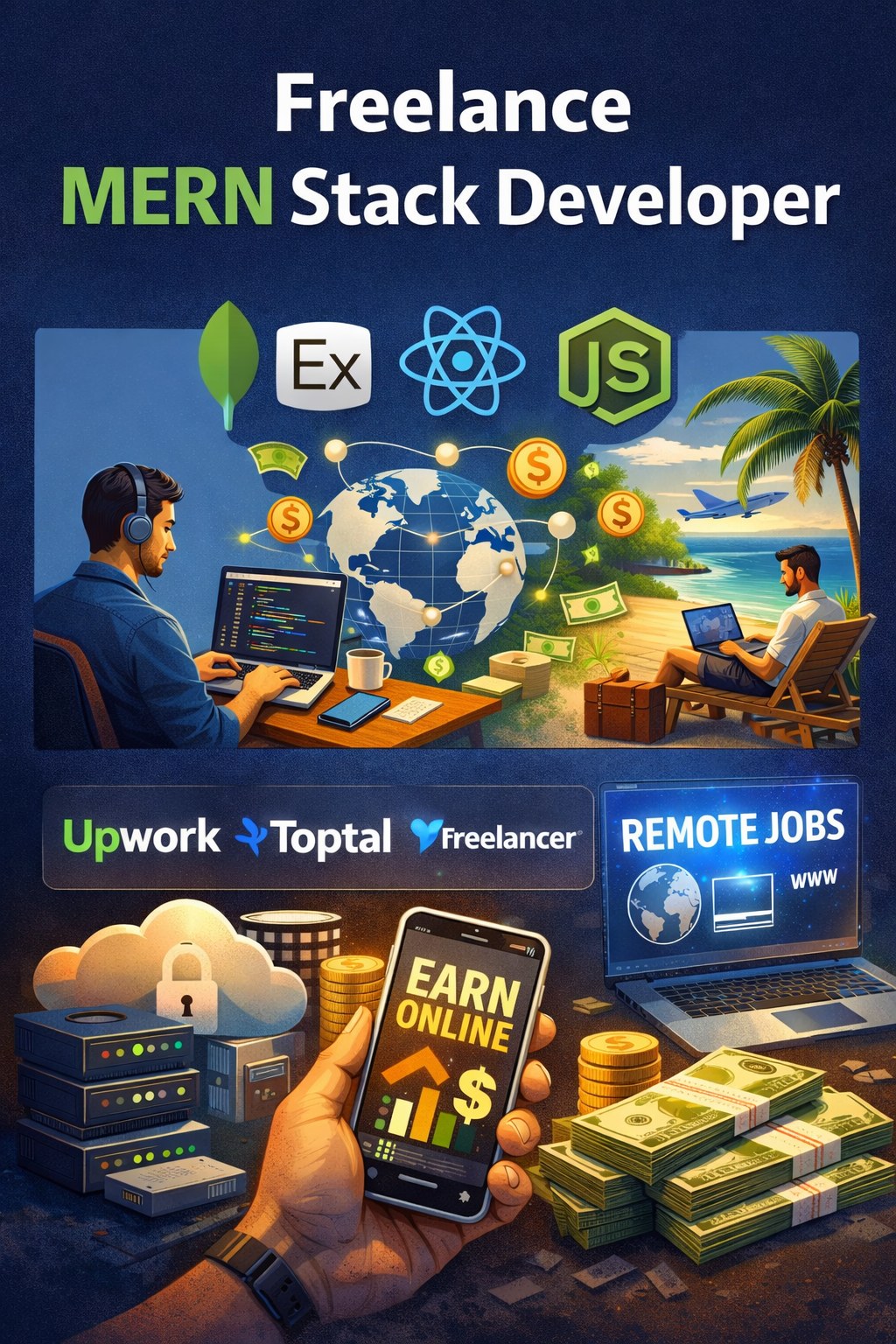
Remote MERN jobs are available through platforms such as Upwork, Freelancer, Toptal, and LinkedIn. Developers can also find clients through networking, referrals, and local business connections. Consistency in applications and proposals is key.
Remote MERN Stack Jobs: Global Opportunities
Remote work is transforming the developer job market. Companies now hire globally rather than locally, and MERN stack developers are among the most sought-after remote roles.
Startups prefer MERN developers because they can build features independently and iterate quickly. SaaS companies hire MERN engineers for dashboards, APIs, and frontend systems. Agencies hire MERN developers for client projects worldwide.
Remote MERN jobs offer multiple advantages. Developers can work for international companies while living in lower-cost regions. Time flexibility allows balancing projects and personal work. Global pay scales often exceed local salaries.
For developers in regions like Mohali or other emerging tech hubs, remote MERN jobs provide access to worldwide opportunities without relocation.
Skills That Increase Freelance MERN Income
Certain skills significantly increase earning potential for MERN freelancers.
Understanding UI/UX design improves frontend quality. Deployment knowledge allows delivering production-ready applications. API integration skills enable complex functionality. Performance optimization and security practices increase project value.
Developers who combine MERN with cloud deployment or DevOps knowledge can command higher rates because they deliver complete solutions rather than code alone.
Challenges in Freelance MERN Development
Freelancing also involves challenges. Beginners may struggle with client communication, project scope, or time estimation. Managing multiple projects requires discipline and planning.
However, these challenges decrease with experience. Clear requirements, milestone-based work, and proper documentation help manage projects effectively. Over time, freelancers build confidence and workflow efficiency.
Long-Term Career Growth for MERN Freelancers
Freelance MERN development is not limited to small projects. Many freelancers grow into agencies, consultants, or product founders. Full-stack independence enables building teams or launching startups.
Some MERN freelancers specialize in SaaS development, others in enterprise dashboards, and some in startup MVPs. Career flexibility is one of the biggest advantages of MERN skills.
Remote experience also strengthens employability. Freelancers often transition into high-paying remote roles or leadership positions after gaining experience.
Why MERN Stack Is Future-Proof for Freelancing
The future of digital services is web-based platforms, SaaS products, and cloud applications. MERN stack aligns directly with these trends. Its unified JavaScript ecosystem, scalability, and global adoption ensure long-term relevance.
Businesses will continue needing developers who can build and maintain web systems. MERN freelancers therefore remain valuable across industries and regions. Unlike niche technologies, MERN skills apply universally.
Conclusion: MERN Stack as a Freelance and Remote Career Path
Becoming a freelance MERN stack developer offers one of the most flexible and rewarding technology careers today. MERN skills allow developers to earn independently, work remotely, and build digital products without relying on teams. From client projects and startup development to SaaS creation and global remote jobs, the earning potential of MERN stack expertise is substantial.
As the world moves toward digital platforms and remote collaboration, MERN developers stand at the center of this transformation. By mastering full-stack development and building real projects, anyone can transition into freelancing and remote MERN jobs. The MERN stack is not only a technical skill — it is a gateway to financial independence and global career opportunity in the modern digital economy.
Best Platforms to Find Freelance MERN Stack Work
One of the biggest questions aspiring freelance MERN developers ask is where to find clients and remote opportunities. Fortunately, the global demand for full-stack JavaScript developers has created multiple platforms where MERN professionals can connect with businesses and startups.
Freelance marketplaces such as Upwork and Freelancer host thousands of MERN-related projects including web applications, dashboards, SaaS platforms, and API development. Beginners can start with smaller fixed-price jobs to build reviews and credibility. As experience grows, developers can apply for higher-value contracts and long-term collaborations.
Professional networks like LinkedIn have also become powerful channels for remote MERN jobs. Many startups and companies post remote full-stack developer roles directly on LinkedIn. By sharing projects, code snippets, and technical insights, MERN developers can attract recruiters organically without traditional job applications.
Another emerging path is developer-focused communities such as GitHub, Indie Hackers, and Discord tech groups. Open-source contributions and project showcases often lead to freelance offers and remote opportunities. Clients increasingly trust developers with visible coding activity and community engagement.
Building a Strong Freelance MERN Brand
Success in freelancing is not only about technical skill; personal branding plays a major role. A freelance MERN stack developer must present themselves as a reliable problem solver rather than just a coder. This begins with a professional online presence.
A strong GitHub profile acts as a technical portfolio demonstrating coding consistency and project quality. Well-documented repositories, live demos, and clear README files help clients understand capabilities quickly. Personal websites built with MERN itself further showcase full-stack expertise.
Content sharing also strengthens credibility. Writing about MERN projects, development tips, or problem-solving experiences on LinkedIn or blogs positions a developer as knowledgeable and trustworthy. Clients prefer freelancers who demonstrate expertise publicly rather than those with only resumes.
Professional communication is equally important. Clear proposals, structured project explanations, and timely responses build client confidence. Over time, reputation becomes the most valuable asset for freelance MERN developers, leading to referrals and repeat clients.
Pricing Strategy for MERN Freelancers
Determining how much to charge is a common challenge for new MERN freelancers. Pricing should reflect skill level, project complexity, and market demand rather than simply competing on low cost.
Beginners often start with moderate rates to gain experience and reviews. As portfolio strength increases, pricing can shift toward value-based models where developers charge for outcomes rather than hours. Full-stack MERN capability justifies higher pricing because clients receive complete solutions instead of partial work.
Project pricing typically varies by scope. Small applications or landing pages may have lower budgets, while full-stack SaaS platforms or dashboards command significantly higher fees. Remote international clients often pay more than local markets, allowing freelancers to increase income over time.
Ultimately, successful MERN freelancers transition from hourly billing to project or retainer models. This approach stabilizes income and reflects professional expertise rather than time spent coding.
Transitioning from Freelancing to Remote MERN Jobs
Freelancing and remote employment often intersect. Many developers begin freelancing and later move into remote full-time roles, while others combine both. Experience gained from freelance MERN projects strengthens employability because it demonstrates independent problem-solving ability.
Remote companies value developers who have worked directly with clients and delivered projects independently. Freelancers typically understand requirement analysis, communication, and delivery timelines better than purely academic candidates. This real-world exposure becomes a major advantage during hiring.
Some freelancers receive direct remote job offers from satisfied clients. Others use freelance portfolios to apply for global remote MERN roles. The boundary between freelancing and remote employment is increasingly fluid, creating flexible career pathways.
Long-Term Financial Growth with MERN Skills
The earning potential of MERN stack skills grows significantly with experience. Beginners may start with smaller freelance projects, but over time developers move toward complex systems, SaaS platforms, and enterprise dashboards. Each stage increases income capacity.
Developers who specialize in niches such as SaaS development, performance optimization, or API architecture often command premium rates. Others expand into product development and subscription platforms generating recurring revenue. MERN’s full-stack independence enables multiple income streams simultaneously.
Some MERN freelancers eventually build agencies or development teams. Others launch startups based on products they initially created for clients. This entrepreneurial potential makes MERN one of the most financially scalable technical skill sets.
Remote Work Lifestyle and Flexibility
Beyond income, MERN freelancing offers lifestyle advantages. Developers can work from home or any location with internet access. Flexible schedules allow balancing personal commitments, learning, and projects. This autonomy is increasingly valued in modern careers.
Remote MERN work also enables global exposure. Developers collaborate with international teams, learn diverse business requirements, and build cross-cultural communication skills. Such experience accelerates professional maturity and opens leadership opportunities.
For developers in emerging tech regions, remote MERN work removes geographic limitations. Talent rather than location determines opportunity. This democratization of work is one of the most transformative aspects of modern web development careers.
Final Perspective: MERN Freelancing as a Modern Career Model
The rise of freelance and remote MERN stack development reflects a broader shift in how technology careers function. Developers are no longer constrained to local employment or single income sources. Full-stack capability allows individuals to operate as independent creators within the global digital economy.
By mastering MERN, building real projects, and establishing a professional presence, anyone can transition into freelance and remote work. Over time, this path can evolve into consulting, product creation, or entrepreneurship. The MERN stack therefore represents more than a technical framework — it is a platform for financial independence and global professional mobility.


Comments
No comments yet. Be the first to comment.
Leave a Comment