

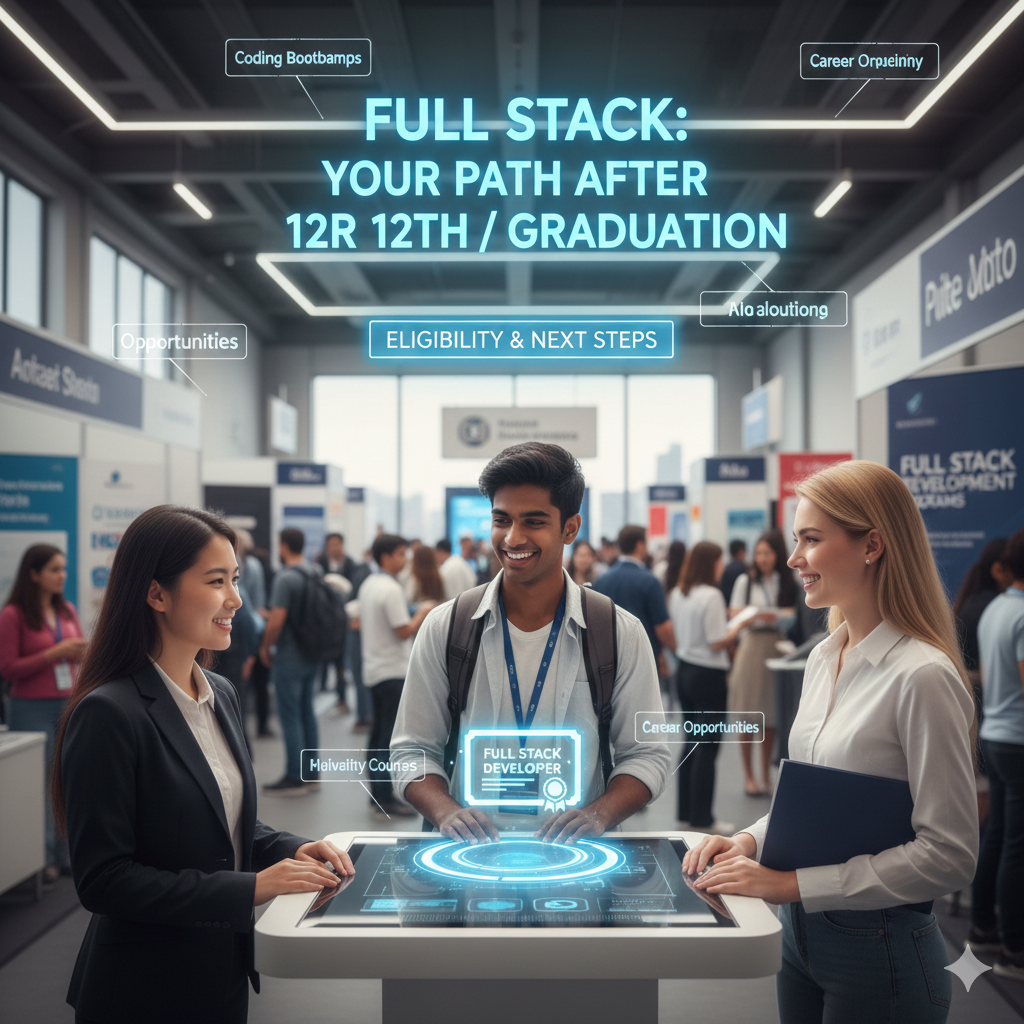
Full stack development is a flexible and skill-based career option that can be pursued after completing 12th grade or after graduation. Unlike many traditional professional courses, full stack development does not have strict eligibility criteria related to a specific academic stream. Students from science, commerce, or arts backgrounds can enter this field as long as they have basic computer knowledge, logical thinking ability, and a genuine interest in learning programming and web technologies.
After completing 12th, students can begin their journey in full stack development by enrolling in diploma programs, certification courses, or degree programs such as BCA, B.Sc Computer Science, or B.Tech in Computer Science or IT. Starting early allows students to build strong technical foundations while continuing their higher education. They can learn frontend technologies like HTML, CSS, and JavaScript, then gradually move to backend development using languages and frameworks such as Node.js, Python, Java, or PHP. Early exposure also provides opportunities for internships, freelancing, and part-time projects, which help in gaining practical experience before graduation.
For students who decide to pursue full stack development after graduation, especially those from non-technical backgrounds, it serves as an excellent career transition option. Many graduates choose full stack development because it is job-oriented and focuses more on practical skills than theoretical knowledge. With structured training and consistent practice, graduates can acquire industry-relevant skills within months and prepare for entry-level developer roles. It is particularly beneficial for those who want to enter the IT industry quickly without pursuing another long-term degree.
The eligibility for full stack development is simple and inclusive. The minimum qualification is generally 12th pass, and there is no mandatory requirement for prior coding experience. What truly matters is dedication, problem-solving ability, consistency in practice, and the willingness to build real-world projects. Since full stack development involves both frontend and backend technologies, learners should be ready to understand how user interfaces, servers, databases, and APIs work together in a complete application.
Overall, full stack development is an accessible career path that offers opportunities at different stages of education. Whether pursued after 12th or after graduation, success in this field depends more on practical skills, project experience, and continuous learning rather than academic background alone.


Comments
No comments yet. Be the first to comment.
Leave a Comment