


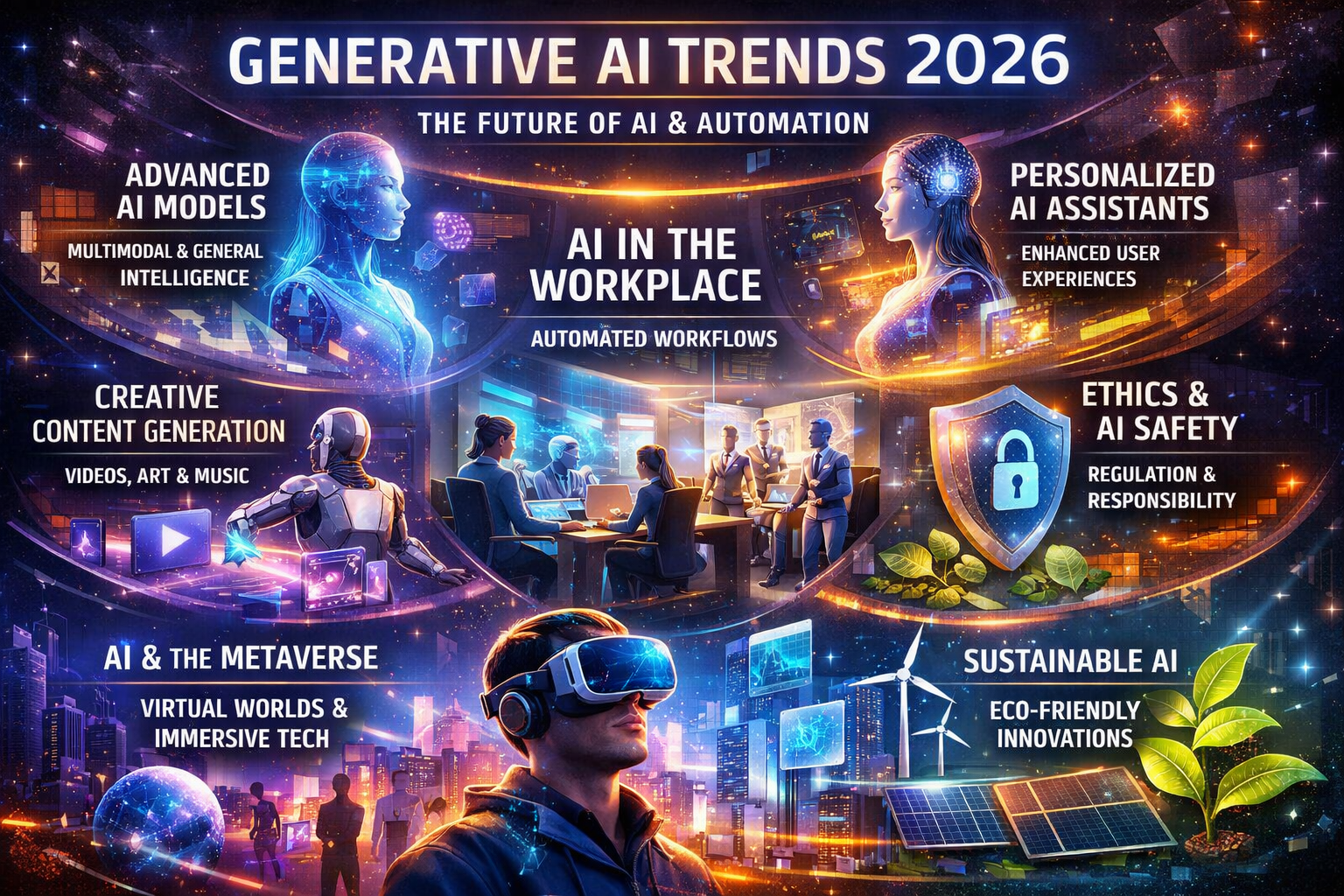
Generative AI Trends 2026, the Future of Generative AI, and AI Automation: Transforming the Digital World
Generative Artificial Intelligence is entering a new phase of rapid growth and innovation. By 2026, generative AI will no longer be limited to producing text or images; it will evolve into advanced intelligent systems capable of understanding and creating content across multiple formats, including video, voice, code, and 3D designs. One of the most important trends shaping this future is multimodal AI, where a single platform can process various data types together. This will revolutionize content creation, customer engagement, education, and software development by offering faster, smarter, and more personalized solutions.
Another major generative AI trend for 2026 is the rise of autonomous AI agents. These intelligent systems will be able to perform complex tasks such as analyzing business data, managing workflows, writing reports, building applications, and responding to customers with minimal human supervision. Organizations will increasingly rely on these AI agents to boost productivity, reduce operational costs, and improve decision-making. Personalization will also reach new heights, with AI delivering customized experiences in marketing, learning platforms, healthcare services, and online shopping.
Looking toward the future of generative AI, continuous learning and real-time intelligence will become core features. AI models will adapt instantly to new information, enabling more accurate predictions and smarter recommendations. Industries such as healthcare will use generative AI for medical imaging analysis, drug discovery, and virtual health assistants. In finance, AI will automate fraud detection, risk assessment, and customer service. Education will benefit from AI tutors that adjust lessons based on each student’s learning speed and style.
At the same time, ethical and responsible AI development will become a top priority. Governments and organizations will introduce stronger policies to ensure transparency, data privacy, and fairness in AI systems. As generative AI becomes more powerful, maintaining trust and accountability will be essential for long-term success.
Alongside generative AI growth, AI automation trends will dramatically reshape the workplace. Automation will move beyond basic repetitive tasks to intelligent systems capable of handling entire business processes. Intelligent Process Automation (IPA) will combine machine learning, natural language processing, and predictive analytics to manage operations such as supply chains, hiring processes, customer support, and financial forecasting.
By 2026, AI-powered chatbots and virtual assistants will become more human-like, understanding emotions, context, and complex questions. Businesses will deploy automated decision systems that analyze massive data sets in real time to optimize strategies and improve customer experiences. Low-code and no-code automation platforms will empower employees without technical backgrounds to design AI-driven workflows, making automation accessible across all departments.
The convergence of generative AI and automation will create a new digital ecosystem where creativity and efficiency work together. Designers will use AI to generate concepts instantly, developers will accelerate software production, and marketers will launch highly targeted campaigns powered by real-time AI insights. Organizations that embrace these technologies early will gain a strong competitive edge in the global market.
In conclusion, generative AI trends in 2026 point toward smarter, more autonomous, and deeply integrated AI systems across every industry. The future of generative AI will focus on innovation balanced with ethical responsibility, while AI automation will transform how businesses operate and how people work. Together, these technologies will drive a new era of productivity, creativity, and digital transformation. For professionals and students alike, learning generative AI and automation skills today will be a key step toward success in the technology-driven future.


Comments
No comments yet. Be the first to comment.
Leave a Comment