


Introduction
Mechanical engineering is one of the most versatile and widely applied branches of engineering. From automobiles and manufacturing plants to robotics and aerospace systems, mechanical engineers play a vital role in designing, analyzing, and improving machines and mechanical systems. However, the expectations of the mechanical engineering industry have changed significantly in the last decade.
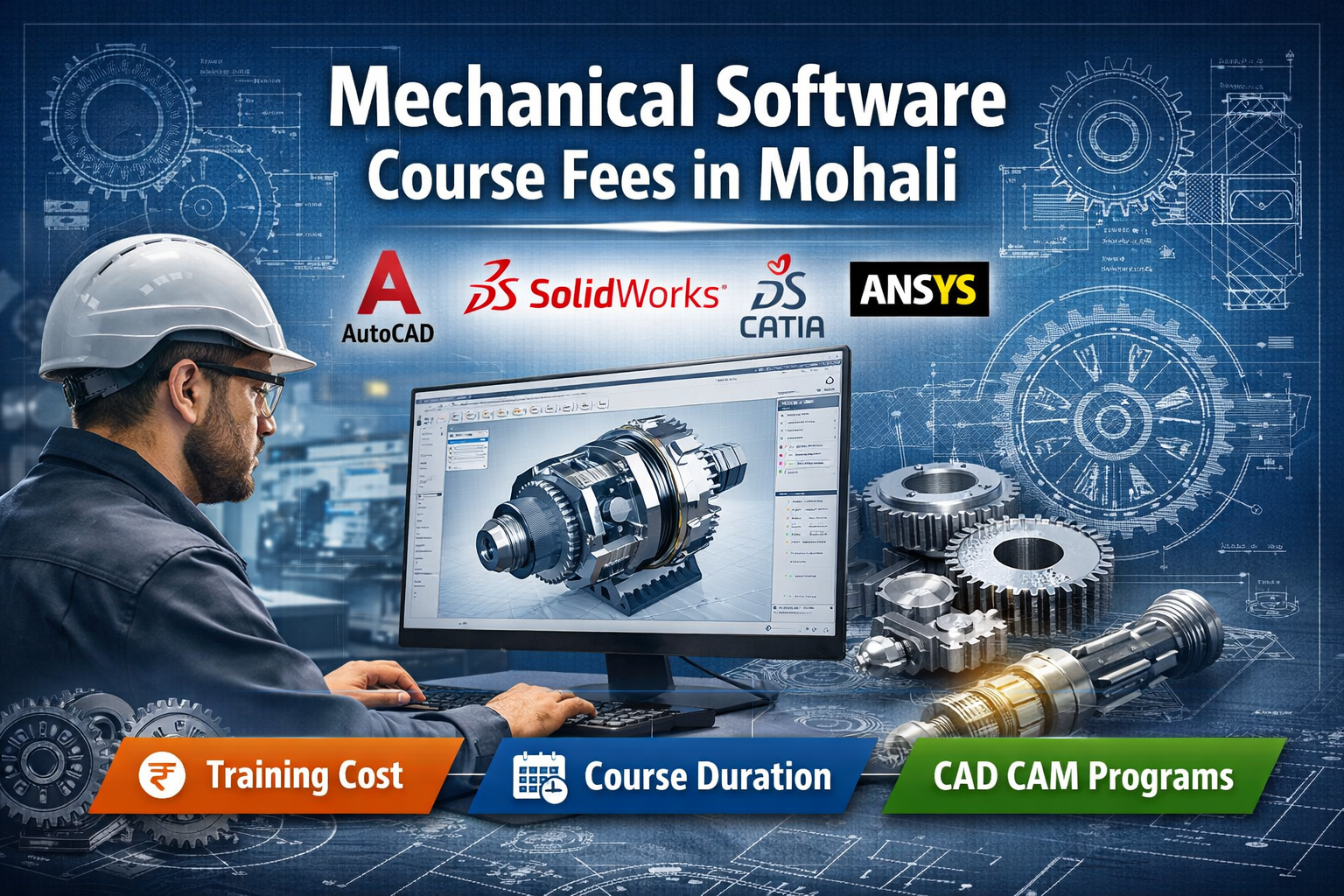
Today, companies are looking for engineers who not only understand theoretical concepts but also possess strong software-based design and modeling skills. Mechanical software tools such as AutoCAD, SolidWorks, CATIA, Creo, and ANSYS have become essential for modern mechanical design and manufacturing processes.
Because of this shift, many students and graduates are enrolling in mechanical software training courses to improve their practical skills and increase their chances of getting a job. Cities like Mohali have become popular training hubs where students can learn industry-relevant software and prepare for careers in mechanical design, product development, and manufacturing.
One of the most common questions students ask is:
-
What are the mechanical software course fees in Mohali?
-
What is the training cost for mechanical design software?
-
How long is the course duration for CAD/CAM training?
This guide will explain everything in detail so that students can make the right decision before enrolling in a training program.
Why Mechanical Software Training is Important
Mechanical engineering education in many universities focuses heavily on theory. While theoretical knowledge is important, industries require engineers who can design, simulate, and analyze products using specialized software.
Mechanical software training helps bridge the gap between academic knowledge and industrial requirements.
Key benefits of learning mechanical design software include:
1. Industry-Relevant Skills
Software like AutoCAD and SolidWorks are widely used in manufacturing, automotive, and product design industries.
2. Better Job Opportunities
Students with software certification often receive better job opportunities compared to those with only a degree.
3. Practical Design Experience
Training programs usually include projects where students design components, assemblies, and full mechanical systems.
4. Higher Salary Potential
Engineers who specialize in mechanical design often earn higher starting salaries.
5. Career Flexibility
Mechanical software skills can be used in multiple industries such as:
-
Automotive
-
Aerospace
-
Manufacturing
-
Robotics
-
Product design
-
Industrial equipment
Mechanical Software Courses Available in Mohali
Training institutes in Mohali offer a wide variety of CAD/CAM and mechanical design courses.
The most common software courses include:
AutoCAD Mechanical
AutoCAD is one of the most widely used drafting software tools. It is commonly used for creating 2D drawings and technical layouts.
Students learn:
-
2D drafting
-
Dimensioning
-
Layout design
-
Mechanical drawings
-
Engineering documentation
AutoCAD is often the first software mechanical engineers learn.
SolidWorks
SolidWorks is a powerful 3D modeling and product design software used in many engineering industries.
Students learn:
-
3D modeling
-
Assembly design
-
Sheet metal design
-
Product simulation
-
Rendering and visualization
SolidWorks is particularly popular in product design and manufacturing industries.
CATIA
CATIA is widely used in automotive and aerospace industries.
Training includes:
-
Advanced 3D modeling
-
Surface design
-
Assembly design
-
Product lifecycle management
Many multinational companies use CATIA for complex product development.
Creo (Pro-E)
Creo is another powerful software used in industrial design.
Students learn:
-
Parametric modeling
-
Product simulation
-
Advanced assemblies
-
Engineering drawings
ANSYS
ANSYS is used for engineering simulation and analysis.
Training includes:
-
Structural analysis
-
Thermal analysis
-
Fluid simulation
-
Stress testing
ANSYS helps engineers test products before manufacturing begins.
Mechanical Software Course Fees in Mohali
The mechanical software course fees in Mohali vary depending on several factors.
These include:
-
Software covered in the course
-
Training institute reputation
-
Course duration
-
Level of training (basic or advanced)
-
Certification provided
Below is a general fee structure.
AutoCAD Course Fees
AutoCAD courses are usually the most affordable.
Average fees:
₹8,000 – ₹15,000
Duration:
1–2 months
SolidWorks Course Fees
SolidWorks courses are slightly more expensive because they include advanced 3D modeling.
Average fees:
₹15,000 – ₹30,000
Duration:
2–3 months
CATIA Course Fees
CATIA training focuses on advanced design and surface modeling.
Average fees:
₹20,000 – ₹40,000
Duration:
3–4 months
Creo Course Fees
Creo courses are similar to CATIA in complexity.
Average fees:
₹20,000 – ₹35,000
Duration:
3–4 months
ANSYS Course Fees
Simulation and analysis courses often have higher fees due to specialized training.
Average fees:
₹25,000 – ₹45,000
Duration:
2–3 months
Complete Mechanical Design Course Fees
Many institutes offer combined CAD/CAM packages that include multiple software tools.
Example package:
-
AutoCAD
-
SolidWorks
-
CATIA
-
ANSYS
Average fees:
₹40,000 – ₹80,000
Duration:
4–6 months
These combined courses are popular because they provide comprehensive mechanical design training.
Mechanical Course Duration
The course duration depends on the software and training level.
Typical course durations are:
Short-Term Courses
Duration:
1–2 months
Suitable for:
-
AutoCAD training
-
Basic software introduction
Professional Courses
Duration:
3–4 months
Suitable for:
-
SolidWorks
-
CATIA
-
Creo
Advanced Mechanical Design Programs
Duration:
4–6 months
Includes:
-
Multiple software tools
-
Industrial projects
-
Portfolio development
Diploma-Level Training Programs
Duration:
6–12 months
These programs often include:
-
CAD
-
CAM
-
CAE
-
Industrial training
-
Placement assistance
Factors Affecting Mechanical Training Cost
Several factors influence the mechanical software training cost in Mohali.
Institute Reputation
Well-known institutes may charge higher fees but often provide better training quality.
Course Content
Courses covering multiple software tools usually cost more.
Faculty Experience
Institutes with experienced instructors may charge higher fees.
Practical Training
Programs that include live projects and industrial training are often more valuable.
Certification
Courses that provide recognized certificates can increase the overall value of training.
Benefits of Learning Mechanical Design Software
Mechanical software training provides several career benefits.
Faster Job Placement
Students with practical software skills are often hired faster.
Industry Readiness
Software training prepares students for real engineering work.
Portfolio Development
Students create design projects that can be shown during job interviews.
Improved Design Thinking
Software training improves creativity and problem-solving abilities.
Career Opportunities After Mechanical Software Training
After completing mechanical software courses, students can apply for various job roles.
Common job profiles include:
Mechanical Design Engineer
Responsible for designing machine components and systems.
CAD Engineer
Creates 2D and 3D models using CAD software.
Product Design Engineer
Develops new products using advanced design tools.
CAD CAM Engineer
Works with manufacturing and production teams.
Simulation Engineer
Uses tools like ANSYS to analyze product performance.
These roles are available in industries such as:
-
Automobile manufacturing
-
Aerospace
-
Industrial machinery
-
Consumer product manufacturing
-
Robotics
Tips for Choosing the Best Mechanical Training Institute
Before enrolling in a course, students should consider several factors.
Check the Course Curriculum
Make sure the course includes practical design training.
Verify Faculty Experience
Experienced instructors provide better learning outcomes.
Look for Practical Projects
Hands-on training is essential for skill development.
Placement Assistance
Institutes that provide job placement support can be beneficial.
Software Versions
Ensure the institute uses latest industry software versions.
Future Scope of Mechanical Software Skills
The demand for mechanical design engineers is expected to grow significantly due to:
-
Automation
-
Robotics
-
Electric vehicles
-
Advanced manufacturing
-
Industry 4.0 technologies
Companies are increasingly adopting digital design and simulation tools, making mechanical software training more valuable than ever.
Engineers who combine design software knowledge with mechanical fundamentals will have strong career prospects.
Detailed Breakdown of Mechanical Software Training Modules
Most mechanical software training institutes in Mohali design their courses in multiple modules so that students can gradually learn from basic drafting to advanced product design. These modules ensure that students gain both theoretical knowledge and practical skills.
Module 1: Engineering Drawing Fundamentals
Before learning advanced CAD software, students are usually introduced to the fundamentals of engineering drawing. This module helps students understand the basic principles used in mechanical design.
Topics covered include:
-
Orthographic projections
-
Isometric drawings
-
Dimensioning techniques
-
Section views
-
Tolerances and fits
-
Engineering drawing standards
This foundation is important because CAD software is simply a digital tool used to create engineering drawings.
2D Drafting Training with AutoCAD
The first practical software most mechanical students learn is AutoCAD. It is widely used in engineering, architecture, and manufacturing industries.
Skills Students Learn
During AutoCAD training, students learn how to:
-
Create 2D technical drawings
-
Use drawing tools and editing commands
-
Apply dimensions and annotations
-
Create mechanical part drawings
-
Develop layout plans and blueprints
AutoCAD training helps students understand how mechanical drawings are created in professional environments.
3D Modeling Training
After learning 2D drafting, students move to 3D modeling software such as SolidWorks, CATIA, or Creo.
3D modeling allows engineers to create realistic digital prototypes of mechanical components before they are manufactured.
Topics Covered in 3D Modeling
-
Part modeling
-
Sketching techniques
-
Extrude and revolve operations
-
Surface modeling
-
Sheet metal design
-
Parametric design concepts
These skills help engineers design complex products efficiently.
Assembly Design Training
In real-world engineering projects, machines are made of multiple interconnected components. Assembly design training teaches students how to combine individual parts into a complete mechanical system.
Assembly Design Skills
Students learn how to:
-
Create assemblies
-
Apply mates and constraints
-
Analyze motion between components
-
Detect design interference
-
Build large mechanical assemblies
Assembly design is widely used in industries such as automotive manufacturing and machinery design.
Simulation and Analysis Training
Modern engineering relies heavily on simulation software to test designs before manufacturing.
Software like ANSYS allows engineers to evaluate the performance of a product under different conditions.
Simulation Topics
Students learn how to perform:
-
Stress analysis
-
Thermal analysis
-
Fluid dynamics simulation
-
Vibration analysis
-
Structural testing
Simulation tools help companies reduce product failures and development costs.
Industrial Projects in Mechanical Software Courses
Many training institutes include live projects as part of their curriculum.
Projects help students gain real-world design experience.
Examples of training projects include:
-
Designing a gearbox assembly
-
Creating a piston and cylinder model
-
Designing a mechanical clamp
-
Modeling an automotive suspension system
-
Developing a robotic arm assembly
Working on such projects helps students build professional portfolios.
Placement Support Provided by Training Institutes
One of the biggest advantages of joining a mechanical training institute is placement assistance.
Many institutes help students prepare for job interviews by offering:
Resume Building
Students learn how to create professional resumes highlighting their software skills and projects.
Interview Preparation
Institutes conduct mock interviews and technical question sessions.
Job Referrals
Some training institutes have tie-ups with companies and provide direct interview opportunities.
Salary Expectations After Mechanical Software Training
Mechanical engineers who specialize in design software often receive better salary packages compared to fresh graduates without software skills.
Entry-Level Salary
Fresh mechanical design engineers typically earn:
₹2.5 LPA – ₹4 LPA
Mid-Level Salary
Engineers with 3–5 years of experience can earn:
₹5 LPA – ₹8 LPA
Senior-Level Salary
Experienced design engineers or product designers can earn:
₹10 LPA or more depending on industry.
Industries Hiring Mechanical Design Engineers
Mechanical software skills open career opportunities in many industries.
Some of the major sectors include:
Automobile Industry
Automotive companies hire design engineers to develop vehicle components.
Aerospace Industry
Aircraft manufacturers require engineers for designing aircraft parts and structures.
Manufacturing Industry
Factories require CAD engineers to design machinery and tools.
Robotics Industry
Robotics companies need engineers to design automated systems.
Consumer Product Design
Many companies design household appliances and consumer products using CAD software.
Online vs Offline Mechanical Software Training
Students often have the option to choose between online training and classroom training.
Offline Classroom Training
Benefits include:
-
Direct interaction with instructors
-
Hands-on practice in labs
-
Better learning environment
Online Training
Advantages include:
-
Flexible learning schedule
-
Lower training cost
-
Learning from home
However, mechanical software training is often more effective when done in a practical classroom environment.
Importance of Certification in Mechanical Software Training
After completing a course, students usually receive a certificate.
A mechanical software certification demonstrates that a student has:
-
Completed professional training
-
Learned industry software tools
-
Gained practical design skills
Certificates can improve job prospects and help students stand out during interviews.
Common Mistakes Students Should Avoid
When choosing a mechanical training course, students sometimes make mistakes that affect their learning experience.
Choosing the Cheapest Course
Low fees do not always mean quality training.
Ignoring Practical Training
Practical projects are essential for skill development.
Not Checking Institute Reviews
Students should check feedback from previous students.
Learning Only One Software
Learning multiple software tools can increase job opportunities.
How Mechanical Software Skills Support Industry 4.0
The engineering industry is moving toward Industry 4.0, which integrates digital technologies into manufacturing.
Mechanical software tools play an important role in this transformation.
Examples include:
-
Digital product design
-
Virtual prototyping
-
Automated manufacturing
-
Smart factory systems
Engineers trained in CAD/CAM software are better prepared for the future of manufacturing.
Demand for Mechanical Software Engineers in India
India has a growing manufacturing sector, and companies increasingly require engineers who are proficient in design software.
Cities like Mohali, Chandigarh, Pune, Bangalore, and Hyderabad have many companies hiring mechanical design engineers.
Industries prefer candidates who have:
-
Strong software knowledge
-
Practical design experience
-
Good problem-solving skills
Mechanical software training can significantly improve employability for engineering graduates.
Why Mohali is a Popular Training Hub
Mohali has become a major center for technical education and professional training.
Reasons include:
-
Presence of many training institutes
-
Affordable course fees
-
Proximity to Chandigarh industrial areas
-
Availability of job opportunities
Students from nearby cities often come to Mohali for mechanical software training programs.
Conclusion
Mechanical software training has become an essential step for mechanical engineering students who want to succeed in today’s competitive job market. Learning tools like AutoCAD, SolidWorks, CATIA, Creo, and ANSYS allows engineers to design complex components, simulate product performance, and contribute effectively to modern engineering projects.
The mechanical software course fees in Mohali vary depending on the software and training level, typically ranging from ₹8,000 to ₹80,000. Course duration can range from 1 month to 6 months, depending on the program structure.
By choosing the right training institute and focusing on practical skills, students can significantly improve their career opportunities and move toward roles such as mechanical design engineer, CAD engineer, or product design specialist.
Mechanical software training is not just an educational program—it is a gateway to modern engineering careers.

Comments
No comments yet. Be the first to comment.
Leave a Comment