

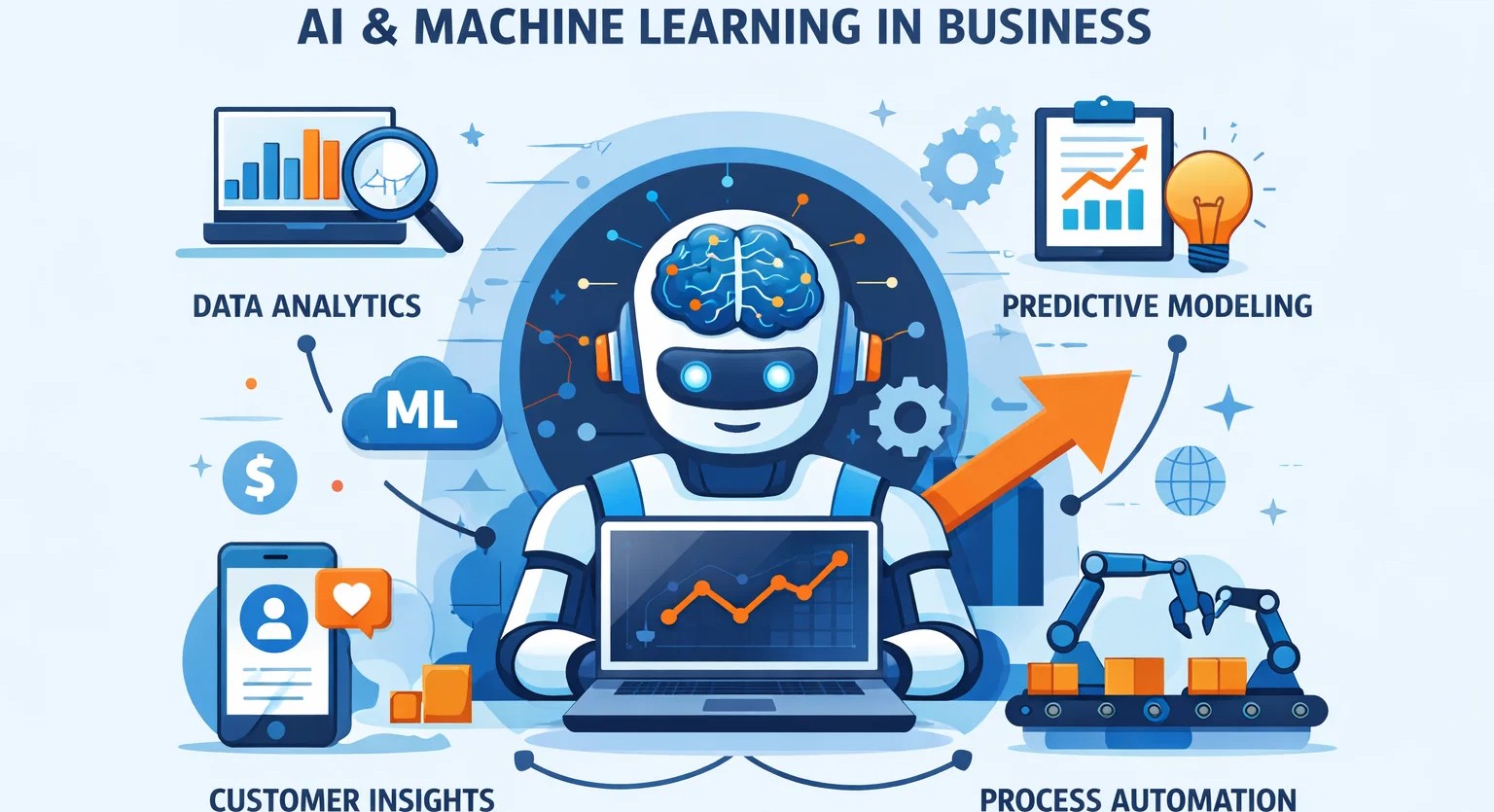
The relationship between machine learning and artificial intelligence has reached a pivotal inflection point in 2026. After years of experimentation and hype, we're witnessing the fundamental transformation of how businesses operate—moving from isolated pilots to enterprise-wide integration that drives measurable business value. According to recent research, roughly 42% of large organizations now run AI in production, with another 40% actively experimenting .
But this isn't just about incremental improvements. The convergence of ML with broader AI capabilities is reshaping entire industries. From manufacturing floors where 41% of employers now use AI-powered vision systems for quality control to financial services where autonomous agents handle complex transactions, machine learning has become the engine driving the next wave of business transformation.
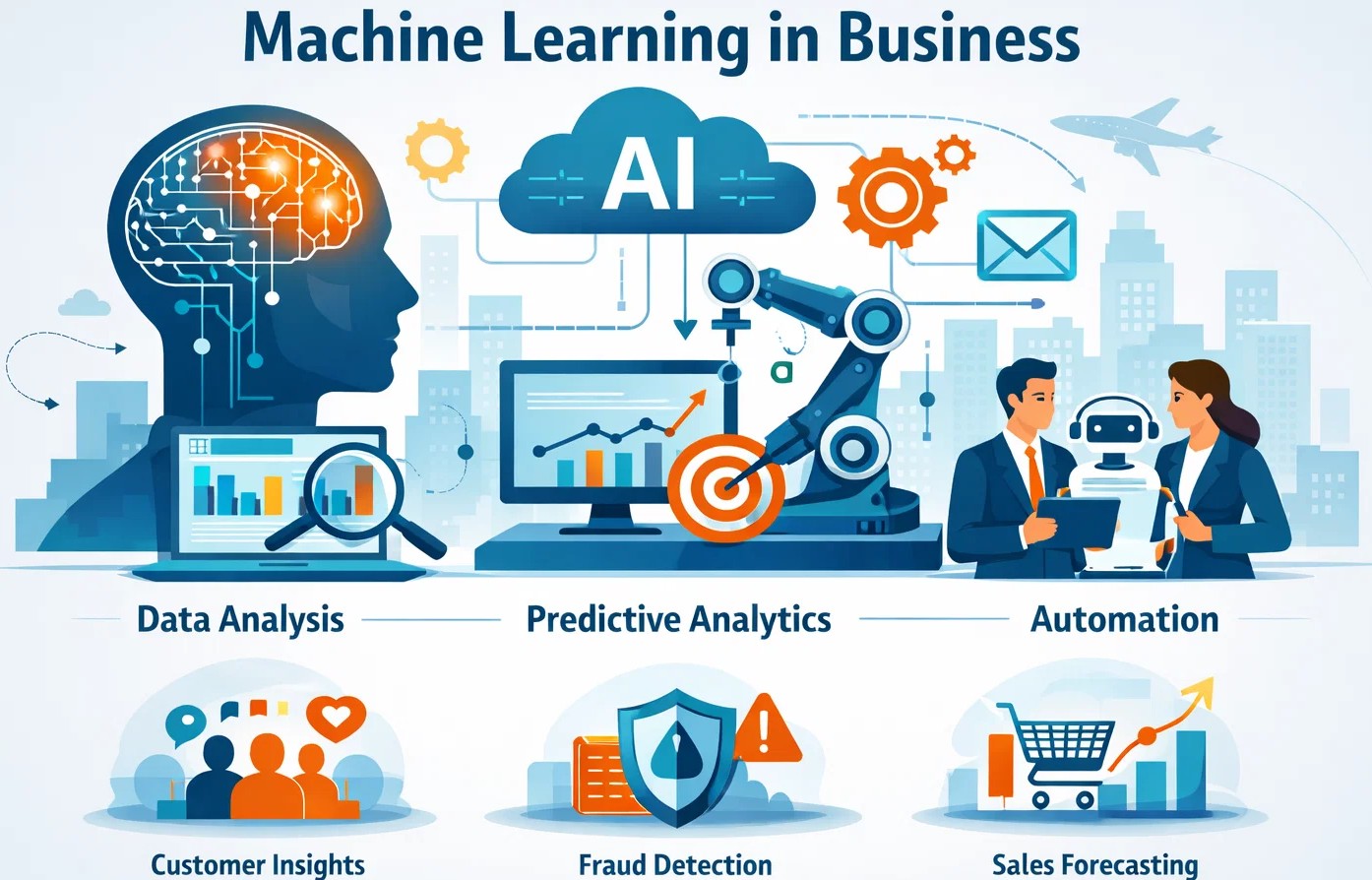
This comprehensive guide explores the state of ML integration with AI in 2026, the most impactful machine learning in business applications across industries, and the emerging ML applications that forward-thinking organizations are deploying today. We'll examine real-world use cases, adoption trends, and provide actionable insights for business leaders navigating this rapidly evolving landscape.
The Great Operational Shift: From Hype to Value
The State of Enterprise ML in 2026
The year 2026 marks a decisive transition from the "hype cycle" to the "value cycle" in enterprise AI . Organizations are no longer asking whether they should use machine learning—they're demanding clear answers on what it has delivered in terms of revenue, cost reduction, and risk mitigation .
This shift is reflected in hard numbers. The global AI market stands at approximately $354 billion today and is projected to reach $1.64 trillion by the end of the decade . More importantly, the nature of AI investment is changing. Most enterprises entering 2026 fall into three categories:
-
Those with ML investments growing faster than measurable ROI
-
Those running multiple pilots without enterprise scaling plans
-
Those where governance and security controls lag behind AI expansion
If any of these patterns exist in your organization, your ML strategy may be increasing risk and cost faster than value. The solution lies in understanding which machine learning trends truly matter for competitive advantage and which can wait without slowing progress .

From Pilots to Production at Scale
Many enterprises moved fast with AI in recent years. Now, legacy ML models are aging, assumptions no longer align with live data, and ML technical debt is surfacing in core operations . Machine learning still runs financial fraud checks, supply chain forecasts, routing optimization, marketing journeys, and ecommerce personalization. But maturity remains uneven across the business:
-
Some units run stable ML models in production with limited data lineage visibility
-
Others remain stuck in proof-of-concepts
-
Critical decisions fall back on spreadsheets when model drift raises doubts
As we move through 2026, this patchy picture becomes harder to justify. Boards expect a clear story on where machine learning truly powers the business, not isolated wins, and whether recent ML investments are built on reliable foundations .
The Convergence of Machine Learning and AI: Key 2026 Trends
Agentic AI: From Assistants to Autonomous Actors
The most significant implementation trend in 2026 is the widespread deployment of Agentic AI—systems that move beyond passive generative models to become proactive digital teammates capable of autonomous decision-making within set guardrails .
Unlike the copilots of previous years that waited for prompts, agentic AI represents a fundamental shift. Multi-Agent Systems (MAS) now communicate with other agents through cross-API orchestration, solving tasks without human handoffs. You set the goal. Agents plan, call tools, and execute .
Why this matters for enterprises:
-
Entire workflows, not single tasks, get automated
-
Cost per transaction drops significantly
-
Cycle times shrink across finance, support, and operations
Enterprise use cases already in production:
-
Support agents resolving tickets end-to-end without human intervention
-
Finance agents reconciling transactions and flagging anomalies in real-time
-
IT agents orchestrating runbooks across complex systems
According to PwC's 2026 AI Business Predictions, companies are moving toward a top-down strategy where "AI agents can go beyond analysis and automate parts of complex, high-value workflows" .
Physical AI: Intelligence Grounded in the Real World
While agentic AI handles digital workflows, Physical AI is transforming how machines interact with the physical world. Nvidia CEO Jensen Huang has been promising that physical AI will reshape every aspect of the enterprise, including smart factories, streamlined logistics, and product improvement feedback loops .
In 2026, physical AI has matured significantly, driving a new era of AI development that truly understands the world. The combination of physical AI blueprints—such as Nvidia's Omniverse and Apollo frameworks—and open interoperability standards (like IEEE P2874) is starting to reshape industrial R&D .
These ecosystems lower the barrier to building simulations, robotics workflows, and digital twins. What once required heavy capital expenditure and specialized engineering teams is shifting to cloud-based, pay-as-you-simulate operational expense models, opening up advanced robotics and simulation capabilities previously limited to larger competitors .
Multimodal ML: Beyond Single-Domain Intelligence
Multimodal ML now works seamlessly across text, images, audio, video, and structured data. Generative ML turns that input into content, code, summaries, and insights. For enterprise teams, this replaces rigid forms with natural "ask and answer" interactions .
Two shifts matter most for business leaders:
Small Language Models (SLMs): Lean, domain-tuned models that are cheaper to run, easier to deploy on-premise or at the edge, and simpler to govern in regulated or latency-sensitive environments .
Retrieval-Augmented Generation (RAG): Grounds generative AI in enterprise data. Models pull approved documents before responding, reducing hallucinations and aligning outputs with policies and contracts .
The result is faster knowledge work, better decision context, and standardized outputs across proposals, reports, and reviews. As Autodesk Research notes, this capability is foundational not just for creative applications, but for robotics, manufacturing, and the built environment .
Edge AI: Intelligence Where the Work Happens
Edge and on-device ML push intelligence from central servers to sensors, gateways, mobile devices, and machines. Models run near the data source, reducing latency, cloud dependency, and exposure of sensitive data .
For enterprises, milliseconds matter. In factory lines, fleets, energy grids, and medical devices, cloud round-trips can mean downtime, safety risks, or compliance gaps. Edge ML enables:
-
Real-time decisions without constant connectivity
-
Lower bandwidth and cloud processing costs
-
Local data processing with stronger privacy controls
According to IoT Analytics, edge AI ranks among the most impactful industrial technologies for 2026, driven by growth in AI-enabled workloads at the edge . Ruggedized gateways with built-in GPUs or neural processors can now run sophisticated models locally, keeping latency low and sensitive process data behind the plant firewall .
Decision Intelligence: ML for Business Decisions
Most enterprises still run critical decisions on spreadsheets and static reports. Decision intelligence changes that flow. It embeds machine learning into workflows and dashboards so business teams can test scenarios and trigger model-backed decisions without writing code .
No- and low-code ML algorithms bring models closer to decision-makers. Data teams build core models, automated feature engineering pipelines, and guardrails. Business teams explore pricing, supply chain, and risk scenarios in minutes, rather than waiting weeks for analysis .
Where this creates impact:
-
Revenue and pricing teams simulate margin and churn outcomes before changing commercial levers
-
Supply chain leaders test capacity and supplier shifts with real-time service and risk trade-offs
-
Risk and finance teams run portfolio stress tests and cash flow simulations
The result is fewer gut-driven calls, less shadow Excel, and auditable decision paths that satisfy both business leaders and compliance requirements.
Machine Learning Applications Across Industries
Manufacturing: The Smart Factory Revolution
The industrial landscape of 2026 has evolved beyond "growth at all costs" to a focus on technological survival. As manufacturers face rising power costs and labor shortages, the convergence of AI, machine vision, and collaborative robotics provides the primary lever for economic resilience .
Adoption rates tell the story:
| Technology | Implementation Rate | Primary 2026 Use Case |
|---|---|---|
| AI Vision | 41% | Quality Control: Deep learning for high-speed defect detection |
| AI LLMs | 35% | Knowledge Management: Conversational AI manuals for technicians |
| AI Programming | 35% | Software-Defined Automation: AI-assisted code generation |
| Edge Computing | 21% | Real-Time Control: Local data processing to reduce latency |
| Humanoid Robots | 13% | Flexible Logistics: Tasks in human-centric spaces |
The most significant momentum is found in Large Language Models (LLMs), which saw a massive jump from 16% interest in 2025 to 35% in 2026—a 19-point surge indicating manufacturers are rapidly moving toward complex, language-based diagnostic and training tools .
Quality Inspection That Sees What Cameras Miss
While many plants already use machine vision, product defects can still slip through when lighting conditions shift or materials vary. In 2026, vision systems are evolving through multimodal sensing, combining depth cameras, acoustic signals, and vibration data with standard imagery .
These richer inputs help detect surface and subsurface flaws that a 2D lens can't capture, and do so at higher line speeds. At the same time, self-supervised machine learning reduces the need for massively labeled image sets whenever a product changes. Retraining models takes hours, not days, ensuring reliable inspections despite constant changeovers .
Maintenance That Drafts Its Own Work Orders
Condition-monitoring systems already flag unusual vibration or electrical current patterns in motors and drives. The next step is prescriptive maintenance models with agent-based AI tools. These analyze sensor data trends, compare them to past failures, and create a maintenance ticket with a probable cause, spare-part list, and downtime window .
Technicians still provide oversight, but this approach shortens diagnosis time and helps maintenance teams plan around production, not react to it. The result is reduced unplanned downtime and extended equipment life.
Process Optimization with a Digital Copilot
Fine-tuning production loops and recipes has always relied on operator skill. New process copilots suggest set-point or feed-rate adjustments aimed at improving yield or energy efficiency. Each proposal includes its reasoning and can be reversed instantly .
Plants testing these systems report measurable improvements in cycle time and cost without compromising process stability. The technology supports operators rather than replacing them, making minor, explainable corrections that add up over long production runs.
Energy Management That Never Sleeps
Energy dashboards have long provided plants with backward visibility into power consumption. In 2026, AI improves energy management by moving from static data displays to dynamic, intelligent tools that offer predictive analytics, real-time power optimization, and anomaly detection .
AI-enabled edge controllers monitor compressors, ovens, and chillers in real time, adjusting parameters by fractions to avoid peak tariffs and reduce emissions. Every change is logged, providing a clear link between actions and savings. The result is steadier consumption, reduced energy costs, and progress toward sustainability goals achieved quietly in the background.
Healthcare: Predictive Diagnostics and Personalized Treatment
In healthcare, machine learning is moving from experimental to essential. The IEEE's 2026 Technology Predictions highlight that adaptive bio-AI interfaces will continuously sense and interpret human biological signals, enabling the adjustment of therapies in real time .
Key applications include:
-
AI-assisted diagnostics catching diseases months earlier by analyzing patient data patterns invisible to the human eye
-
Personalized treatment models that tailor interventions based on individual patient characteristics
-
Drug discovery acceleration through ML-powered molecular modeling
-
Hospital operations optimization for patient flow and resource allocation
The healthcare sector is deploying highly specialized models trained on domain-specific data, enabling precision that generic AI systems cannot match.
Financial Services: Fraud Detection and Autonomous Trading
Financial services remain at the forefront of ML adoption, with use cases spanning the entire value chain. Agentic AI is particularly transformative in this sector, with applications including:
-
Source-of-wealth assistants that automate compliance checks
-
Intelligent fraud prevention systems that detect anomalies in real-time
-
Autonomous trading algorithms that execute strategies based on market conditions
-
Advanced risk analysis for loan underwriting and portfolio management
Privacy-preserving ML techniques such as federated learning are gaining traction in banking, enabling institutions to train models across distributed data sources without centralizing sensitive customer information .
Retail: Hyper-Personalization and Dynamic Operations
Retail in 2026 is defined by hyper-personalized customer experiences that far exceed traditional recommendation engines. AI creates unique shopping experiences for every customer in real-time, adapting to behavior, preferences, and context .
ML applications in retail include:
-
Dynamic pricing optimization that responds to demand, inventory, and competitor actions
-
Personalized marketing journeys across channels
-
Inventory forecasting that reduces stockouts and overstock
-
Visual search allowing customers to find products by image
-
Automated customer service through conversational AI
The logistics sector is particularly notable, with a projected 14.2% CAGR through 2029 as retailers invest in AI-powered supply chain automation .
Logistics and Supply Chain: Real-Time Optimization
Supply chain disruptions of recent years have accelerated ML adoption in logistics. Key applications include:
-
Demand forecasting with greater accuracy than traditional methods
-
Real-time route optimization accounting for weather, traffic, and delivery windows
-
Warehouse automation through AI-coordinated robotics
-
Supplier risk monitoring across global networks
In manufacturing, interest in humanoid robots grew from 8% to 13% year-over-year, reflecting the push for flexible automation in logistics tasks .
Education and Training: Adaptive Learning at Scale
Machine learning is transforming education through adaptive learning software that personalizes instruction based on student progress and learning styles. Generative AI enables the creation of customized instructional content, assessments, and learning paths .
Corporate training is particularly affected. As AI and machine learning evolve rapidly, organizations need continuous workforce development to remain competitive. According to NASSCOM, structured corporate training is essential because:
-
Technology cycles are accelerating faster than informal learning can keep pace
-
Deployment skills are becoming more important than development skills
-
Industry requirements are becoming increasingly specialized
-
Compliance, governance, and accountability demands are growing
The Infrastructure Powering ML Integration
Edge Computing and Real-Time Processing
The biggest shift in ML infrastructure is physical. Manufacturers no longer have to stream gigabytes of sensor or video data to the cloud for inference. Advanced edge processors—industrial PCs, gateways, and controllers equipped with onboard GPUs or neural chips—can run deep-learning models alongside the equipment they monitor .
This local processing means:
-
Decisions happen in milliseconds, not seconds
-
Sensitive production data never leaves the operational technology network
-
Bandwidth costs decrease significantly
-
Reliability improves in environments with intermittent connectivity
Ruggedized devices such as NVIDIA Jetson modules, Intel Movidius units, or purpose-built industrial gateways have made this capability affordable and reliable for widespread deployment.
Cleaner Data Pipelines
The second structural change is in data infrastructure. In many plants, data once moved through a tangle of legacy connections, proprietary tag names, and mismatched sampling rates. AI struggled to make sense of it .
The industry's move toward standardized communication protocols—OPC UA, MQTT, IO-Link, and the emerging Unified Namespace (UNS) model—is fixing this. When tags share consistent naming, units, and context, engineers can route data directly into training pipelines without weeks of manual rework .
Many modern historians and HMI/SCADA systems now include built-in connectors for machine-learning frameworks, so the barrier between control and analytics continues to shrink. The result is faster model development and easier validation—both essential for moving AI from pilot to production.
Clearer Standards, Safer Deployments
A third enabler is regulatory clarity. Until recently, manufacturers had to invent their own risk and governance processes for AI, if they had them at all. That vacuum created understandable hesitation, especially in safety-critical scenarios .
Now, a combination of global and national frameworks is filling that gap:
-
The EU AI Act, taking effect in stages between 2026 and 2027, defines which systems are "high risk" and what documentation, human oversight, and performance monitoring they require
-
The NIST AI Risk Management Framework provides a practical, voluntary standard for identifying and mitigating AI risks in operations
These guidelines may sound bureaucratic, but they're actually liberating. With defined benchmarks for safety and transparency, engineers can focus on results instead of worrying about compliance guesswork.
MLOps 2.0 and LLMOps
As ML systems become mission-critical, the discipline of managing them must mature. MLOps 2.0 is about running ML systems like core production services, not fragile experiments. It manages the full lifecycle—from data and training to deployment, monitoring, retraining, and retirement .
LLMOps extends this to generative AI, tracking prompts, responses, latency, cost, safety, and business impact. This discipline becomes essential as organizations move from isolated experiments to production-scale generative AI deployments.
According to industry analysis, most enterprises already have ML models running in production, but many lack visibility into data lineage, model drift, and technical debt. A focused ML audit can identify these gaps before they cause failures .
Governance, Security, and Responsible AI
The Data Quality Imperative
As AI systems gain autonomy, data quality becomes mission-critical. According to Qlik research cited in industry analysis, 77% of companies with $5B+ in revenue expect poor AI data quality to cause a major crisis .
The stakes are higher with autonomous AI than with traditional analytics. When a dashboard shows wrong numbers, a human might notice and question them. When an AI agent acts on incorrect information, the consequences can cascade rapidly and invisibly.
Organizations are responding by investing in:
-
Metadata management to establish context for enterprise data
-
Business glossaries with relevant KPIs to create semantic layers ideal for LLMs to reason over
-
Automated data quality monitoring that flags issues before they impact models
-
Data lineage tracking to trace problems to their source
Privacy-Preserving Machine Learning
Some of the most valuable data for enterprise workflows face privacy and security concerns. This is driving investment in privacy-preserving ML techniques :
-
Federated learning enables training models across distributed data sources without centralizing sensitive information
-
Secure enclaves provide hardware-level isolation for data processing
-
Homomorphic encryption allows computation on encrypted data
-
Synthetic data generation creates realistic training data without exposing real records
According to Protiviti's Patrick Anderson, "As we move toward ambient agents that are autonomous, this will introduce significant risk due to data quality leading to poor decisions" .
Regulation-Ready AI Governance
With the EU AI Act taking effect in 2026 and similar frameworks emerging globally, enterprises must build governance into their AI systems from the ground up. This means:
-
Clear model lineage documenting training data, algorithms, and version history
-
Traceable data flows showing how information moves through systems
-
Audit-ready decision logs that explain model outputs
-
Controls that prove how models behave, not just what they predict
Forward-thinking facilities are already folding these steps into existing quality systems. Model cards sit beside calibration sheets, update logs record who approved each change, and dashboards flag when confidence scores slip. These habits keep the technology accountable and make audits routine rather than stressful .
AI-Powered Security Threats and Defenses
The security landscape in 2026 is defined by speed and automation. Attackers use AI to automate malware creation and attack execution. Phishing has evolved into "hyper-social engineering" —using generative AI to scrape social media and professional networks to create messages that mimic the tone, voice, and context of colleagues or executives with terrifying accuracy .
Deepfake audio and video are now standard tools for fraud. To combat this, velocity now defines risk. Security Operations Centers (SOCs) must use AI to detect anomalies and isolate threats in milliseconds—faster than any human analyst could react. The best defense in 2026 is an AI that fights for you .
The Evolving Workforce: Human-AI Collaboration
Role Transformation, Not Just Replacement
The impact on jobs in 2026 is nuanced but profound. The fear of mass unemployment is being replaced by the reality of "role transformation." However, displacement is real for specific categories:
-
Roles centered on repetitive data processing—basic bookkeeping, customer service representatives, routine research analysis—face significant reduction
-
The "human in the loop" for these tasks is increasingly being removed as AI agents demonstrate the ability to handle end-to-end processes
Yet a new paradigm is emerging: the Human-AI Hybrid Team. The most valuable employees are those who combine technical fluency with distinctly human skills like critical thinking, empathy, and strategic leadership .
New Roles in Demand
We're seeing a surge in demand for roles that didn't exist five years ago:
-
AI-human collaboration specialists who design workflows combining human judgment with machine efficiency
-
AI ethicists who ensure systems operate within ethical boundaries
-
Prompt engineers who craft effective interactions with generative AI
-
Model validation specialists who audit AI outputs for accuracy and bias
-
MLOps engineers who manage production ML systems
The Skills Challenge
The challenge for 2026 is not a lack of jobs, but a skills mismatch. Organizations that fail to prioritize reskilling are finding themselves with a workforce obsolete for the tools they own .
According to Robert Half's HR forecast, the human connection is becoming a premium. The most successful leaders are those who use AI to handle administrative "noise," freeing them up to focus on coaching, empathy, and culture-building. Interactions are becoming more intentional; because AI can handle the "what" of business, humans must master the "why" and "how" of collaboration .
Corporate Training as Strategic Necessity
As AI and machine learning evolve rapidly, organizations need continuous corporate training to ensure their workforce remains capable, competitive, and aligned with business transformation goals . This training is essential because:
-
New AI frameworks, agent-based architectures, and multimodal systems demand fresh skills
-
With inference workloads dominating enterprise AI, engineers must learn optimization techniques and cost-efficient deployment
-
Healthcare, finance, manufacturing, and logistics each require domain-specific AI knowledge
-
As AI becomes more autonomous, organizations face stricter expectations around transparency, explainability, and ethical deployment
The Economic Outlook: Will the Bubble Burst?
The Great Debate
The economic question of 2026 is whether massive capital expenditure on AI will pay off. Market signals are mixed, creating a volatile environment .
The bullish view: AI investment will continue to power earnings growth. As AI benefits "permeate" the broader economy, improving margins and productivity, the bull market could extend with potential S&P 500 targets reaching up to 7,400 .
The bearish view: The "AI boom will turn to bust in 2026." Concerns center on AI assets depreciating faster than they generate profit, with hyperscalers facing massive depreciation expenses. If AI adoption rates moderate or fail to deliver promised revolutionary ROI immediately, we could see a significant market correction .
What This Means for Business Leaders
Regardless of market volatility, the message for business leaders is clear: the only safe harbor is genuine, measurable utility . Organizations that treat AI as a strategic teammate will accelerate away from those that treat it as a mere tool.
Key considerations for 2026:
-
Focus on use cases with clear ROI, not technology for its own sake
-
Build on solid foundations—data quality, governance, and talent
-
Start small with controlled pilots, then scale what works
-
Measure impact rigorously with metrics tied to business outcomes
-
Prepare for volatility by maintaining flexibility in AI investments
Practical Guidance for Business Leaders
Assessing Your ML Maturity
Before diving into new trends, assess where your organization stands. Most enterprises fall into one of three categories:
| Stage | Characteristics | Priority Actions |
|---|---|---|
| Experimenting | Multiple pilots, no scaling, scattered tools | Consolidate, establish governance, identify 2-3 high-value use cases |
| Deploying | Some production models, uneven maturity, data lineage gaps | Conduct ML audit, address technical debt, build MLOps capabilities |
| Scaling | Models across business units, measurable ROI, governance in place | Invest in differentiation, explore agentic AI, optimize infrastructure |
A Framework for Evaluating ML Opportunities
C-suite leaders don't need to track every new model release. A simple lens for analyzing ML trends helps:
-
Run-the-business trends: Improve existing processes and show near-term ROI
-
Change-the-business trends: Enable new products, services, or business models
-
Protect-the-business trends: Strengthen governance, security, and resilience as ML scales
Use this framework to prioritize investments. You don't have to bet on everything. You have to decide what will run, change, and protect your business.
Starting Points for 2026
For organizations beginning their ML integration journey, consider these practical starting points:
1. Identify one high-value workflow for automation or optimization. Focus on a measurable goal—reducing scrap, cutting downtime, saving energy—rather than declaring a digital transformation .
2. Use AI to analyze data already collected. Feed model results back to control systems as familiar tags. Operators stay in charge, approving or rejecting recommendations .
3. Add sensors if needed to enhance data collection. Once results hold steady through several production runs, the system becomes part of normal operations.
4. Document everything—data sources, model versions, validation results. This creates the foundation for governance and future scaling.
5. Treat each model as an asset. It has a number, a record, and a schedule for review and retraining .
Conclusion: The Intelligence Era
The integration of machine learning with broader AI capabilities in 2026 represents more than technological progress—it's a fundamental shift in how businesses operate, compete, and create value. From manufacturing floors where AI vision systems catch defects in milliseconds to financial services where autonomous agents handle complex transactions, ML has become the invisible engine powering the modern enterprise.
Key takeaways for different stakeholders:
For business leaders:
-
Focus on measurable outcomes, not technology for its own sake
-
Build governance and data quality foundations before scaling
-
Treat ML as a portfolio balancing near-term wins and strategic investments
-
Prepare for economic volatility by maintaining flexibility
For practitioners:
-
Develop skills in deployment and operations, not just model building
-
Understand domain context—the most valuable ML solves real business problems
-
Embrace continuous learning as technologies evolve rapidly
-
Cultivate human skills—critical thinking, communication, ethics—that AI cannot replace
For organizations:
-
Move from pilots to production with disciplined MLOps
-
Invest in data infrastructure and quality
-
Build cross-functional teams combining technical and domain expertise
-
Embed governance, security, and compliance throughout the ML lifecycle
As one operations lead explained about their AI rollout: "Our objective wasn't to prove that AI works, it was to prove it fits the way we work" . That mindset keeps efforts practical and repeatable, turning isolated pilots into enterprise-wide programs.
The year 2026 is not just another year of technological incrementalism; it is a checkpoint for the AI revolution. We are witnessing a divergence where the companies that treat AI as a strategic teammate will accelerate away from those that treat it as a mere tool . From the deployment of autonomous agents to the necessity of AI-powered cybersecurity, the message is clear: the future belongs to the disciplined, the agile, and the human-centric.


Comments
Leave a Comment