


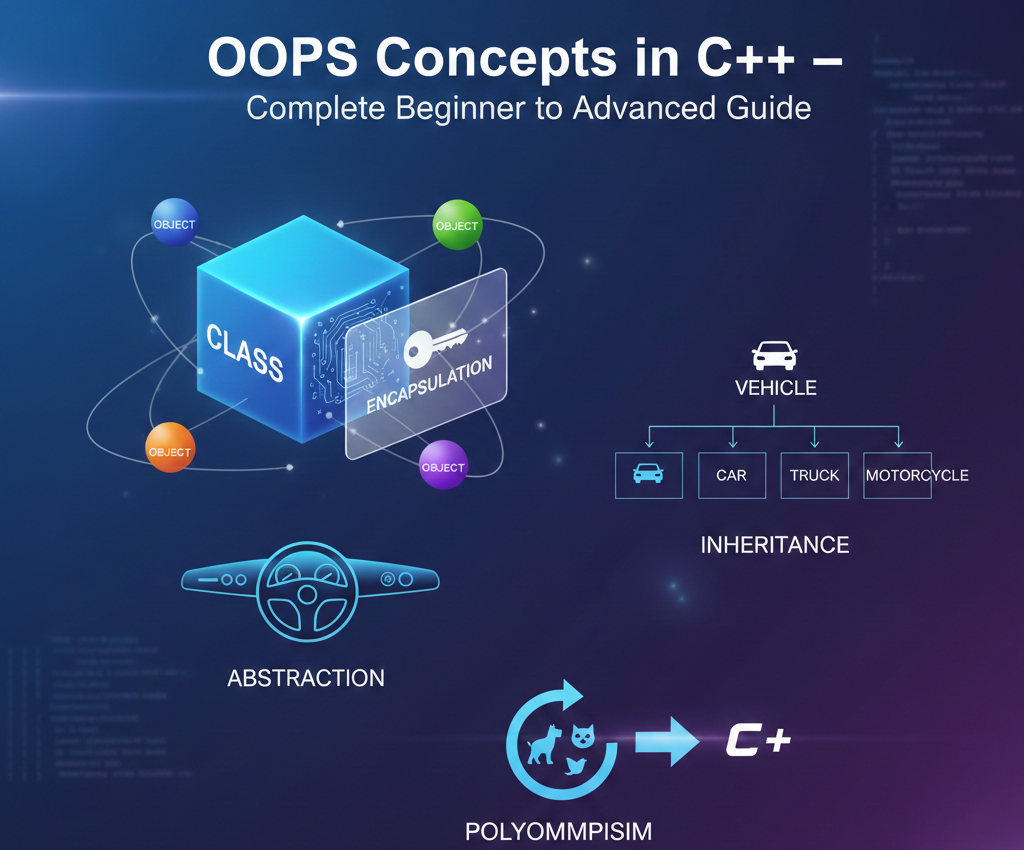
OOPS Concepts in C++ – Complete Beginner to Advanced Guide
By Techcadd Mohali
Object-Oriented Programming (OOPS) is one of the most important concepts in modern software development. If you want to build strong programming fundamentals and become industry-ready, mastering OOPS in C++ is essential.
At Techcadd Mohali, we provide in-depth, practical, and industry-oriented training in OOPS concepts using C++. With over 10 years of teaching and real-world experience, we simplify complex programming ideas and help students build strong logical thinking skills.
This course is designed for beginners, students, and aspiring developers who want to understand how real-world software is built using object-oriented principles.
What is Object-Oriented Programming (OOPS)?
Object-Oriented Programming is a programming paradigm that focuses on creating programs using objects and classes rather than just functions and procedures.
In simple terms:
-
Traditional programming focuses on functions.
-
OOPS focuses on objects that contain both data and functions.
C++ is one of the most powerful programming languages that fully supports object-oriented concepts. It allows developers to build secure, reusable, and scalable applications.
At Techcadd Mohali, we ensure that students understand not just the definition of OOPS, but also how and why it is used in real-world software development.
Why Learn OOPS in C++?
Learning OOPS in C++ offers several advantages:
1. Strong Programming Foundation
C++ is widely used in system programming, game development, embedded systems, and high-performance applications. Understanding OOPS in C++ builds a solid base for advanced programming.
2. Code Reusability
With inheritance and modular design, you can reuse existing code and reduce redundancy.
3. Better Code Organization
OOPS helps structure your program in a logical and manageable way.
4. Improved Security
Encapsulation and data hiding protect sensitive information.
5. Industry Requirement
Most software companies expect candidates to have strong OOPS knowledge for interviews and development roles.
At Techcadd Mohali, we combine theory with practical coding exercises so that students can confidently apply concepts in real projects.
Core OOPS Concepts Covered in Our Course
We cover all major OOPS concepts in C++ from basic to advanced level.
1. Classes and Objects
What is a Class?
A class is a blueprint or template used to create objects. It defines the properties (data members) and behaviors (member functions) of an entity.
Example:
public:
string name;
int age;
void display() {
cout << name << " " << age;
}
};
What is an Object?
An object is an instance of a class. It represents a real-world entity.
s1.name = "Rahul";
s1.age = 20;
s1.display();
At Techcadd Mohali, we explain classes and objects using real-life examples like cars, mobile phones, bank accounts, and students to ensure conceptual clarity.
2. Encapsulation
Encapsulation means binding data and functions together inside a single unit (class).
It also involves data hiding using access specifiers such as private, public, and protected.
Example:
private:
double balance;
public:
void deposit(double amount) {
balance += amount;
}
double getBalance() {
return balance;
}
};
Benefits of Encapsulation:
-
Protects data from unauthorized access
-
Improves security
-
Makes code modular
-
Easier maintenance
In our course at Techcadd Mohali, students learn how to implement proper data hiding in real-world applications.
3. Abstraction
Abstraction means hiding internal implementation details and showing only essential features to the user.
Example:
When you use a car, you only interact with the steering, accelerator, and brake. You don’t need to understand how the engine works internally.
In C++, abstraction is achieved using:
-
Classes
-
Access specifiers
-
Abstract classes
-
Pure virtual functions
Example:
public:
virtual void draw() = 0; // Pure virtual function
};
Abstraction improves program simplicity and reduces complexity.
4. Inheritance
Inheritance allows one class (child class) to inherit properties and behavior from another class (parent class).
Example:
public:
void eat() {
cout << "Eating";
}
};
class Dog : public Animal {
public:
void bark() {
cout << "Barking";
}
};
Types of Inheritance Covered:
-
Single Inheritance
-
Multiple Inheritance
-
Multilevel Inheritance
-
Hierarchical Inheritance
-
Hybrid Inheritance
Advantages:
-
Code reusability
-
Reduced duplication
-
Logical relationship modeling
At Techcadd Mohali, students practice inheritance using real case studies to fully understand parent-child relationships in programming.
5. Polymorphism
Polymorphism means “many forms.” It allows the same function to behave differently depending on the context.
There are two types:
5.1 Compile-Time Polymorphism
Achieved using:
-
Function Overloading
-
Operator Overloading
Example:
return a + b;
}
double add(double a, double b) {
return a + b;
}
5.2 Run-Time Polymorphism
Achieved using:
-
Function Overriding
-
Virtual Functions
Example:
public:
virtual void show() {
cout << "Base class";
}
};
class Derived : public Base {
public:
void show() {
cout << "Derived class";
}
};
Polymorphism makes programs flexible and extensible.
Constructors and Destructors
Constructor
A constructor is a special member function that initializes objects.
Types covered:
-
Default Constructor
-
Parameterized Constructor
-
Copy Constructor
Example:
public:
Demo() {
cout << "Constructor called";
}
};
Destructor
A destructor releases resources when an object is destroyed.
cout << "Destructor called";
}
At Techcadd Mohali, we teach object lifecycle and memory management clearly.
Access Specifiers in C++
-
Public – Accessible everywhere
-
Private – Accessible only within class
-
Protected – Accessible in derived class
Understanding access control is essential for writing secure and professional code.
Important Advanced OOPS Topics Covered
Our course also includes:
Static Data Members and Functions
Shared among all objects.
Friend Functions
Allow access to private data.
Inline Functions
Improves performance.
Virtual Functions
Enable runtime polymorphism.
Pure Virtual Functions
Used to create abstract classes.
Abstract Classes
Cannot be instantiated; used as base classes.
This Pointer
Refers to the current object.
Dynamic Memory Allocation
Using new and delete operators.
Operator Overloading
Redefining operators for custom behavior.
Copy Constructor
Creates a new object as a copy of an existing object.
All these topics are taught with practical coding exercises.
Real-World Application of OOPS in C++
At Techcadd Mohali, we don’t just teach syntax. We show how OOPS is used in:
-
Banking software
-
Library management systems
-
Student management systems
-
Inventory systems
-
Game development
-
Embedded systems
Students build mini projects to gain real-world experience.
Who Should Join This Course?
This OOPS in C++ course is perfect for:
-
B.Tech, BCA, MCA students
-
Beginners in programming
-
Diploma students
-
Job seekers preparing for interviews
-
Anyone preparing for software development roles
No prior advanced knowledge is required. We start from basics and move step-by-step toward advanced concepts.
Teaching Methodology at Techcadd Mohali
Our teaching approach is structured and practical:
Step 1: Concept Explanation
We explain concepts using real-life examples.
Step 2: Syntax Understanding
Students learn proper C++ syntax and structure.
Step 3: Live Coding Practice
Hands-on coding sessions for each concept.
Step 4: Assignments
Practice problems to strengthen logic.
Step 5: Mini Projects
Real-world application development.
Step 6: Interview Preparation
OOPS interview questions and answers.
We focus on building strong logical thinking skills.
Career Opportunities After Learning OOPS in C++
Mastering OOPS in C++ opens career opportunities such as:
-
Software Developer
-
C++ Developer
-
System Programmer
-
Game Developer
-
Embedded System Engineer
-
Application Developer
Strong OOPS knowledge also helps in learning:
-
Data Structures
-
Java
-
Python
-
C#
-
Object-Oriented Design
-
System Design
Why Choose Techcadd Mohali?
There are many institutes, but Techcadd Mohali stands out because:
-
10+ Years of Training Experience
-
Industry-Oriented Curriculum
-
Practical-Based Learning
-
Small Batch Size
-
Individual Attention
-
Real-Time Projects
-
Interview Preparation Support
-
Certification
We believe in building programmers, not just teaching programming.
Course Outcomes
After completing this OOPS in C++ course, students will be able to:
-
Understand all core OOPS concepts
-
Write structured and modular C++ programs
-
Apply inheritance and polymorphism correctly
-
Design object-oriented applications
-
Crack technical interviews confidently
-
Develop mini and real-time projects
Start Your Programming Journey Today
If you want to build a strong career in software development, mastering OOPS in C++ is the first step.
At Techcadd Mohali, we are committed to providing high-quality training that prepares you for real industry challenges.
Learn from experienced trainers.
Practice with real coding examples.
Build strong programming logic.
Boost your career opportunities.
Enroll Now at Techcadd Mohali
Take the first step toward becoming a skilled programmer.
Contact Techcadd Mohali today and start mastering OOPS in C++ with confidence.
Deep Understanding of OOPS Design Principles in C++
Learning OOPS is not only about understanding definitions like class, object, or inheritance. True mastery comes when you understand how to design software using object-oriented principles.
At Techcadd Mohali, we teach students how to think like a programmer. Our focus is not just on writing code but on designing clean, scalable, and maintainable applications.
Importance of Object-Oriented Design Thinking
Many students learn syntax but struggle in interviews because they don’t understand design logic.
In our OOPS in C++ course, we train students to:
-
Identify real-world entities
-
Convert real-world problems into classes
-
Define relationships between classes
-
Apply inheritance properly
-
Use polymorphism for flexibility
-
Protect data using encapsulation
For example, if you are building a Library Management System, we teach you how to design:
-
Book class
-
Student class
-
Librarian class
-
Transaction class
And how these classes interact with each other.
This approach builds problem-solving ability, which is highly valued in software companies.
Memory Management in OOPS using C++
One of the biggest advantages of learning OOPS in C++ is understanding memory management.
Unlike some high-level languages, C++ gives you control over memory using:
-
new operator
-
delete operator
-
Constructors
-
Destructors
At Techcadd Mohali, students learn:
-
Stack vs Heap memory
-
Object lifetime
-
Dynamic object creation
-
Memory leaks and how to avoid them
-
Importance of destructors
This knowledge makes students more confident in technical interviews and system-level programming.
Difference Between Procedural Programming and OOPS
We help students clearly understand the difference between traditional programming and object-oriented programming.
Procedural Programming:
-
Focus on functions
-
Data is exposed
-
Less secure
-
Difficult to maintain large projects
Object-Oriented Programming:
-
Focus on objects
-
Data is protected
-
Secure and modular
-
Easy to maintain and extend
Understanding this comparison helps students appreciate why OOPS is essential in modern development.
Real Interview Preparation with OOPS
At Techcadd Mohali, we also prepare students for technical interviews.
We cover commonly asked interview questions such as:
-
What is the difference between struct and class in C++?
-
What is virtual destructor and why is it important?
-
What is the diamond problem in multiple inheritance?
-
What is the difference between overloading and overriding?
-
What is deep copy vs shallow copy?
-
Explain runtime polymorphism with example.
Students practice writing answers and explaining concepts clearly, which improves confidence during interviews.
Project-Based Learning Approach
We strongly believe that practical implementation is the best way to learn OOPS.
During the course, students work on mini projects like:
-
Student Management System
-
ATM Simulation
-
Bank Account Management
-
Employee Record System
-
Inventory Management
Through these projects, students learn:
-
How to create multiple classes
-
How to manage object interaction
-
How to apply inheritance
-
How to implement polymorphism
-
How to structure large programs
By the end of the course, students can design complete object-oriented applications independently.
Common Mistakes Students Make in OOPS (And How We Fix Them)
Many beginners make mistakes such as:
-
Making everything public
-
Not using constructors properly
-
Misusing inheritance
-
Ignoring encapsulation
-
Not understanding object lifecycle
At Techcadd Mohali, we correct these mistakes early by giving structured practice and real-time debugging sessions.
We ensure students develop clean coding habits from the beginning.
How OOPS in C++ Helps in Learning Other Languages
Once you master OOPS in C++, learning other object-oriented languages becomes much easier.
C++ builds strong fundamentals that directly help in:
-
Java
-
Python (OOP concepts)
-
C#
-
PHP
-
JavaScript (OOP based frameworks)
Students who learn OOPS deeply in C++ usually perform better in advanced technologies and frameworks.
Strong Logical Development
One major benefit of our OOPS training at Techcadd Mohali is logical development.
We train students to:
-
Break problems into smaller components
-
Identify reusable modules
-
Write modular code
-
Avoid code duplication
-
Think in structured patterns
This logical thinking is the backbone of successful software engineers.
Industry-Oriented Curriculum
Our OOPS in C++ course is designed keeping industry requirements in mind.
We focus on:
-
Clean coding standards
-
Proper naming conventions
-
Modular programming
-
Real-world examples
-
Best practices
Students don’t just learn theory — they learn how professionals write and structure code.
Support and Guidance
At Techcadd Mohali, we provide:
-
Doubt clearing sessions
-
Practice assignments
-
Regular assessments
-
Personal attention
-
Career guidance
Our goal is to ensure every student gains confidence in OOPS concepts.
Final Words
Mastering OOPS in C++ is not optional if you want a strong career in software development — it is essential.
With structured training, practical implementation, project-based learning, and interview preparation, Techcadd Mohali ensures that students develop a deep and clear understanding of object-oriented programming.

Comments
No comments yet. Be the first to comment.
Leave a Comment