


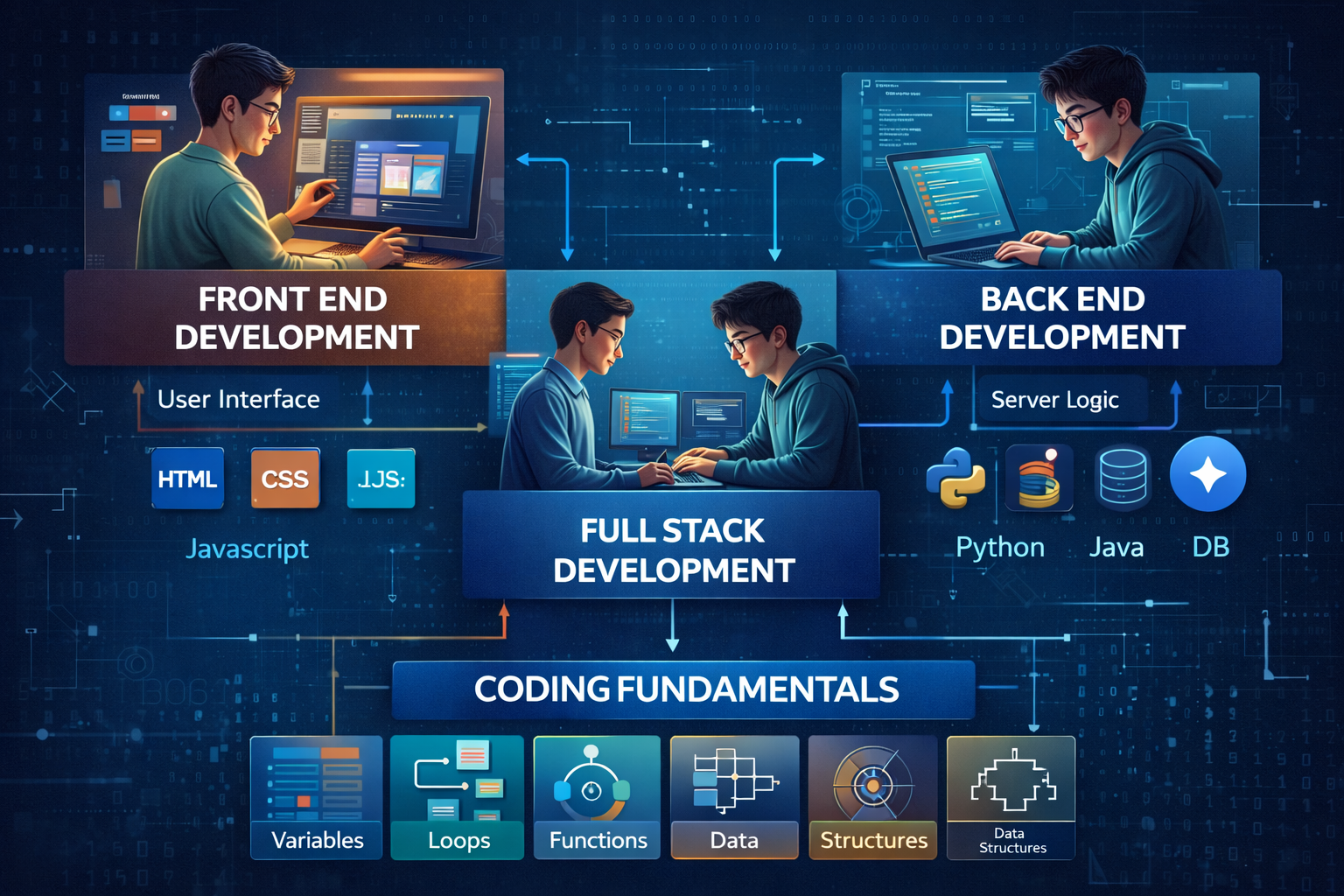
Programming Front End vs Back End, Full Stack Overview & Coding Fundamentals – A Complete Career Guide
Programming has become one of the most in-demand skills in today’s digital world. From websites and mobile apps to software systems and cloud platforms, programming powers almost everything we use daily. If you’re planning to learn coding or build a career in software development, you’ve probably come across terms like front end programming, back end programming, full stack development, and coding fundamentals.
For beginners, these terms can be confusing. Questions like “Front end vs back end – which is better?”, “What is a full stack developer?”, or “Do I need strong coding fundamentals?” are very common. This blog will give you a complete, beginner-friendly understanding of front end vs back end programming, a clear full stack overview, and the importance of coding fundamentals.
What Is Programming?
Programming is the process of writing instructions that a computer can understand and execute. These instructions are written using programming languages such as Python, JavaScript, Java, C++, and many others. Programming helps create websites, applications, software systems, and digital tools that solve real-world problems.
At a high level, programming is divided into different areas based on what part of a system you work on. The most common division is front end programming and back end programming, with full stack development combining both.
Understanding Front End Programming
What Is Front End Programming?
Front end programming focuses on the user-facing part of an application or website. Everything you see on a website—buttons, layouts, menus, colors, animations, and text—is created using front end technologies. Front end developers ensure that users can interact smoothly with a website or application.
In simple words, front end programming is about what users see and interact with.
Key Responsibilities of Front End Developers
Front end developers are responsible for:
-
Designing and building website layouts
-
Creating responsive designs for mobile, tablet, and desktop
-
Ensuring fast loading and smooth user experience
-
Making websites visually appealing and interactive
-
Connecting the design with back end data
A strong front end developer understands both design principles and coding logic.
Common Front End Technologies
Some widely used front end programming technologies include:
-
HTML – Structure of a webpage
-
CSS – Styling, layout, colors, and responsiveness
-
JavaScript – Interactivity and dynamic content
-
Front end frameworks like React, Angular, and Vue
These tools help developers create modern and interactive user interfaces.
Skills Required for Front End Programming
To succeed in front end programming, you need:
-
Strong understanding of HTML, CSS, and JavaScript
-
Basic design sense and UI/UX understanding
-
Responsive web design knowledge
-
Debugging and browser testing skills
Front end programming is ideal for those who enjoy visual creativity along with logic.
Understanding Back End Programming
What Is Back End Programming?
Back end programming focuses on the server-side logic of an application. It handles everything that users don’t see but depend on—databases, servers, APIs, authentication, and application logic.
In simple terms, back end programming is about how things work behind the scenes.
Key Responsibilities of Back End Developers
Back end developers are responsible for:
-
Writing server-side logic
-
Managing databases and data flow
-
Handling user authentication and security
-
Creating APIs for front end communication
-
Ensuring performance, scalability, and reliability
Back end developers make sure that data is processed correctly and delivered securely.
Common Back End Technologies
Popular back end programming technologies include:
-
Programming languages: Python, Java, PHP, Node.js, C#
-
Databases: MySQL, PostgreSQL, MongoDB
-
Servers & APIs
-
Frameworks like Django, Spring Boot, Express
Back end programming focuses more on logic, data, and performance.
Skills Required for Back End Programming
To excel in back end programming, you need:
-
Strong problem-solving skills
-
Knowledge of databases and queries
-
Understanding of server architecture
-
API development skills
-
Security and data handling knowledge
Back end programming is ideal for those who enjoy logic, data, and system design.
Front End vs Back End Programming – Key Differences
Understanding front end vs back end helps you choose the right career path.
| Aspect | Front End Programming | Back End Programming |
|---|---|---|
| Focus | User interface | Server-side logic |
| Visibility | Visible to users | Hidden from users |
| Skills | Design + coding | Logic + data handling |
| Tools | HTML, CSS, JS | Python, Java, Databases |
| Creativity | High | Moderate |
| Logic | Moderate | High |
Both roles are equally important and work together to create complete applications.
What Is Full Stack Development?
Full Stack Development Explained
Full stack development combines both front end and back end programming. A full stack developer can work on the complete application—from user interface to server logic and databases.
In simple terms, full stack developers handle both what users see and how things work.
Why Full Stack Development Is Popular
Full stack development is popular because:
-
Companies prefer multi-skilled developers
-
Faster development and deployment
-
Better understanding of complete systems
-
Higher career flexibility
A strong full stack overview gives you clarity about the entire development process.
Technologies Used in Full Stack Development
Full stack developers work with:
-
Front end technologies (HTML, CSS, JavaScript)
-
Back end languages (Python, Java, Node.js)
-
Databases and APIs
-
Version control systems like Git
They act as a bridge between front end and back end teams.
Is Full Stack Development Right for Beginners?
Yes, but with a structured approach. Beginners should:
-
Learn coding fundamentals
-
Start with basic front end programming
-
Move to back end concepts
-
Practice building full projects
Full stack development requires patience, consistency, and practice.
Coding Fundamentals – The Foundation of Programming
What Are Coding Fundamentals?
Coding fundamentals are the basic concepts that apply to all programming languages. No matter which technology you choose, strong fundamentals make learning easier and faster.
Coding fundamentals include:
-
Variables and data types
-
Conditional statements
-
Loops
-
Functions
-
Arrays and data structures
-
Basic algorithms
Why Coding Fundamentals Are Important
Many beginners rush to frameworks and advanced tools without learning the basics. This leads to confusion and poor understanding.
Strong coding fundamentals help you:
-
Write clean and efficient code
-
Understand any programming language easily
-
Debug errors faster
-
Crack technical interviews
-
Grow into advanced roles
Whether you choose front end, back end, or full stack, coding fundamentals are essential.
Coding Fundamentals for Front End Developers
Front end developers use coding fundamentals in:
-
JavaScript logic
-
Event handling
-
Dynamic UI updates
-
Data manipulation
Without strong basics, even front end frameworks become difficult.
Coding Fundamentals for Back End Developers
Back end programming relies heavily on:
-
Conditional logic
-
Loops and data structures
-
Algorithmic thinking
-
Efficient data handling
Strong fundamentals are critical for writing scalable back end systems.
Which Path Should You Choose?
Choosing between front end vs back end or full stack depends on:
-
Your interests
-
Your strengths
-
Your career goals
Choose front end programming if:
-
You enjoy design and visuals
-
You like building user interfaces
-
You enjoy creativity
Choose back end programming if:
-
You enjoy logic and data
-
You like solving complex problems
-
You enjoy system-level thinking
Choose full stack development if:
-
You want complete control over projects
-
You enjoy learning multiple technologies
-
You want higher flexibility
Career Opportunities in Programming
With strong skills in programming, you can work as:
-
Front end developer
-
Back end developer
-
Full stack developer
-
Software engineer
-
Web developer
-
Freelancer or startup founder
Programming skills open doors to global and remote opportunities.
Importance of Practical Learning
No matter which path you choose, practical learning is essential. Real growth comes from:
-
Building projects
-
Solving coding challenges
-
Working on real-world problems
-
Understanding errors and fixing them
A strong focus on practical learning strengthens both fundamentals and advanced skills.
Final Thoughts
Understanding programming front end vs back end, having a clear full stack overview, and mastering coding fundamentals are the keys to a successful software development career. Front end programming focuses on user experience, back end programming handles logic and data, and full stack development combines both.
Before choosing any specialization, build strong coding fundamentals. They form the backbone of all programming skills and make learning new technologies easier. Whether you aim to become a front end developer, back end expert, or full stack professional, consistency, practice, and strong fundamentals will guide you toward long-term success in the tech industry.


Comments
No comments yet. Be the first to comment.
Leave a Comment