

Python for Data Science Career Scope: Why 2026 is Your Year to Enroll at Techcadd Mohali
The world is generating data at an unprecedented rate. Every online transaction, every social media scroll, every sensor in a smart device creates a digital footprint. But raw data is meaningless; it is the insights hidden within that drive business decisions, scientific breakthroughs, and technological innovation. The professionals who extract those insights are Data Scientists, and their most powerful tool is Python.
If you are a student in Mohali, a working professional seeking a career upgrade, or someone looking to enter the tech world, you have likely heard the terms Data Science, Artificial Intelligence, and Machine Learning. Behind the buzzwords lies a fundamental truth: a career in Python for Data Science is not just another job opportunity. It is one of the most secure, lucrative, and future-proof career paths available in 2026.
At Techcadd Mohali, we do not simply teach Python programming. We build data scientists. We transform beginners into industry-ready professionals equipped with the skills that companies are desperately seeking. This blog will walk you through the immense scope of a Python for Data Science career, the skills you need to master, the roles you can target, and why Techcadd Mohali is the ideal place to begin your journey.
The 2026 Landscape: Why Python and Data Science Dominate
Let us look at the current market reality. As of 2026, Python remains one of the most sought-after programming languages worldwide. Its simplicity, versatility, and powerful ecosystem of libraries make it the undisputed king for data-related work. But why is this combination exploding in India specifically?
1. The AI and Data Boom in India
India is experiencing a massive surge in artificial intelligence, data analytics, and machine learning adoption across industries. Industry reports and projections indicate a significant shortage of skilled professionals. Estimates suggest a gap of over one million AI, machine learning, and data analytics experts by the end of 2026. This gap represents a golden opportunity for anyone entering the field now. Companies in fintech, healthcare, e-commerce, manufacturing, and even traditional sectors are racing to hire talent that can interpret data and drive intelligent decision-making.
2. Python is the Language of Data
While other programming languages exist, Python has become the lingua franca for data science. Its extensive libraries are purpose-built for the task. Libraries like Pandas and NumPy handle data manipulation. Matplotlib and Seaborn create powerful visualizations. Scikit-learn provides machine learning tools. TensorFlow and PyTorch enable deep learning and artificial intelligence. If you want to work in data, learning Python is not optional; it is mandatory.
3. Data Science Applies Everywhere
One of the most attractive aspects of this field is its cross-domain applicability. Data science is not confined to technology companies. It is revolutionizing finance through algorithmic trading and fraud detection. It is transforming healthcare with predictive diagnostics and personalized medicine. It is reshaping marketing through customer segmentation and recommendation engines. It is optimizing supply chains in retail and manufacturing. As a Python for Data Science professional, you are not limited to one industry. You can work in a bank, a hospital, a retail giant, or a cutting-edge AI startup.
4. Remote Work and Global Opportunities
By 2026, the remote work revolution is well-established. The freelance and remote market for Python developers and data scientists is stronger than ever. You can secure projects and full-time positions from companies based in Bangalore, Mumbai, the United States, or Europe, all while sitting comfortably in Mohali. This opens up salary potential that was previously only achievable by migrating to metro cities.
Career Opportunities: What Can You Become?
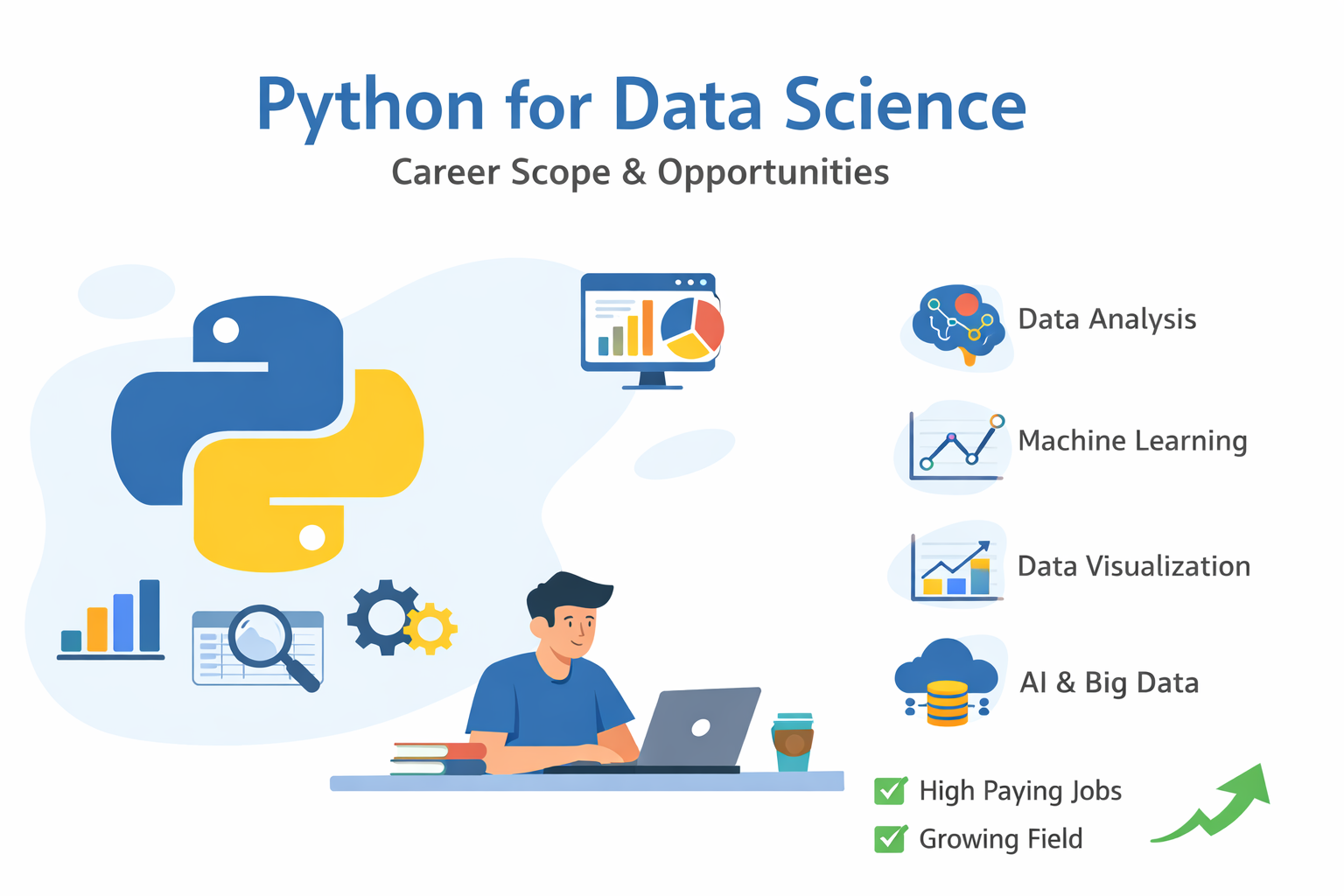
One of the most exciting aspects of entering the Python for Data Science field is the variety of high-paying roles available. As you progress through your training at Techcadd Mohali, you will be prepared to target multiple career paths. Here are the top roles you can aim for in 2026.
Data Analyst
The Data Analyst role is often the entry point into the data world. Analysts focus on interpreting existing data, creating reports, and building dashboards that help companies understand their performance and make informed decisions. They use Python, SQL, and visualization tools to answer specific business questions. In India, the average salary for a Data Analyst ranges from ₹6 to ₹12 lakhs per annum.
Data Scientist
The Data Scientist role is more advanced and involves building complex predictive models to forecast trends and solve intricate business problems. Data Scientists work with machine learning algorithms, perform statistical analysis, and communicate their findings to stakeholders. This role commands a higher salary, typically ranging from ₹10 to ₹22 lakhs per annum in India.
Machine Learning Engineer
Machine Learning Engineers focus on designing and implementing the algorithms and systems that allow machines to learn from data. They are closer to software engineering than traditional data analysis, building the pipelines that deploy models into production. Salaries for Machine Learning Engineers in India range from ₹14 to ₹28 lakhs per annum.
AI Engineer
AI Engineers work at the cutting edge, developing applications that involve artificial intelligence. They work with neural networks, deep learning, natural language processing, and computer vision. As AI adoption accelerates, this role is becoming increasingly critical, with salaries ranging from ₹18 to ₹35 lakhs per annum.
Other exciting roles in the ecosystem include Data Engineers who build the infrastructure for data generation and transformation, Business Intelligence Analysts who focus on strategic decision support, and Automation Specialists who use Python to streamline business processes. Python's versatility also keeps doors open to web development and emerging fields like the Internet of Things and quantum computing.
The Skills You Need to Master
To capture these opportunities and build a successful career, you need more than just basic Python knowledge. You need a structured, comprehensive, and job-oriented skillset. At Techcadd Mohali, our curriculum is designed to build you from the ground up into a confident, industry-ready professional. Here is the step-by-step roadmap to becoming a data scientist.
Phase 1: The Foundation
Every skyscraper needs a strong foundation. Your data science career begins here.
-
Python Programming: You must master core Python, including data structures like lists and dictionaries, object-oriented programming concepts, and exception handling. This is the language you will use every single day.
-
Statistics: Data science is built on mathematics. You need to understand descriptive statistics, inferential statistics, probability distributions, and hypothesis testing. Without this foundation, you cannot interpret data correctly.
-
SQL: Data lives in databases. You must learn to extract, filter, and aggregate data using Structured Query Language. SQL is a non-negotiable skill for any data professional.
Phase 2: Core Data Science Skills
With the foundation laid, you move to the tools of the trade.
-
Data Manipulation and Analysis: You will master Pandas and NumPy, the essential Python libraries for cleaning, transforming, and analyzing data. Real-world data is messy; these tools help you make sense of it.
-
Data Visualization: Insights are useless if you cannot communicate them. You will learn to tell stories with data using Matplotlib and Seaborn for Python-based visualizations, and tools like Power BI or Tableau for interactive dashboards.
-
Data Cleaning and Munging: This is the grunt work that occupies a huge portion of a data scientist's time. You will learn to handle missing values, identify and treat outliers, and normalize data for analysis.
Phase 3: Advanced Machine Learning and AI
This is where you move from analysis to prediction and intelligence.
-
Machine Learning: You will dive into supervised learning techniques like regression and classification, unsupervised learning techniques like clustering, and learn how to evaluate model performance using Scikit-learn.
-
Advanced Techniques: You will explore specialized areas like time series forecasting for predicting trends over time, natural language processing for working with text data, and building recommendation systems.
-
Deep Learning and Generative AI: The cutting edge. You will work with neural networks, understand large language models, and get hands-on experience with frameworks like TensorFlow and PyTorch.
Phase 4: Deployment and Portfolio
Learning is complete only when you can show what you have built.
-
Model Deployment: A model sitting on your laptop is useless. You will learn to put your models into production using cloud platforms like AWS or Azure, and tools like Docker for containerization.
-
Portfolio Building: Your GitHub profile is your new resume. You will build three to five real-world projects that demonstrate your skills to potential employers. These projects are what will get you hired.
Why Techcadd Mohali is Your Ideal Launchpad
You now understand the what and the why of a Python for Data Science career. The final, critical question is where to get trained. Choosing the right institute is the most important decision in your journey. Here is why Techcadd Mohali stands out as the best choice in the region.
Industry-Relevant and Updated Curriculum
The tech world changes fast. Our courses are not static brochures printed years ago. They are updated every quarter to match the 2026 industry standards. We cover everything from core Python fundamentals to advanced machine learning and generative AI. You learn exactly what companies are hiring for right now.
Expert Faculty with Real-World Experience
At Techcadd Mohali, you learn from professionals, not freshers. Our trainers have worked in multinational corporations and faced real business challenges. They do not just teach theory from a textbook. They mentor you on how to think like a data scientist, how to approach problems logically, and how to navigate the realities of a corporate job.
Hands-On, Project-Based Learning
We firmly believe that you learn to code by coding. Our approach is heavily project-based. You will work on multiple live projects throughout the course, building a strong portfolio that speaks louder than any certificate. From cleaning messy datasets to deploying machine learning models, you get your hands dirty at every stage.
Comprehensive Placement Support
Our commitment to you does not end when the course ends. We provide 100% placement assistance. This includes resume building workshops that teach you to present your skills effectively. It includes rigorous mock interview sessions that prepare you for the pressure of real interviews. It includes soft skills training to make you a well-rounded candidate. Our dedicated placement cell maintains strong connections with the tech industry in Mohali, Chandigarh, and beyond, actively working to connect you with relevant opportunities.
A Trusted Name in Punjab
Techcadd has established itself as a leading and fastest-growing IT training institute in Punjab. Our mission is simple: to bridge the gap between academic learning and the practical requirements of the industry. We are a trusted name among students and parents alike, built on a foundation of quality education and genuine care for student success.
Your 12-Month Transition Plan
Switching to a data science career is a journey, not a sprint. It requires dedication and a structured approach. Here is a realistic timeline to guide your expectations and efforts.
-
Months 1 to 2 (Foundation): Focus on mastering Python fundamentals, basic statistics, and Excel. Start building very small, simple projects to apply what you learn.
-
Months 3 to 4 (Core Skills): Dive deep into SQL for data extraction. Learn data visualization using Power BI or Tableau. Create your first interactive dashboards.
-
Months 5 to 6 (Machine Learning): Learn regression and classification algorithms. Build at least three machine learning models on real datasets.
-
Months 7 to 9 (AI and Deployment): Explore deep learning concepts and large language models. Learn to deploy your models on cloud platforms.
-
Months 10 to 12 (Portfolio and Placement): Polish your GitHub profile with your best projects. Network actively on LinkedIn. Attend mock interviews. Start applying for jobs with confidence.
At Techcadd Mohali, our courses are structured to fit this timeline, and our mentors guide you every step of the way, ensuring you never feel lost or overwhelmed.
Conclusion: Your Future Starts Today
The data science revolution is not coming; it is already here. The job market in India for 2026 is set for robust demand for AI and data science professionals. The skills gap is real, and companies are desperate for trained, job-ready talent. The question is not whether you should enter this field. The questions are when you will start and where you will get the right training.
Delaying your decision means delaying your career growth and letting opportunities pass you by. Every month you wait is a month where someone else grabs the job you could have had.
Techcadd Mohali invites you to take that first, decisive step. Do not let this wave pass you by. Equip yourself with the most in-demand skills of the decade and build a career that is secure, intellectually stimulating, and financially rewarding.

Comments
No comments yet. Be the first to comment.
Leave a Comment